
Uganda studies Swiss market to customise tourism products
“Our presence in Zurich provides the opportunity to establish first-hand the Swiss traveller’s profile and to customise product development and market infrastructure interventions accordingly,” Mugarra said in a press release.
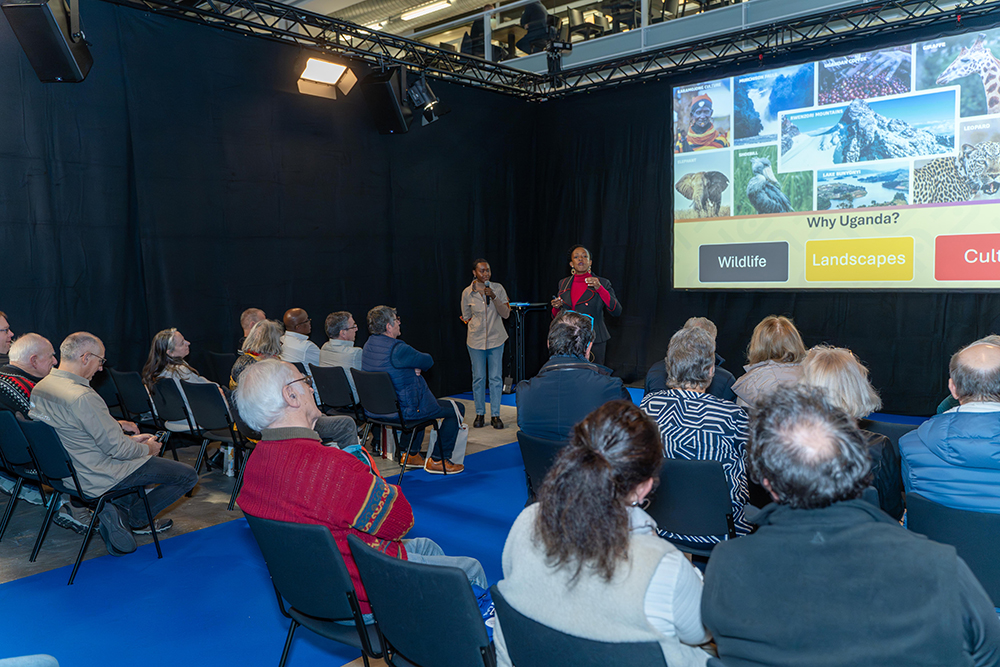
Uganda Tourism Board (UTB) chief executive officer Juliana Kaggwa said the expo offered an immersive learning environment rather than a conventional marketing fair. (Courtesy photos)
_______________
Uganda has begun a deliberate effort to study Swiss travel habits as it seeks to redesign its tourism products for one of Europe’s most selective and high-spending markets, government officials said during the country’s first participation with a national pavilion at the FESPO and Golfmesse tourism expo in Zurich.
Leading Uganda’s delegation, state tourism minister Martin Mugarra Bahinduka said the country’s presence at the four-day expo was less about immediate sales and more about understanding how Swiss travellers plan, choose and experience holidays.
He said this first-hand exposure would guide future product development and tourism infrastructure investments.
“Our presence in Zurich provides the opportunity to establish first-hand the Swiss traveller’s profile and to customise product development and market infrastructure interventions accordingly,” Mugarra said in a press release.
The 34th edition of FESPO, Switzerland’s largest tourism exhibition, attracted more than 42,000 visitors and over 500 exhibitors, most of them planning long-haul summer holidays.
Uganda joined destinations such as Italy, Australia, Jordan and Indonesia, marking only the second time an African country, after South Africa, has hosted a full country pavilion at the event.
Uganda Tourism Board (UTB) chief executive officer Juliana Kaggwa said the expo offered an immersive learning environment rather than a conventional marketing fair.
She noted that understanding the Swiss market required detailed observation of traveller preferences, presentation styles and communication methods.
“It is important to acquire first-hand market insights and get to know the Swiss market in order to discover new areas of product development,” Kaggwa said.
“FESPO gives us the opportunity to benchmark our marketing materials and improve what we already have, while networking with Swiss tour operators who sell African destinations.”
She added that one of the early lessons from Zurich was the importance of language diversity in tourism promotion. Despite Switzerland’s relatively small population, marketing materials often need to be produced in German, French and Italian to effectively reach different regions of the country.
Uganda’s participation was supported by the Uganda Mission to the Swiss Confederation under the government’s Economic and Commercial Diplomacy (ECD) program, with subsidised slots for 13 members of the Association of Uganda Tour Operators (AUTO).
Officials from the ministries of Foreign Affairs, Finance, Tourism, and the Uganda Tourism Board attended, alongside representatives of the Ugandan diaspora in Switzerland.
Deputy permanent representative to the Swiss Confederation, Amb. Arthur Kafeero, cautioned that entering new tourism markets without adequate research could result in poorly designed products and misplaced marketing investments.
He said Uganda deliberately avoided a one-size-fits-all approach in Switzerland.
“As a Mission, we have used ECD resources to do our homework to guide the UTB on how to develop tourism products that reflect an understanding of Swiss demographics,” Kafeero said.
“This includes recognising the cultural differences between the French, German and Italian regions of Switzerland.”
Industry players say consistency in market engagement will be critical if Uganda is to gain traction among Swiss travellers. Anjelica Evans, representing Let’s Go Travel, a Ugandan destination marketing company, said trust in European markets is built gradually through repeated presence and familiarity.
“Familiarity in the Swiss market builds trust,” Evans said, drawing comparisons with Uganda’s long-term engagement in Germany. She recalled that sustained participation at travel expos such as ITB Berlin eventually led to increased visitor numbers after years of consistent branding and industry representation.
She argued that similar commitment in Switzerland over several years could yield comparable results, especially if supported by government through diplomatic and tourism promotion channels.
Uganda’s renewed focus on targeted markets comes as tourism earnings continue to recover, with the Ministry of Finance reporting revenues of $1.7 billion in the 2024/25 financial year. Officials attribute the growth to improved security, investment in tourism infrastructure and expanded economic diplomacy.
At FESPO, Uganda showcased adventure and nature-based experiences, including hiking trails, cycling tours, golf course resorts and international sports events, alongside cultural heritage and premium coffee. Officials said the aim was to align Uganda’s tourism offering with the expectations of experienced travellers who prioritise quality, authenticity and tailored experiences.
Ugandan also said future tourism promotion will increasingly be shaped by market intelligence rather than broad, generic campaigns, with Switzerland serving as a testing ground for a more customised approach to international tourism marketing.