
Poaching, encroachment threatens wildlife survival
Five corridors provide ecological connectivity between and within protected areas in the GVL partner countries, Uganda and Democratic Republic of Congo (DRC), four corridors that link habitats within the same protected area in Uganda, and four corridors that link habitats within Virunga National Park in the DRC.
(L-R) Dr Albert Sebagenzi director ICCN in DRC, Tremayne Stanton Kennedy climate and nature lead at British High Commission, Dr Andrew Seguya execuitive secretary Greater Virunga Transboundary Colloboration, Dr James Musingunzi executive director UWA, and Solani Mhango director for Conservation Impact Africa WWF International display a dummy report of Wildlife Corridors in Greater Virunga Landscape during its launch at Kampala Sheraton. (Credit: Francis Emorut)
KAMPALA - A report on wildlife population survival along wildlife corridors shows their movement has been threatened by poaching, habitat loss and degradation by communities living near the corridor sites.
Wildlife corridors play a vital role in enabling the movement of wildlife populations (especially landscape species) during migration seasons.
The report titled Wildlife Corridors in Greater Virunga Landscape, produced by World Wildlife Fund Uganda in collaboration with Uganda Wildlife Authority, Jane Goodall Institute and Wildlife Conservation Society, was released on Friday, May 29, at Kampala Sheraton Hotel.
The study assessed the status and functionality connectivity of wildlife corridors within Greater Virunga Landscape, focusing on landscape target species, which include lions, elephants, chimpanzees and mountain gorillas.
Paul Hatanga, programme manager with World Wildlife Fund Uganda, explained that these landscape species require large home ranges for their survival and significantly influence the structure and functioning of ecosystems.
The study assessed 20 wildlife corridors in Greater Virunga Landscape, of which seven are transboundary.
Five corridors provide ecological connectivity between and within protected areas in the GVL partner countries, Uganda and Democratic Republic of Congo (DRC), four corridors that link habitats within the same protected area in Uganda, and four corridors that link habitats within Virunga National Park in the DRC.
The 2025 landcover and use map for the Greater Virunga Landscape showed that 47% (8) of the identified corridors are impacted by habitat loss and degradation.
“Habitat loss and degradation increase the resistance to movement and use of the corridors by the target species, and risk of human-wildlife conflict. Poaching was documented to be highly prevalent along five corridors,” Hatanga stated.
These are the Ishasha corridor, Muhokya corridor, Kyambura – Kashyoha Kitoma corridor, Bwera corridor, while habitat loss and degradation were observed in Virunga National Park, Kasyoha Kitomi Forest Reserve, and the Kyambura gorge corridors.
Key Findings
The study shows that the populations of the elephants, mountain gorillas are increasing, stable for chimpanzees, while declining for lions within the Greater Virunga Landscape.
On conservation actions, the findings indicate that communities living near the corridor sites preferred the implementation of compensation schemes, for example, direct payment for livestock loss and electric fencing as the most preferred intervention to mitigate human wildlife conflict in the Greater Virunga Landscape.
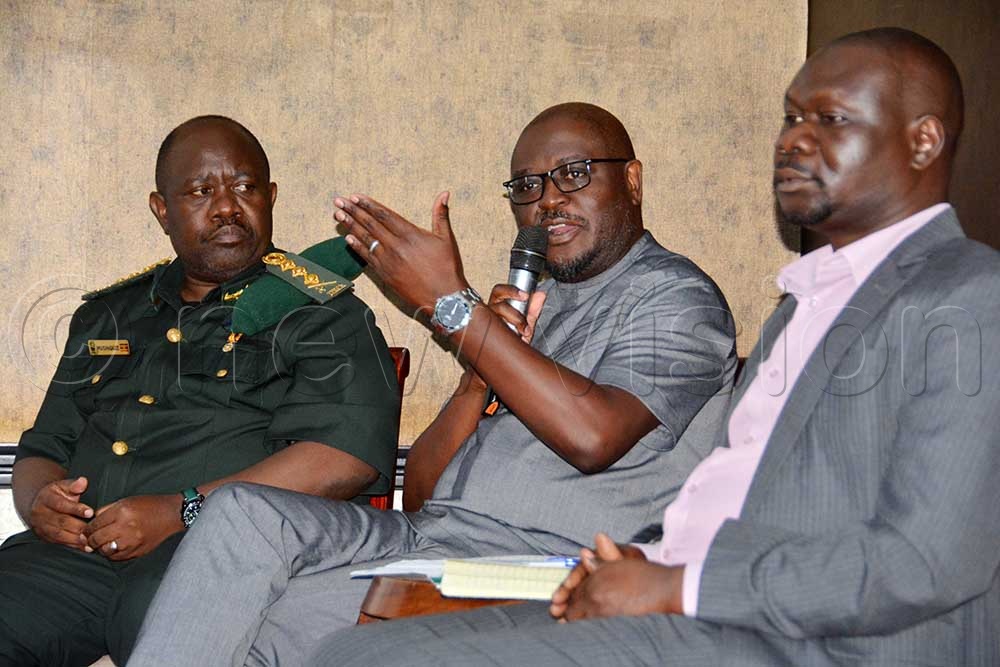
(L-R) Dr James Musingunzi executive director UWA, Solani Mhango director for Conservation Impact Africa WWF International display and Dr Ismael Ochen Ochen addressing participants during the launch of Wildlife Corridors in Greater Virunga Lansscape report at Kampala Sheraton Hotel. (Credit: Francis Emorut)
To enhance wildlife corridor management and conservation within the Greater Virunga Landscape, researchers made a raft of recommendations among them strengthening law enforcement to prevent encroachment (habitat loss and degradation) and poaching, habitat restoration and community engagements for corridors located outside protected areas, promoting the construction of electric fences, rolling out compensation schemes, and community initiated projects as mechanisms of mitigating human-wildlife conflicts; reviewing effects of collaborative forest management on corridor sites, and examining the potential of expanding the size of the narrow corridor sites.
Dr James Musingunzi, the executive director of Uganda Wildlife Authority, said a combined effort by all stakeholders is needed to mitigate the wildlife threat along the corridors.
He informed guests that his organisation has embraced the use of technology in providing real-time monitoring to reduce wildlife-human conflict.
He added that the use of community scouts is critical for early warning systems.
Somani Mhango director conservation Impact Africa World Wide Fund International, encouraged participants to address the bottlenecks affecting wildlife corridors as 75% of the corridors are functional in providing ecological connectivity between and within protected areas for the target species.
Dr Grace Nangendo, director conservation planning and research at Wildlife Conservation Society, emphasised the need to address threats by coming up with long-term solutions as a country and looking at what it can market.
Dr Ismail Ochen Ochen, program coordinator Great Virunga Transboundary Collaboration, called for ways of protecting ecological integrity by looking beyond borders, having joint integrated planning and interventions.
The nature and lead at British High Commission, Tremayne Stanton Kennedy, emphasised the need for suitable use of ecosystems and accessing development financing as well as tapping into traditional knowledge.
Ritah Murungi, senior environment officer, Rubirizi district, stressed the need to engage the community in planning to restore the degraded corridors and minimize wildlife human conflict.