
First census confirms 426 Chimpanzees in Bwindi National Park
The census was carried out by the Jane Goodall Institute (JGI)- Uganda in partnership with the Uganda Wildlife Authority (UWA) and the Greater Virunga Transboundary Collaboration.
A juvenile chimpanzee seated relaxed up in the tree branches. The census report released on February 24, 2026, in Kampala city is the first-ever census of the endangered species in this park. (Photos by Julius Luwemba)
________________
The chimpanzee census carried out in Bwindi Impenetrable National Park mid last year, confirmed the existence of 426 individuals with only 5% margin of error, New Vision Online has learnt.
The census report released on February 24, 2026, in Kampala city is the first-ever census of the endangered species in this park.
"Results indicate that chimpanzees are widely distributed across all four sectors of Bwindi (Buhoma, Ruhija, Nkuringo and Rushaga), occupying habitats ranging from mixed Afromontane to higher montane elevation montane forest," Jane Goodall Institute (JGI) team leader in Uganda, James Byamukama, says, adding that the census was conducted between May and June 2025.
The census was carried out by the Jane Goodall Institute (JGI)- Uganda in partnership with the Uganda Wildlife Authority (UWA) and the Greater Virunga Transboundary Collaboration.
Byamukama says he is optimistic that the census findings will go a long way to address the long-standing knowledge gaps and clarify the conservation status of chimps in Bwindi while contributing to the overall national chimpanzee conservation strategy.
"We, therefore, believe that this census will guide conservation planning, protected area management and regional biodiversity strategies while also supporting Uganda's alignment with international conservation and climate commitments," he said.
How the Census was done
Michael Jurua, who works with the JGI as the manager for conservation science and monitoring, says the team used standardised line transects where the entire forest was virtually split into 2km transects. A transect is a straight line often marked by measuring tapes, laid across a habitat to map and sample ecosystems, species distribution or environmental changes over distance.
"There were 39 transects laid evenly and distributed across the entire national park, and we started looking for the chimpanzee nests along the laid transects," he stated, adding that the nests were used as proxies for the presence of chimpanzees. The entire survey effort was about 160 kilometres, covering two sweeps. The population density of 426 translated into 1.33 chimps per square kilometre.
It was also observed that the highest concentration of chimpanzees is in the northern sector of Bwindi (Buhoma and parts of Rushaga). It was also discovered that gorillas and chimpanzees live harmoniously in Bwindi forest. "This was confirmed when we found gorilla fresh nests and chimpanzee fresh nests in a given area on the same day," Jurua says.
The researchers also relied on radar imagery, the type of satellite imagery that uses high-penetrating signals to go through the clouds and dense canopies of Bwindi Impenetrable Forest. Supplementing Jurua's explanation, Dr Peter Apell, also from the JGI, noted that each survey team consisted of three experienced observers who searched for nests on and near the transect line.
Tourism State Minister Martin Mugarra (2nd left), launching the Chimps in Bwindi impenetrable national park, at a function held on Tuesday at UWA headquarters.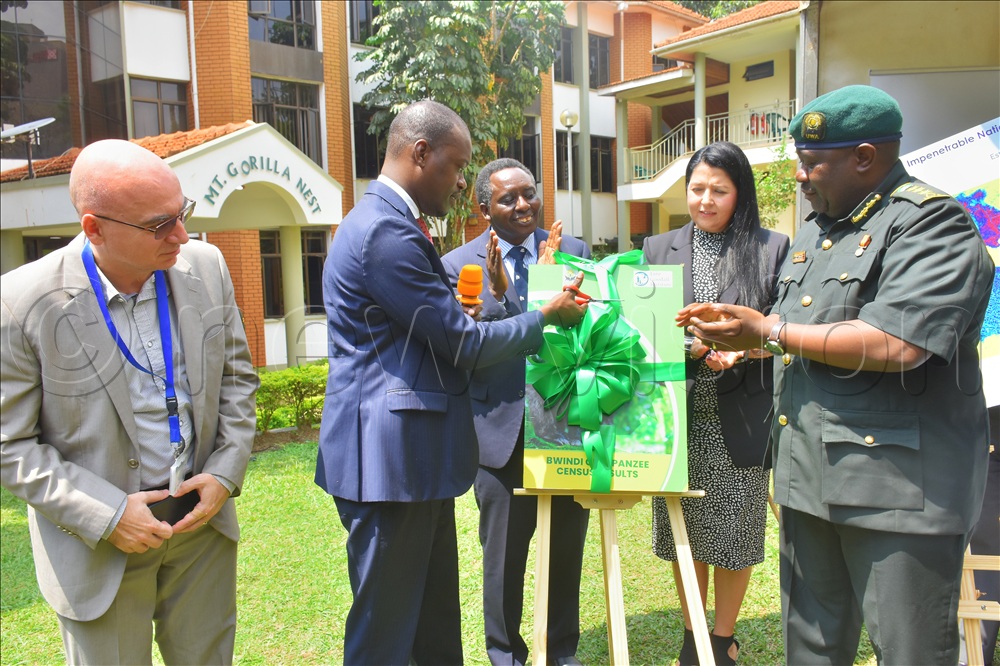
"On average, a chimpanzee builds one nest per night. By factoring in nest production and decay rates, researchers scientifically modelled the population density," Apell says.
UWA executive director Dr James Musinguzi says the status of chimpanzees in Bwindi has remained less documented for many years.
"This census has addressed this gap and confirmed that chimpanzees are not incidental occupants of the forest, but an integral and widely distributed component of Bwindi's great ape assemblage," Musinguzi says.
He adds that the findings strengthen the ability to plan and manage the national park using evidence-based approaches.
"The data will inform protected area management decisions, guide conservation investments and support the integration of chimpanzees into long-term conservation and monitoring frameworks alongside other flagship species".
According to Musinguzi, the findings open opportunities for carefully considered conservation initiatives.
"It's an opportunity for us to create livelihood options through tourism diversification in order to emancipate and empower the communities. We are also going to institutionalise the long-term monitoring of chimps in the Bwindi eco-system, strengthen health risk-mitigation, as well as diversifying sustainable tourism," the UWA boss stated.
Martin Mugarra, the minister of state for tourism, wildlife and antiquities, expressed commitment from the government to supporting initiatives that strengthen conservation, promote sustainable tourism and ensure that communities living around protected areas benefit from Uganda's natural heritage.
"The findings of the census will inform policy, guide protected-area management and strengthen Uganda's contribution to regional and global biodiversity conservation efforts," Mugarra remarked.
About Bwindi
Bwindi impenetrable national park is Uganda's single most important tourist hotspot which protects a rugged landscape of steep hills and valleys. The tangled forested slopes of Bwindi provide shelter to one of Africa's most diverse mammalian faunas including the mountain gorillas.
Bwindi forest has 160 tree species and more than 100 fern species. Gazetted as a national park in 1991, the forest covers over 32,000 hectares and is known for its exceptional biodiversity with more than 120 species of mammals, 357 bird species and 220 species of butterflies among several reptiles.
Bwindi has a tropical climate, with the rainforest contributing to high amounts of evapotranspiration, leading to an average annual rainfall of 1,500mm. It remains a vital catchment area, being a source of five major rivers that flow into Lake Edward. Due to its diverse features and ecological importance, the forest became a United Nations Educational, Scientific and Cultural Organisation (UNESCO) World Heritage Site.
Chimpanzee population in Uganda
According to JGI's Dr Peter Apell, the very first chimpanzee census in Uganda was conducted in 2001, which identified that the chimpanzees were distributed across 21 forest blocks, all of them in the Albertine rift, with a population estimate of 5,000 individuals.
"Out of these, Budongo forest had about 680 chimpanzees, Bugoma had slightly below 600 chimps, Kibale had about 1,200 chimps, and the complex of Kalinzu, Maramagambo, Kasiyo-Kitomi forests had close to 1,000 chimps. Since then, we had a very long lapse without conducting another census comprehensively," Apell stated.
He, however, acknowledged that other individual institutions have been conducting separate censuses across the country between 2015 and 2018. "We've been using that to do an update of the population of chimps in the country. From those findings, we projected that the chimp population had risen to an extra 50-500 chimpanzees from the number (5,000) of chimps recorded in 2001," he added.
UWA assistant commissioner in charge of research and monitoring , Dr Caroline Asiimwe, said chimpanzee census in other landscapes have been undertaken, awaiting data computation and analysis.
"We also have chimps that live in fragments. They do not stay in the known parks, especially between Budongo and Bugoma central forest reserves. For those, we do not use the method of counting nests because the chimps live in riverine forests. Therefore, we carry out reconnaissance and get their DNA because they are so mobile," she explained.
Meanwhile, according to Dr Asiimwe, the chimpanzee census in Kibale National Park was conducted, pending analysis and release of data this year.