
Uganda’s sports fraternity urged to embrace intellectual property pillars
URSB Commissioner for Intellectual Property Robert Mugabe said the body will work closely with the National Council of Sports (NCS) to guide sports federations on the importance of registering their brands.
Officials from the Uganda Registration Service Bureau (URSB) with sports federation representatives and sports journalists from various media organizations during a one-day Intellectual Property workshop at URSB offices in Kololo on April 20, 2026. (Photo: Silvano Kibuuka)
As World Intellectual Property Day of April 26 closes in, the Uganda Registration Service Bureau (URSB) has held a sensitization seminar for the sports fraternity on the value of intellectual property in trade.
URSB Commissioner for Intellectual Property Robert Mugabe said the body will work closely with the National Council of Sports (NCS) to guide sports federations on the importance of registering their brands.
Mugabe emphasized that federations and their affiliated entities must prioritize brand registration to secure copyrights and maximize financial benefits in the rapidly growing sports industry.
He noted that it is time for stakeholders in the sports sector to identify and protect ownership of their properties, including patents, trademarks, designs, and copyrights.
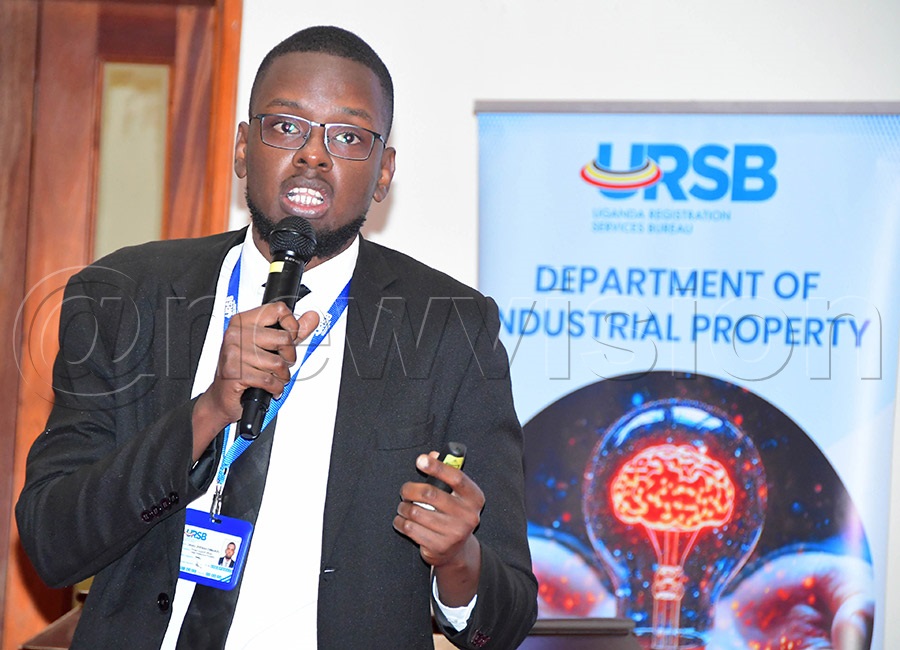
Project Support Officer at the Uganda Registration Service Bureau (URSB), Jeremiah Okaka, addressing sports federation officials and sports journalists from various media organizations during a one-day Intellectual Property workshop at URSB offices in Kololo. Photo: Silvano Kibuuka
He made the remarks during a one-day workshop held at URSB offices in Kololo on Monday. The workshop aimed at sensitizing the sports fraternity on the often-neglected area of legally owning and protecting intellectual property.
The event was also part of activities marking World Intellectual Property Day, celebrated globally on April 26. This year’s theme is “IP and Sports: Ready, Set, Innovate,” targeting sports federation officials and journalists.
URSB Deputy Registrar General Mustapher Ntale noted that copyright law plays a key role in promoting socio-economic development, from technical management to governance of sports, in line with Uganda’s Vision 2040.
Keynote speaker Jeremiah Okaka, a Project Support Officer at URSB, underscored the value of intellectual property, saying that behind every penalty kick, world record, and sold-out stadium lies an invisible system that makes sports commercially viable.
He revealed that the global sports industry is currently valued at over $600 billion annually. Of this, sports media alone accounted for $50 billion in 2023, while the licensed sports merchandise market reached $37 billion in 2025.
Okaka cited the example of the 2010 FIFA World Cup, where broadcasting rights generated $2.4 billion — about two-thirds of the event’s total revenue. He added that most English Premier League clubs earn a significant portion of their income from broadcast rights, which must be protected from piracy.
He further advised athletes to register trademarks, especially for the commercial use of their images, while also understanding the extent of privacy and fair use provisions under the law.
Referring to the Federation of Uganda Football Associations (FUFA), Okaka noted that the body has several brands, particularly through its jerseys. He challenged the federation to explore ways of monetizing these assets, especially ahead of upcoming continental tournaments like AFCON.
URSB officials also urged stakeholders to seek guidance on registering their intellectual property. Registration costs a minimum of 275,000 shillings, granting a license valid for seven years.