
Lira University researchers say developed herbal product to curb mosquito breeding
Catherine Abonyo, a research assistant on the project, said the formulation is produced as a powder and does not require mixing with water. Users apply about two grams per square metre directly onto stagnant water where mosquitoes breed.
Abonyo showing the product to fight malaria during National Science Week 2026, at Kololo Independence Grounds in Kampala. (Photo by John Odyek)
_________________
Researchers at Lira University have developed a plant-based larvicide designed to kill mosquito larvae, offering a new tool in the fight against malaria, dengue and other mosquito-borne diseases.
The innovation, known as Project HELICEL- Herbal Larvicide Innovation, uses extracts from indigenous plants to disrupt mosquito breeding in stagnant water. The team says the product is safe, affordable and environmentally friendly, with potential use in both urban and rural settings.
The researchers showcased the larvicide during National Science Week 2026, held from April 30 to May 3, 2026, at Kololo Independence Grounds in Kampala city.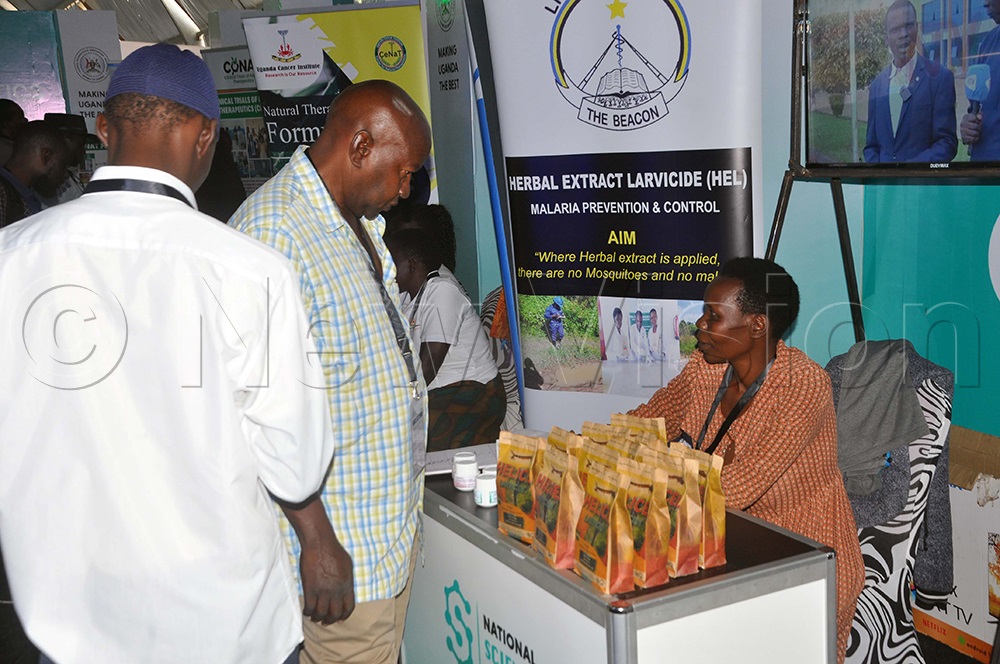
Abonyo (Right) talking to clients during National Science Week 2026, at Kololo Independence Grounds in Kampala. (Photo by John Odyek)
Catherine Abonyo, a research assistant on the project, said the formulation is produced as a powder and does not require mixing with water. Users apply about two grams per square metre directly onto stagnant water where mosquitoes breed.
“It is easy to use and organically made. We have carried out tests from the laboratory to field validation with officials from the Ministry of Health,” Abonyo said.
She added that the team is in the final stages before commercial rollout, with plans to take the product to market by the end of the year. The project is funded by the government through the Ministry of Science, Technology and Innovation.
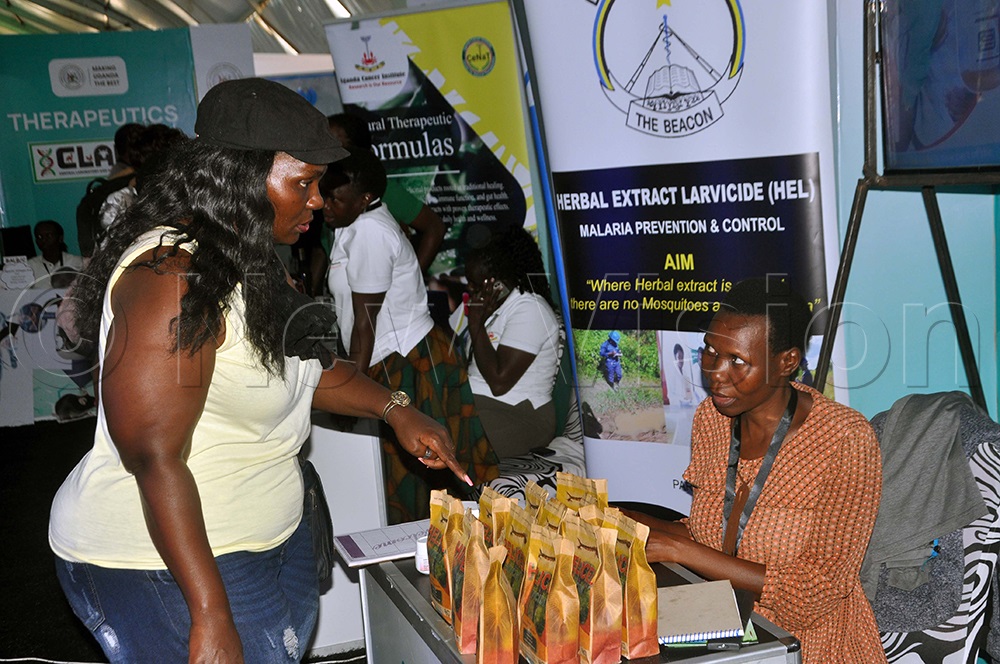
Abonyo talking to clients during National Science Week 2026, at Kololo Independence Grounds in Kampala. (Photo by John Odyek)
The plant used in the extract is sourced from Aroma village in Lira city, though its identity has not yet been disclosed as the team works to secure intellectual property rights.
The project began in 2023 and has progressed through laboratory research and field trials. Researchers plan to conduct small-scale rollout exercises before full market entry. Solomon Icel, a lecturer at the university, is the principal investigator of the project.
The National Science Week, held under the theme “STI Works: Powering Uganda to a $500 Billion Economy,” brought together scientists, innovators and the public to showcase home-grown solutions in health, agriculture and industry.
Dr Monica Musenero, Minister for Science, Technology and Innovation, said the exhibition helps the public understand how research translates into products that can drive economic growth.
Musenero noted that developing a single product often requires multiple research processes, from early-stage science to manufacturing and market preparation. Musenero said Uganda’s push toward a $500 billion economy depends heavily on science, technology and innovation, which she described as central to increasing value across sectors.
She urged innovators to pay attention to packaging and branding, noting that products must meet market expectations to compete effectively. A new centre for packaging and branding, set up in collaboration with Makerere University, Made in Uganda and partners at Lugogo, Kampala will support innovators in preparing their products for market entry.