
MPs participate in simulated voting using biometric voter verification kits
“To be very sincere, this is where we were supposed to be 20 years ago. What we have seen, how I wish it succeeds, we shall be a step ahead… I am among the people who is praying very hard to make sure we embrace this; it succeeds in the village, next time in 2031, we shall be on another level,” Kibalya said.
Kabweri County MP David Mugole being taken through a simulation of how the Biometric Voter Verification Kits (BVVKs) will be deployed during the 2026 General Election. (Credit: Dedan Kimathi)
KAMPALA - The Electoral Commission (EC) has walked lawmakers through a simulation of how the Biometric Voter Verification Kits (BVVKs) will be deployed in the 2026 General Election.
The December 18, 2025, exercise brought to a close, weeks of agitation by lawmakers that peaked on December 2, 2025, during the processing of the body’s shillings 469 billion supplementary.
At the time, Members of Parliament (MPs) including Leader of Opposition (LOP) Joel Ssenyony,i were concerned at the origin and functionality of the kits.
“As I did mention, I heard colleagues in the NRM (National Resistance Movement), some of them complaining that they were being rigged in their primaries and so on and so forth. This is a concern for all of us, not just us in the Opposition. You also want to be sure that this process is fair, understandable regardless of where you belong,” Ssenyonyi emphasised.
Instantly winning, Speaker Anita Annet Among’s backing.
“Maybe, we need to have a training for Members of Parliament since we are representatives of the people and we are stakeholders. Can we organise for Electoral Commission to have an interaction with us, so that we get to understand what the machines do, how they are supposed to be used? So that we go out there, able to tell the people that this is what you expect at the end of the day,” Among said.
“Actually, the Electoral Commission should come out clearly. Not Government. Because the leadership of Government are all candidates,” she added.
Unfortunately, after making inquiries, Among was told that this was impossible at the time, considering the fact that several EC bigwigs had travelled abroad for ballot printing.
“Honourable members, we are going to discuss with the Electoral Commission and we will send you a message when EC will be available on such and such a day and endeavour to come,” she ruled.
Demonstration
During the exercise, which was held in Parliament’s Conference Hall on December 18, 2025, the EC was provided with a list of 556 MPs.
However, for demonstration and data-extraction purposes, but the kits were loaded with 375 names, leaving out 181 to simulate different scenarios.
After the Declaration of Results (DR) forms for the President, Direct MP and Woman MP were filled, they were scanned. Officials then captured photographs of both pages, one and two, before submitting them.
Electoral Commission officials explained that once this process is completed, the first option on the device is greyed out, meaning the procedure cannot be repeated.
However, judging by the questions raised, many lawmakers remained unconvinced, with the exception of Bugabula South MP Maurice Kibalya, who expressed confidence in what he described as a groundbreaking innovation.
“To be very sincere, this is where we were supposed to be 20 years ago. What we have seen, how I wish it succeeds, we shall be a step ahead… I am among the people who is praying very hard to make sure we embrace this; it succeeds in the village, next time in 2031, we shall be on another level,” Kibalya said.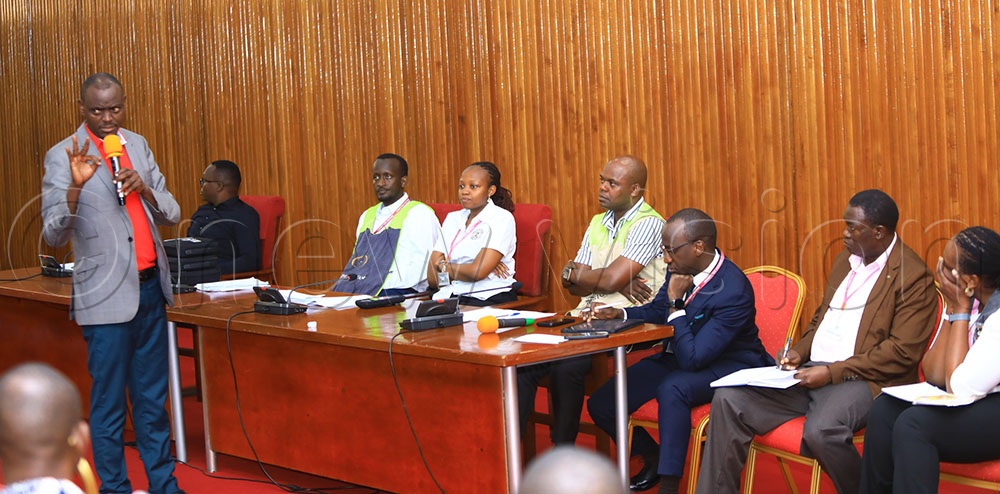
Ntenjeru South MP Patrick Nsanja, submitting as EC officials look on. (Credit: Dedan Kimathi)
Delivery of ballots
According to Christine Akello (Erute North, Independent), the exercise will be in vain if ballot papers are not delivered on time, as has been the case in previous elections.
“This one happened in 2021… People go there by 7:00am and they delay up to 4:00pm. Like where I had more support, they delivered the ballot papers at 4:00pm, I don’t know if it was a trick, but they used one truck to deliver in 300 plus polling stations,” Akello said.
Potential machine failure
Ntenjeru South MP Patrick Nsanja (NUP) noted that it becomes tricky when some officials declare that technology will be mandatory in the polls.
Section 12(1)(2) of the Electoral Commission’s Act states that the body may, in the exercise of its powers adopt technology in the management of elections.
Section 12(1)(4) further stipulates “The Minister shall, by statutory instrument, in consultation with the Commission, make regulations prescribing the manner in which technology will be used in the management of elections.”
“Assuming the machines fail at a polling station. They are not in place or unable to deliver, can the election go in that particular polling station?” Nsanja said.
However, in response, EC director of technical services support Solomon Muhumuza said, “The Electoral Commission procured 109,142 biometrics. Of that, we have 50, 739 polling stations. For each polling station, we are giving it two. That leaves us with a balance of 7,664 kits. So, we have contingency at the polling station. But we also have at the district.”
Supreme Court ruling
Talking about failure of biometric machines, it was one of the grounds in the famous Amama Mbabazi Supreme court case challenging President Yoweri Museveni’s victory in the 2016 presidential election.
Amama who had polled 132,574 (1.43 per cent) against Museveni’s 5.6 million votes (60.75 per cent), had argued that by using slow and unreliable machines, the EC had disenfranchised legitimate registered voters from exercising their constitutional right.
However, court held that in the case of Raila Odinga & 3 others vs The Independent Electoral and Boundaries Commission (IEBC) 2013, there had been a similar complaint.
But nevertheless, the IEBC used the voter’s register as a basic document for identifying voters whose outcome was upheld by the Supreme Court of Kenya.
What others say
Dr Emmanuel Otaala (West Budama South, NRM)
We don’t know which centre you are submitting whatever you have submitted. Because there is speculation that perhaps maybe you submitted to security agencies to first of all verify. So, which centre are you submitting to and do you first share with all the agents to ascertain that this is what is going to be submitted?
Margaret Ayebare Rwebyambu (Mbarara District Woman MP, Indep)
How can we verify that the machine is empty, at the beginning of it all. That it has not scanned anything.
Moses Kabuusu (Kyamuswa county, PFF)
My constituency is made up of 71 scattered islands. It rains always on polling days for presidential and parliamentary elections.
The effect of water of water on those substances (machines), unlike in your constituencies where there are built-up spaces and areas, most of our polling areas are open playgrounds. What would be possible with those machines when it rains or when they get in contact with water.
Sarah Opendi (Tororo District Woman MP, NRM)
Why don’t you have a situation where, after verification in the system, the polling assistant gives me for president, I tick put in that box. The other polling assistant gives me for directly elected MPs, I tick and put in the box. And the last one, then giving people all three (ballots), yet we clearly know that some of our people can neither read nor write. It took me close to twenty minutes.