
2026 polls: Maj.Gen Katungi says soldier deployment averted bloodshed in Lira
“Although there are complaints about deployment, we were likely to have a lot of bodies in this city.”
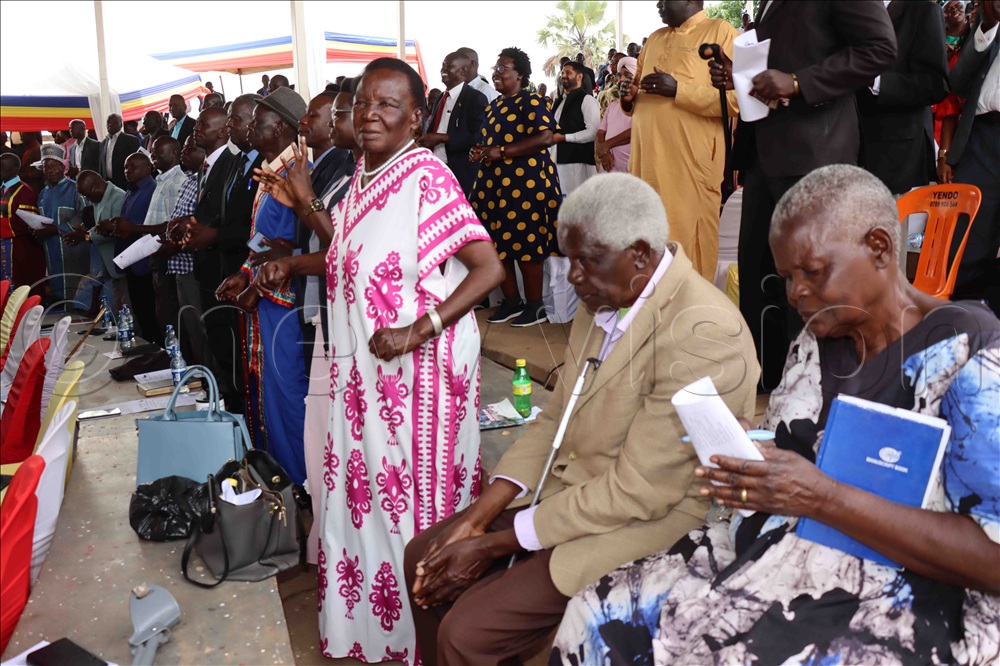
Maj. Gen. Keith Katungi addressing a high-level reconciliation meeting convened by the Won Nyaci (paramount chief) at the Lango Cultural Centre on March 3, 2026. (Photos by Hudson Apunyo)
________________
The heavy military deployment that defined the recent general election period in Lira was not an act of intimidation, but a calculated move to avert what could have turned into deadly violence, Maj. Gen. Keith Katungi has said.
Addressing a high-level reconciliation meeting convened by the Won Nyaci (paramount chief) at the Lango Cultural Centre on March 3, 2026, the Uganda army 5th division commander said security agencies acted on credible assessments that tensions were dangerously high.
“Those of us providing security in this area, the adrenaline was high,” Katungi told a packed hall of political, religious and cultural leaders.
“Although there are complaints about deployment, we were likely to have a lot of bodies in this city.”
His remarks offered the clearest official explanation yet for the conspicuous presence of soldiers across Lira during the election period, a deployment that drew criticism from sections of the political class.
Among the most vocal was Uganda People’s Congress (UPC) president Jimmy Akena, who publicly questioned the scale of the military presence, describing it as unprecedented.
However, Katungi insisted the security posture was preventive, not punitive.
“Other than the Angwetangwet incident, we had a peaceful election in Lango,” he said, crediting both the security forces and the public for exercising restraint.
“We came to lower the adrenaline and start a new chapter.”
Some days before the election, a group of people wielding pangas and clubs stormed Angwetangwet in Lira City East Division and beat up people at random; two people later succumbed to their injuries from Lira Regional Referral Hospital.
A region on edge
The reconciliation meeting was convened by Won Nyaci Michael Moses Odongo Okune and brought together incoming and outgoing political leaders, Resident District Commissioners, religious figures, senior civil servants, business leaders and clan heads.
The aim was to heal divisions that emerged during the election and to chart a united path for peace and development in Lango.
Katungi painted a picture of a region historically vulnerable to conflict, warning that the tensions witnessed this year were not isolated.
“If you think it was only about two ministers standing against each other, you are wrong,” he said. “Even before that, we were deploying in this city because the soil here is fertile for conflict.”
He recalled earlier political and religious rivalries that had threatened stability in Lira, arguing that security agencies could not afford complacency.
Security accountability
The General also used the platform to account for broader security operations in the region.
He revealed that strategic adjustments were made following earlier security lapses, including sealing off infiltration routes used by cattle rustlers from Karamoja through Abim District — a move he said significantly reduced livestock theft in Otuke and Alebtong.
Within days of restructuring deployments in 2023, he reported, organised cattle raids were halted.
However, he acknowledged persistent challenges from local criminality, including livestock theft and granary break-ins, as well as a recent spike in murder cases now under police investigation.
“We don’t know whether it is election anger or land wrangles,” he said of the killings. “But there is a slight increase, and it is a big challenge.”
He called for the full implementation of the policy providing 18 police officers per sub-county, complete with motorcycles for mobility, and urged the establishment of a juvenile remand home in Lango to prevent children in conflict with the law being transferred to distant facilities.
A call for unity
While security dominated his remarks, Katungi framed reconciliation as the long-term antidote to instability.
“There is no doubt that reconciliation builds relationships, trust and empathy,” he said, supporting proposals for a cross-sectoral leadership team to steer Lango’s development agenda.
The broader meeting echoed that spirit.
Bishop Emeritus John Charles Odurkami urged leaders to abandon jealousy and internal sabotage, while Denis Hamson Obua called for resolving conflicts internally before presenting a united front to the President.
Business leaders, led by Muhamad Atiq Nawaz, pressed for infrastructure improvements to sustain Lira’s growing industrial base. For the Won Nyaci, the message was clear: the election is over; reflection must begin.
“Open your ears to listen to the opinion of the people,” he urged leaders. “Repair what is wrong so that people do not lose trust in you.”
As the meeting ended in a calm and attentive atmosphere — described by organisers as hopeful — one thing stood out: behind the camouflage and criticism, security commanders say their mission was simple — to ensure that ballots, not bullets, defined Lango’s 2026 election.