
Dr Anne Merriman remembered for transforming palliative care in Uganda and Africa
“It is only after Dr Merriman came to Uganda that palliative care truly began in this country, and that is a milestone we can never take for granted.”
Laying a wreath on Dr Merriman's resting place. (Photos by Jacky Achan)
________________
A memorial mass has been held for Dr Anne Merriman, the woman who pioneered palliative care in Uganda more than 30 years ago and whose work transformed the lives of thousands of critically ill patients across Africa.
Born in Liverpool on May 13, 1935, Merriman lived a life guided by a promise she made as a child to care for the sick and suffering.
Inspired by missionary work in Africa from an early age, she joined the Medical Missionaries of Mary in Ireland at the age of 18, beginning a 20-year journey of service that would take her across continents.
Father Augustine Kalemeera of Mbaaga Major Seminary (centre), assisted by Reverend Father Aloysius Lumala of Ggaba parish and Deacon Onesmus Ajuna of Mbaaga Major Seminary, conducting the memorial mass of Dr Anne Merriman.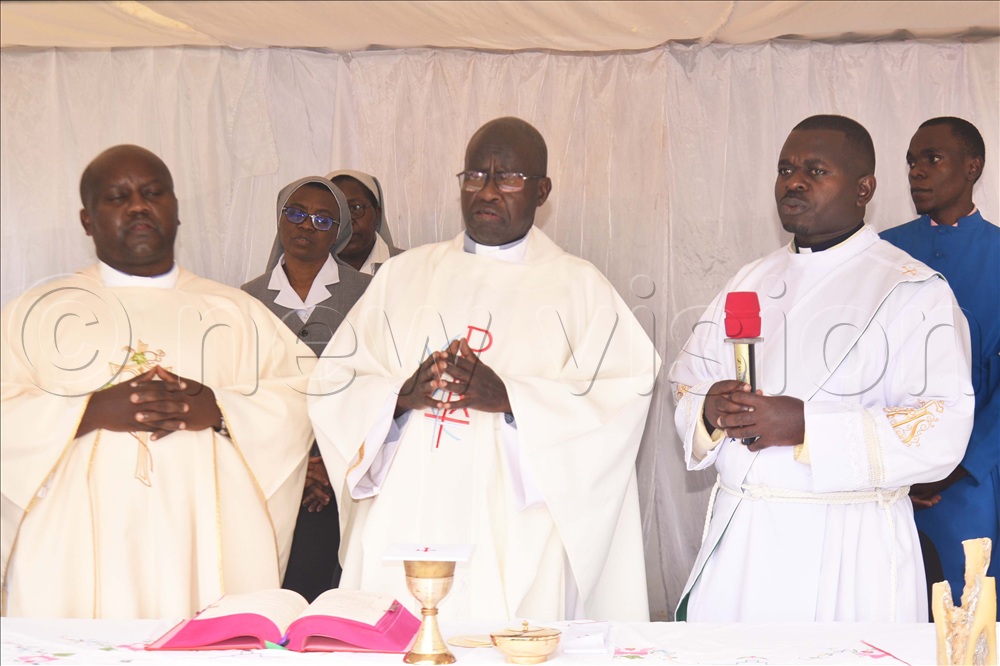
After studying medicine at University College Dublin, where she earned her degree and completed her internship in Drogheda, Merriman received a mission call to Nigeria. She served as a surgeon, paediatrician, gynaecologist and general physician in underserved communities.
Even during the Biafran war, she remained in the country, working in a 100-bed hospital where she was the only doctor caring for more than 200 patients with the help of just five nurses and a few young girls whose education had ended at an equivalent of primary seven.
The difficult working conditions later forced her to return home, where she became a senior lecturer at the University of Liverpool, the first university in the United Kingdom to teach geriatric medicine.
In 1981, Merriman pursued a master’s degree in international community health. She later worked in Malaysia and Singapore, where she and a team of nurses started a home-based care programme for terminally ill patients, work that laid the foundation for Singapore’s palliative care movement.
A chance meeting at a conference brought her back to Africa, this time to Nairobi Hospice, where patients had no access to morphine and endured unbearable pain. There, she helped develop an oral form of morphine that is still used today.
Following her work in Nairobi, Kenya, Merriman received requests from seven African countries asking her to replicate the model. Looking for a country where she could establish a base and train others in palliative care, she chose Uganda.
In 1993, Merriman drove from Nairobi to Kampala with a few volunteers and one goal: to bring palliative care to people living in pain. With the support of the then minister of health, Dr James Makumbi, she introduced affordable oral morphine.
That marked the birth of Hospice Africa Uganda (HAU), which went on to inspire palliative care services in 37 African countries.
Since then, HAU has cared for more than 40,000 critically ill patients and their families. During the 2024 to 2025 financial year alone, Hospice Africa Uganda provided care to more than 2,000 patients across its sites in Kampala, Mbarara and Hoima, with more than 1,000 newly enrolled patients.
On Monday, May 18, 2026, on the first anniversary of her death, patients, health workers, family, friends and leaders gathered at the Hospice Africa Uganda (HAU) head office in Makindye, Kampala, where a memorial mass and blood donation drive were held to pay tribute to the woman who changed care for those in chronic pain.
One of the beneficiaries of HAU’s palliative care services is Nalongo Joyce Kavuma, who has received care since 2005 after being introduced to the organisation by hospice doctor Dr Ekiria Kikule following cancer treatment.
“I was badly off. When I got on palliative care, the drugs first treated me badly. It wasn’t a good experience. I asked Dr Kikule how I would be, and she told me I would be fine. Indeed, they gave me medication, and I became fine,” Kavuma said.
She recalled how, in 2005, a palliative care nurse named Sarah and Dr Merriman visited her home while she was in severe pain.
“I was in awe of how they treated me. If every medical worker had the work ethic of the team Dr Merriman worked with, we would all be healthy and fine,” she said.
“They handled me with respect and dignity without disgust or judgment. At that point, I had just received cancer treatment, and the care they gave me left me happy.” Kavuma urged people battling illness not to hide their pain or avoid treatment.
“I urge sick people not to hide their disease and pain. Accept treatment and seek help. Today I am cancer-free. I use a walking stick because I was involved in an accident, but I am cancer-free,” she said.
Dr Miriam Ajambo, the Vice Chairperson of the Palliative Care Association of Uganda (PCAU) and Acting Head of the Palliative Care Division at the Ministry of Health making her remarks.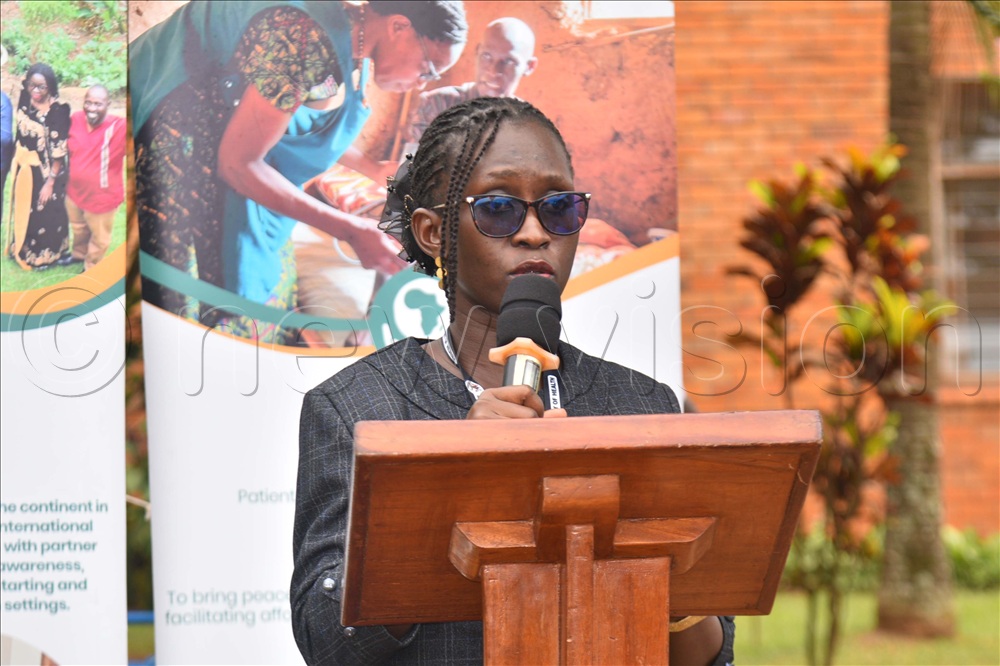
“Dr Merriman has left us with dedicated staff committed to caring for patients with dignity and respect. It’s not easy to find hospitals like HAU.”
She also appealed to both government and private individuals to continue supporting Hospice Africa Uganda so that patients can continue receiving treatment and support.
Molly Rutamwebwa also paid tribute to Merriman, recalling how her father benefited from Merriman’s programmes after being diagnosed with cancer.
“When I was young, my father suffered from cancer, and we were told he would live for only six months, but he lived for five years because of Dr Merriman and her programmes,” Rutamwebwa said.
“She became a friend of my father. He lived on a farm many miles away from here, and Dr Merriman would always say, ‘If he wants to stay at the farm, let him stay there because that is where he finds peace and happiness.’ She visited him for years.”
Rutamwebwa, who spoke on behalf of friends, said she would always remain committed to supporting Hospice Africa Uganda.
“A friend in need is a friend indeed. I will always stand with HAU at all costs. I speak about HAU wherever I go because I know what it means to support someone in pain,” she said.
She added that she had worked with hospice at a younger age and that HAU remained close to her heart.
At the memorial mass, Caoimhe O’Hagan, who represented the Ambassador of Ireland to Uganda Mags Gaynor, described Merriman as a pillar of the Irish community.
“She was a formidable woman who never backed down from a challenge,” O’Hagan said.
“She saw suffering and death not as moments to be pushed away, but as important moments in life, and she approached them with humility and dignity.”
“She wanted everyone to feel that dignity and friendship, and that is something we as a country continue to stand for. She was a wonderful person whose legacy will continue to live on.”
Dr Miriam Ajambo, Vice Chairperson of the Palliative Care Association of Uganda (PCAU) and Acting Head of the Palliative Care Division at the Ministry of Health, described Merriman as an exceptional human being.
“She taught us to love and care, to alleviate pain and suffering, and to value every life with dignity,” Ajambo said.
“It is only after Dr Merriman came to Uganda that palliative care truly began in this country, and that is a milestone we can never take for granted.”
Ajambo praised Merriman for introducing the local production of morphine, which continues to serve patients across Uganda.
“Our patients depend on this medicine to relieve pain. Without it, many would not be living the quality of life they have today,” she said.
She also commended the government for continuing to procure morphine and ensuring that it remains available to patients who need it.
Ajambo further praised Merriman for founding the Palliative Care Association of Uganda and for creating a platform that united organisations working to advance palliative care.
“She did not only introduce palliative care in Uganda but also across Africa. You cannot gather palliative care stakeholders on the continent without Dr Merriman being part of the conversation,” she said.
“She left all of us with a responsibility to continue her legacy and ensure that everyone who needs palliative care can access it.”
Ajambo said the Ministry of Health would continue supporting palliative care services across the country, including integrating them into chronic care services at regional referral hospitals and lower health facilities.
She added that community health departments were also incorporating palliative care into outreach programmes and other community-based services.
Merriman died peacefully at her home in Munyonyo, Kampala, on May 18, 2025, at the age of 90.
Hospice Africa Uganda continues to provide palliative care services to patients in need while also serving as a training ground for palliative care students from Uganda and across Africa through the Institute of Hospice and Palliative Care in Africa.