
And Then What? Kamulegeya's memoir reveals CV to his future mother-in-law
“It is my story. If you know yourself and you’re comfortable with who you are, you owe it to yourself and to humanity to tell it because if you don’t, others will tell it for you when you die, and they may not get it right,” Kamulegeya told the audience.
Author Francis Kamulegeya poses with a copy of his new book, “And Then What?”, alongside the Katikkiro of Buganda, Charles Peter Mayiga, and his wife, Margaret Mayiga, during the official launch at the Sheraton Kampala Hotel on April 30, 2026. The book reflects on Kamulegeya's distinguished career and his insights on leadership and life transitions. (Photo by Richard Sanya)
_________________
Francis Kamulegeya shocked a packed ballroom when he revealed two deeply personal decisions: writing a CV to his future mother-in-law and organising his mother’s funeral before she died, offering a rare, unfiltered insight into how he approaches life, duty, and mortality.
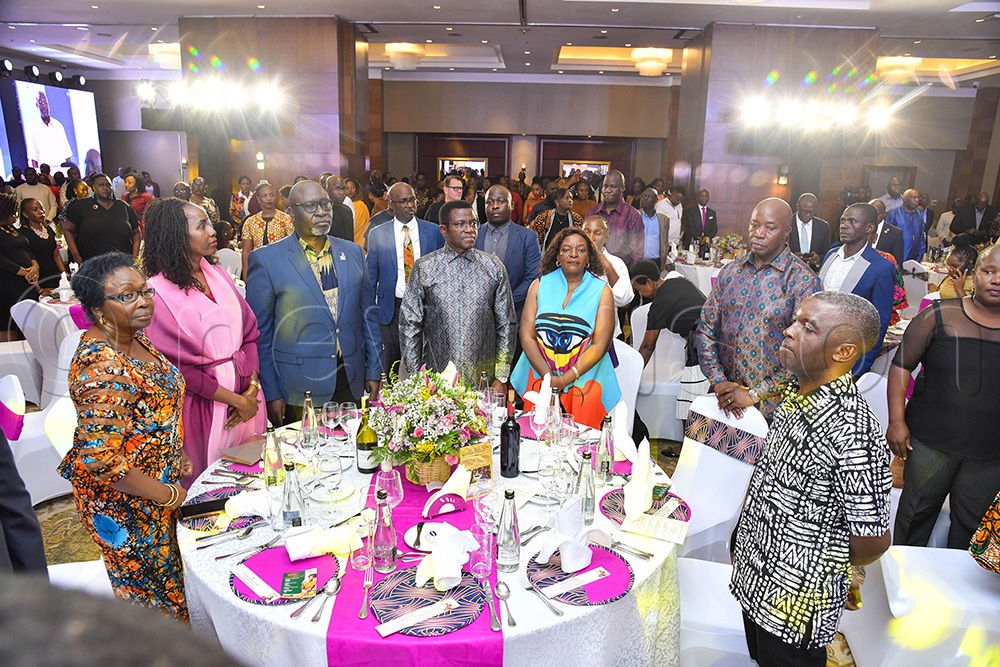
Speaking during a public book review conversation at Sheraton Kampala Hotel on April 30, alongside Charles Peter Mayiga, the Katikiro of Buganda, Kamulegeya said neither moment was about shock value, but rather deliberate choices shaped by clarity, self-awareness, and a firm belief in preparing for what lies ahead, however uncomfortable that may be.
“It is my story. If you know yourself and you’re comfortable with who you are, you owe it to yourself and to humanity to tell it because if you don’t, others will tell it for you when you die, and they may not get it right,” Kamulegeya told the audience.
(L-R) Former Finance Minister Maria Kiwanuka, Betty Ethel Naluyima Waggwa, Second Deputy Katikkiro Owek. Robert Waggwa Nsibirwa, Katikkiro Charles Peter Mayiga, Margaret Mayiga, author Francis Kamulegeya, and Omutaka Nicholas Namugera Kakeeto Kasekende during the launch of Kamulegeya’s book, “And Then What?”, at the Sheraton Kampala Hotel on April 30, 2026. The event drew prominent leaders to celebrate Kamulegeya’s reflections on leadership and life after a 27-year career at PwC. (Photo by Richard Sanya)
And Then What? is a deeply reflective and personal memoir in which Francis Kamulegeya examines one of life’s most important but often avoided questions of what comes after success.
In the book, he traces his journey from a modest upbringing in Masaka through Uganda’s turbulent years, to building an international career and eventually returning home to contribute to the country’s private sector.
But the book is not simply a story of professional achievement or upward mobility. Instead, it deliberately shifts the focus away from milestones and titles, urging readers to think more critically about identity, purpose, and the meaning behind the lives they are building.
At its core, And Then What? challenges readers at every stage of life to pause and reflect whether they are just starting out, deep in their careers, or approaching transition and to confront a simple but powerful question: beyond everything you are working toward now, what truly comes next?
One of the most striking accounts came from his early relationship with his now wife, Sofia Kamulegeya, when concerns from her family, particularly her mother, prompted an unusual but calculated response from him while he was still in the United Kingdom.
“She wanted to know who Kamulegeya was, and I was not available, so I sat down and wrote my CV properly. Three pages. Education, background, what I had done, what I was doing, where I was going. I wasn’t joking about it. I sent it because I needed them to understand who I was,” he recalled.
“My number one referee who was my wife Sofia had failed to convince so I did not add on anyone else. If she wasn’t enough, how do I now start listing referees in the UK? So, I said, let me present myself properly, in a way they can understand,” he said, drawing laughter.
Katikkiro Charles Peter Mayiga and his wife, Margaret Mayiga, join author Francis Kamulegeya and his wife, Sophie Kamulegeya, in cutting a cake to mark the official launch of Kamulegeya’s book, “And Then What?”, at the Sheraton Kampala Hotel on April 30, 2026. The ceremony served as the highlight of the evening, celebrating the release of the highly anticipated memoir. (Photo by Richard Sanya)
The document, he said, was not about impressing but about accountability offering a structured explanation of himself at a time when trust had not yet been built and when his relationship had already reached a serious stage.
“When I finally met her (the mother to my wife), we sat, we had lunch, we talked. She never mentioned the CV. Not even once. But for me, it had done its job. It had crossed that line,” he said.
Years later, Kamulegeya faced a far more difficult moment, one that would test not just his sense of order but his emotional resilience when his mother was admitted to intensive care with severe lung complications that she had gotten from cooking on firewood.
“She was in ICU, tubes everywhere, machines beeping. That was not the mother I knew,” he said. “The doctors explained the condition—pneumonia, lungs damaged—and they told us clearly: recovery was very unlikely.”
The turning point came when the family agreed to sign a “do not resuscitate” order, a decision that formally acknowledged that medical intervention would no longer prolong meaningful life.
“The moment you sign that, what are you saying?” he reflected. “You are saying when she gets a cardiac arrest, please allow her to rest in peace. That is the reality. That is the truth.”
For Kamulegeya, that clarity demanded action not later, but immediately.
“I knew that if I waited for the call… I wouldn’t have the courage to organise the kind of funeral she deserved. So, I started. I went to the office. I picked a Catholic hymn book. I started selecting songs, readings, structuring the service and organising everything that I believed would be needed,” he said.
He described the moment a colleague found him photocopying hymns and asked if he had joined a choir.
“I told her, ‘No, I’m preparing my mother’s funeral service book.’ She was shocked. She asked, ‘Has she died?’ I said, ‘No, not yet.”
To him, the decision was not morbid, it was practical, even respectful, rooted in accepting what had already been medically and emotionally established.
“To sit there and pretend nothing is happening and then when the call comes, you’re running up and down, confused that’s not how I do things. I prepare. I deal with reality as it is, not as I wish it to be,” he said.
His mother died days later. The arrangements were already complete.
“Three days later, people came, they sang the hymns joyful, uplifting hymns. Everything was in place. We gave her a dignified send-off. That mattered to me,” he said.
Throughout the conversation, Kamulegeya returned repeatedly to a single idea that life must be lived with intention, not reaction and that avoiding difficult truths often leads to disorder, both personal and professional.

Katikkiro Charles Peter Mayiga and his wife, Margaret Mayiga, join author Francis Kamulegeya and his wife, Sophie Kamulegeya, in launching Kamulegeya’s book, “And Then What?”, at the Sheraton Kampala Hotel on April 30, 2026. (Photo by Richard Sanya)
“You cannot outlive your job. Titles are important, yes, but they are overrated. If you don’t know who you are without the title, then you have a problem,” he said.
At the centre of his philosophy is a question he believes too many people avoid asking, even as they chase success, promotions, and recognition without pause.
“Whatever you are doing your job, your career, your ambitions, if that is not the end, then you owe it to yourself to ask: and then what? because that question forces you to see beyond today,” he said.
He warned that without confronting that question, people risk living full but misdirected lives, achieving success without ever understanding its purpose or limits.
“Success is what you do for yourself. Significance is what you do for others. If you do not know what is enough, you will never be satisfied no matter how much you achieve,” he said.
Closing the conversation, the Buganda premier Mayiga reflected on the deeper lesson behind Kamulegeya’s stories and urged the audience to see beyond the unusual details and focus on the clarity and courage they represent.
“This is not about writing a CV or planning a funeral. It is about living deliberately, understanding your journey, accepting your beginning, and shaping your end with purpose,” Mayiga said.

Author Francis Kamulegeya (center) receives a commemorative photo board from event panelists (L-R) Jacqueline Asiimwe, Apollo Makubuya, Sophie Kamulegeya, Robert Kabushenga, Crystal Kabajwara, and Gloria Byamugisha during the launch of his book, “And Then What?”, at the Sheraton Kampala Hotel on April 30, 2026. The presentation followed a panel discussion on the book's themes of leadership and personal transition. (Photo by Richard Sanya)
He added that Kamulegeya’s openness offered something many people avoid an honest confrontation with life’s full cycle, from ambition and success to mortality and legacy.
“The authenticity liberates us. It reminds us that it is not where you start, but how you understand your journey and what you choose to do with it, that truly defines you. it is important that we document our experiences for others to learn from. I encourage everyone to read this book and, in the same spirit, consider writing their own stories.,” Mayiga said.