
West Ankole Diocese faces criticism over proposed sale of Katikamwe Church land
Many are urging the Diocese to consider alternative development strategies that do not involve surrendering church land.
The Bishop of West Ankole Anglican Diocese Rt. Rev. Johnson Twinomujuni (centre) joined by his wife and church officials in a group photo. (Credit: Bruno Mugizi)
________________
BUSHENYI - Christians in West Ankole Anglican Diocese are up in arms over a controversial proposal to sell off 28 acres of Church land in Katikamwe, Kyabugimbi town council in Bushenyi district.
The proposal, which has sparked a heated debate across the diocese, drawing concern from both local churchgoers and stakeholders across the region, is intended to finance new diocesan development projects.
Last year, the Diocesan Council convened to address the challenge of limited financial income, particularly from tithes and other traditional sources. With a goal to expedite development, the Council reviewed proposals from the Diocesan Investments Committee aimed at transforming Church assets into sustainable revenue streams.
Among the key ideas proposed were:
The construction of student hostels at Ankole Western University
Investment in Jubilee SACCO to generate interest income
Development of a commercial building in Mbarara City.
The Diocese of West Ankole invested in a forest plantation 30 years ago with the objective of long-term revenue generation. However, due to low market demand, high operational costs, theft and fire outbreaks, the project has proven unprofitable.
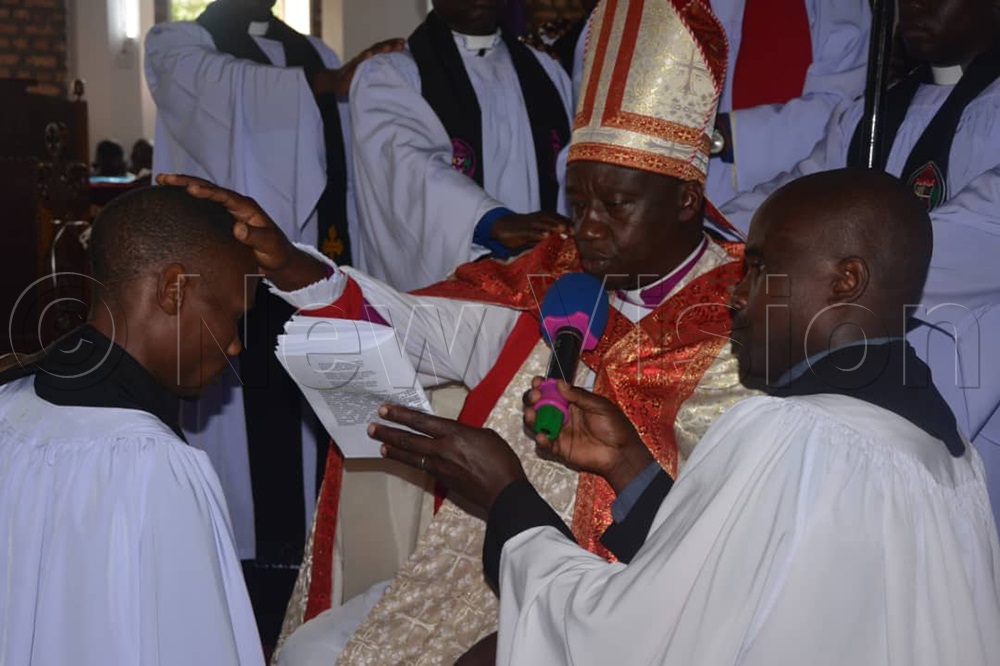
Bishop of West Ankole Anglican Diocese, Rt. Rev. Johnson Twinomujuni, praying for a church member. (Credit: Bruno Mugizi)
Limited liquidity
While the Council expressed strong support for the new proposals, it also acknowledged the Diocese’s limited liquidity. As a result, leaders proposed selling off Church land to raise capital, initially suggesting the sale of Kabira Church land. However, local Christians objected, citing historical and sentimental attachment to the land, which was originally donated by members of the Church.
In response to the backlash, attention shifted to the Katikamwe land, acquired during the tenure of Bishop Joram Bamunoba. The 28 acres currently used for forestry, have previously generated income through timber sales.
The proposed sale of the Katikamwe land has not gone unchallenged. A section of West Ankole Christians has questioned whether the decision aligns with the long-term interests of the Church and its followers.
Find alternatives
Many are urging the Diocese to consider alternative development strategies that do not involve surrendering church land.
"South Ankole Diocese has successfully turned its land into productive coffee, banana, and bean plantations, creating a steady source of income. Ankole Diocese has developed assets like the St Paul Shopping Mall and schools all without selling land," Martin Rushegyera, a concerned whistleblower and Christian from Rwenjeru Church of Uganda, said.
Philip Murwani, a Christian from Katunda Church of Uganda, publicly expressed his concerns earlier this week and has now reiterated his call for sustainable alternatives:
“This is a great concern to the Church and beneficiaries of West Ankole Church of Uganda. The proposals themselves are good, but no proposal should involve any change of proprietary interest that disadvantages the Christian community,” he said on August 25, 2025.
“The Bishop's advisors should guide him to use the land for a coffee plantation, taking lessons from Ntungamo Diocese, which is already thriving in coffee production. I carefully reviewed the proposal, and it appears that the option of coffee farming was downplayed, despite being one of the most sustainable uses of the land.”
Murwani, who is also affiliated with Kabushaho Church of Uganda, emphasised that with proper planning and benchmarking, the Diocese could benefit from long-term, land-based income streams instead of one-off sales.
An extraordinary Diocesan Council meeting held on August 8, 2025, the West Ankole Bishop highlighted that, “The Diocese had succeeded in restoring peace and unity, completed the renovation of Katungu Mission Hospital, and that they were now transforming idle Diocesan land into an income-generating asset guided by biblical and philosophical principles of wise stewardship.”
Rev. Joseph Mweyungye, the Diocesan Secretary, issued a statement clarifying that the proposal followed established procedures and remains subject to further review.
“The idea originated from the Investments Committee, which was mandated by the Diocesan Synod. After deliberation, it was reviewed by the Diocesan Board of Finance and later approved by the Diocesan Council. This is not a unilateral decision by the Bishop, but a collective resolution made through proper church governance structures,” he said.
He noted that the process is still ongoing, and the resolution will be presented to the Diocesan Synod. If approved, it will then be forwarded to the Provincial Board of Trustees, who hold final authority on such matters.
The Rev. Mweyungye also reminded the faithful that while open consultation at every stage may not be practical, the Diocese operates through representative bodies entrusted with the stewardship of church matters.