
‘Water scarcity fueling sexual harassment at sources’
“Lack of immediate access to clean water and sanitation, compounded by long queues, directly results in the exploitation of women and girls. For instance, using shared bathing and toilet facilities not only increases exposure to abuse and harassment, but also to corruption when accessing these services.” Musaazi stated.
Representing the permanent secretary at the Ministry of Water and Environment, Dr Alfred Okidi, the Principal Sociologist, Rural Water Supply and Sanitation Department, Doreen Namara, said Uganda has made significant strides to provide access to safe water, noting that currently, 68% of Ugandans have access to safe water. (Credit: Juliet Kasirye)
KAMPALA - Experts in the water and sanitation sector have expressed concern about the increasing cases of sexual harassment, particularly in rural water-stressed areas, stating that it is not only a governance and protection issue, but a human rights crisis.
Since many boreholes and wells, especially in rural communities, are quite far from people’s residences, the Executive Director of Uganda Water and Sanitation Network (UWASNET), Yunia Musaazi, said, Women and girls continue to bear the primary responsibility for water collection and sanitation management.
This responsibility, according to Musaazi, translates into long hours spent fetching water, lost time for education and livelihoods and increased exposure to risk and sex exploitation.
“Lack of immediate access to clean water and sanitation, compounded by long queues, directly results in the exploitation of women and girls. For instance, using shared bathing and toilet facilities not only increases exposure to abuse and harassment, but also to corruption when accessing these services.” Musaazi stated.
Musaazi noted that Uganda is estimated to lose at least $177m annually due to poor sanitation and inadequate WASH services, driven by healthcare costs, lost productivity, and reduced economic output.
However, for women and girls, Musaazi said: “This burden manifests through reduced participation in income-generating activities, school absenteeism, especially among girls, with up to 20% missing two to three days per month due to poor menstrual hygiene management and increased unpaid care responsibilities.”
She made the remarks during the high-level dialogue on the dissemination of the findings on sexual corruption in WASH held at the Royal Suites Hotel in Bugolobi on Wednesday.
While giving a keynote address, Dr Richard Asaba from Makerere University said, no women or girls deserve to be sexually abused in order to get water. (File Photo)
The dialogue that attracted stakeholders from government, civil society organisations, development partners and non-government organisations focused on the intersection between water, service delivery and safeguarding concerns, particularly gender-based risks within the WASH sector.
To understand the experiences women and girls face at different water points, between 2024 and 2025, Water Integrity Network (WIN), with support from UWASNET and ANEW, conducted a study on the prevalence of sexual corruption in access to WASH services in Bunyangabu, Kabarole and Lira districts.
The study, which engaged about 1,200 women in urban, peri-urban, and rural water-stressed areas, focused on generating evidence of the hidden and systemic burden faced by women and girls in accessing WASH services.
Additionally, the study also assessed indicators of water and economic insecurity, service access, and household demographics to determine risk factors for occurrence of sexual corruption.
While presenting the findings of the study, the programme lead at Water Integrity Network (WIN), Rebecca Sands revealed that out of the 1,200 women and girls who shared their experiences about sextortion and other forms of gender-based violence, 16.7% of the surveyed women reported to have experienced or knew women who experienced sextortion at public water points, communal bathing areas and shared Latrines.
This vice, according to Sands, is mainly triggered by poverty, water scarcity and location of water points. Adding that, the more hardships women face in accessing clean water, especially in rural communities, the more likely they are to experience sexual violence.
“For instance, a woman in Bunyangabu who treks long distances to fetch water has 88.8% more chances to receive sexual exploitation than a woman in Kabarole with fewer hardships (only 0.17%). Regarding reporting perpetrators, Women in Bunyangabu (54.7%) and Lira (31.8%) are significantly more likely to report such experiences compared to those in Kabarole (13.4%),” stated the study.
According to the study, in some villages, some men demanded sex or sexual activity as payment for debt owed for water, toilet and bathing facilities.
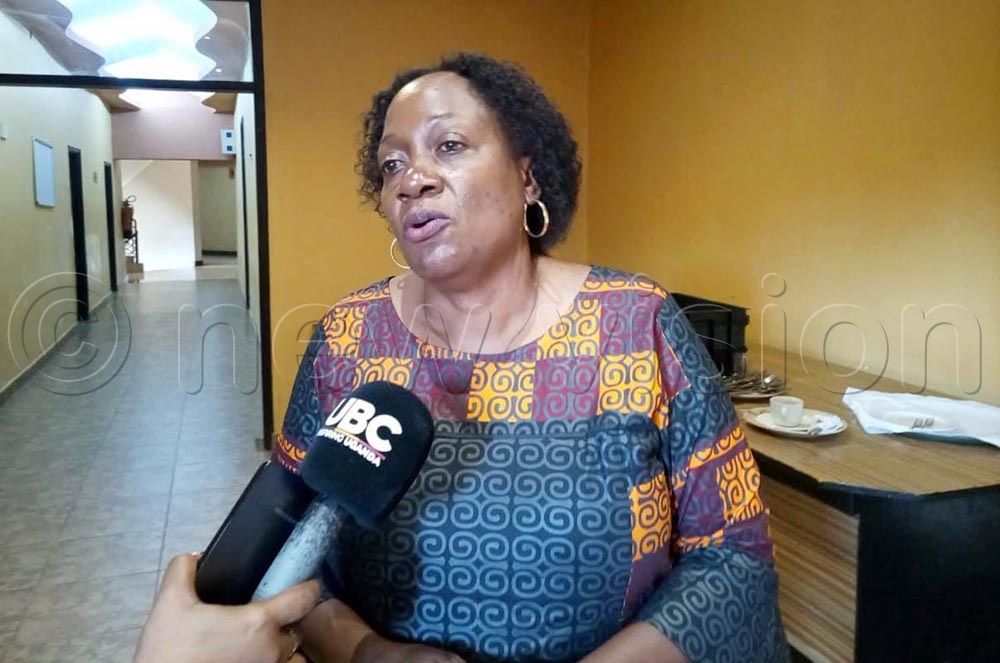
Since many boreholes and wells, especially in rural communities, are quite far from people’s residences, the Executive Director of Uganda Water and Sanitation Network (UWASNET), Yunia Musaazi, said, Women and girls continue to bear the primary responsibility for water collection and sanitation management. (Credit: Juliet Kasirye)
Other forms of Sexual and Gender Based Violence (SGBV) women and girls experience at water sources include being groped or fondled, kissed, touched on private parts, gestures, and jokes, among others.
To stop transactional sex in WASH and other sectors, Sands requested all stakeholders to raise awareness and ensure availability of survivor-centred reporting mechanisms, stop impunity with clear standards and focus on structural drivers through infrastructure and social protection investment.
While giving a keynote address, Dr Richard Asaba from Makerere University said, no women or girls deserve to be sexually abused in order to get water.
“Sextortion needs to be integrated in WASH and all human rights policies, especially in developing countries, particularly Uganda, because it not only violates the rights of women and girls, but also hinders the right of bodily integrity of girls and their access to water,” advised Asaba.
While representing the permanent secretary at the Ministry of Water and Environment, Dr Alfred Okidi, the Principal Sociologist, Rural Water Supply and Sanitation Department, Doreen Namara, said Uganda has made significant strides to provide access to safe water. Noting that currently, 68% of Ugandans have access to safe water.
However, as we advance, Namara explained that there is a need to recognise that access to safe water goes hand in hand with safety, dignity and inclusiveness.
According to her, gender violence risk in the WASH sector is not isolated or an individual issue; it reflects broadly on the structural challenges which are tied down to poverty, inequity and service delivery gaps.
To address these gaps, Namara requested all stakeholders to consider strengthening policies and regulatory frameworks, enhancing service standards and oversight mechanisms, extending access to safe and inclusive infrastructure, and establishing accessible and confidential reporting channels.
“As a government, we remain committed to strengthening safeguarding measures within the WASH programme, ensuring governance and accountability systems that promote gender responsiveness and inclusive service delivery, upgrading infrastructure that prioritises safety and accessibility, as well as upholding firm standards against any forms of extortion and abuse,” Namara stated.