
UWA receives smart surveillance equipment to protect apes from Ebola
On Thursday, June 11, Conservation Through Public Health (CTPH), an NGO which advocates for a one-health approach and a cordial coexistence between humans and wildlife, donated equipment worth sh113m to UWA.
UWA boss James Musinguzi (3rd left), David Musingo (left) the commissioner for community conservation receiving a donation of protective gear from CTPH directors led by Dr Gladys Kalema (4th left) at the UWA headquarters in Kampala on Thursday. (Photo by Julius Luwemba)
__________________
The Uganda Wildlife Authority (UWA) has received a donation of smart surveillance equipment as part of enhanced efforts to protect the great apes of Bwindi-Mgahinga conservation area against the spread of the Ebola virus.
On Thursday, June 11, Conservation Through Public Health (CTPH), an NGO which advocates for a one-health approach and a cordial coexistence between humans and wildlife, donated equipment worth sh113m to UWA.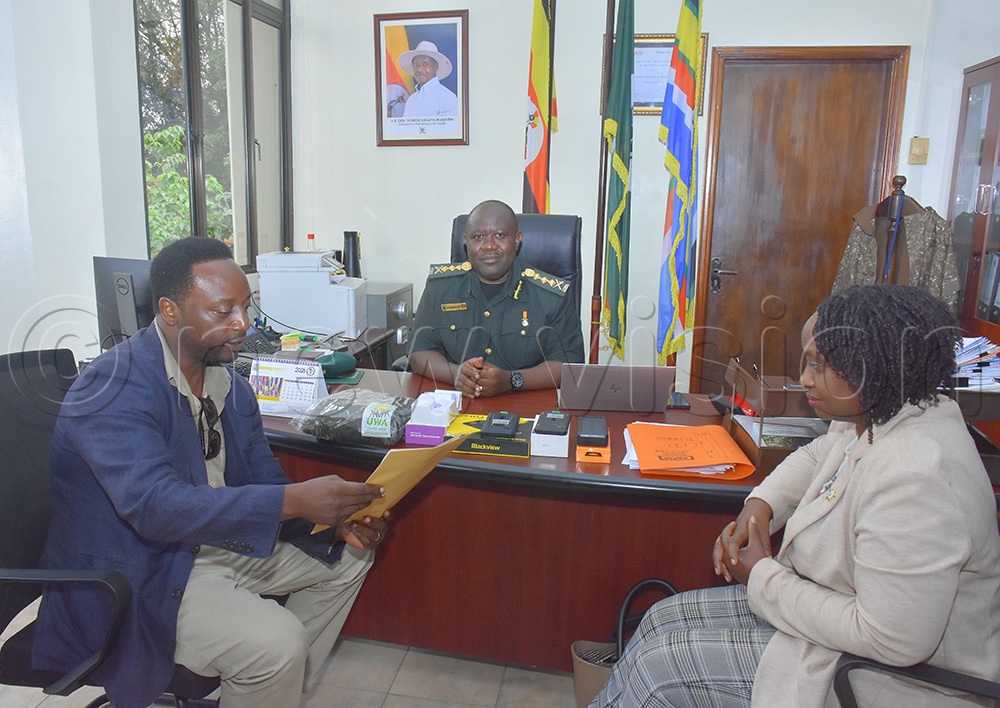
Dr Gladys Kalema and Lawrence Zikusoka, the CTPH director meeting Dr James Musinguzi, the UWA executive director before handing over a donation worth sh113m of protective gear for the wellbeing of UWA rangers and the apes they protect. (Photo by Julius Luwemba)
The consignment consisted of: 25 non-contact infrared thermometers that will be used by the UWA staff to measure temperature of each tourist heading for gorilla and chimpanzee tracking, 450 branded rain gear (jacket and trouser) for all the UWA rangers deployed in Bwindi and Mgahinga national parks, 33 black-view pro plus smartphones that will be used by the rangers to monitor the health status of gorillas and chimpanzees and 33 solar power banks.
The smart devices, according to CTPH officials, can operate even without telecom network signals, deep in the jungles of the impenetrable forests.
The package was received by Dr James Musinguzi, the UWA executive director, on Thursday at UWA headquarters in Kampala.
Acknowledging the support, he described the donation of the protective gear as a proactive measure, saying that acting swiftly to prevent human-wildlife transmission of Ebola will protect the primates whilst also protecting people's livelihoods.
"Minimising the spread of Ebola will help to maintain mountain gorilla and chimpanzee conservation as well as the tourism industry," Musinguzi expressed.
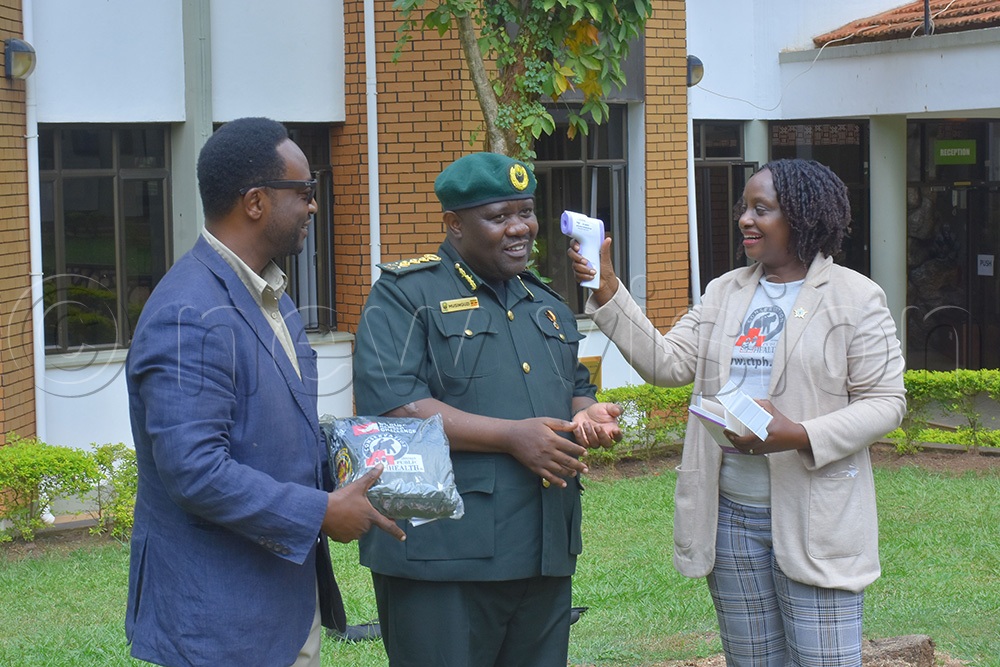
Dr. Gladys Kalema (right) with husband Lawrence Zikusoka (left) exhibiting how the infrared thermometers operate. The consignment consisted of 25 non-contact infrared thermometers that will be used by the UWA staff to measure temperatures of each tourist heading for gorilla and chimpanzee tracking. (Photo by Julius Luwemba)
She expressed optimism that, whereas Ebola is a serious, rare and fatal disease, Uganda has had robust experience in combating the past eight Ebola outbreaks, among other infectious diseases and pandemics such as Covid-19.
"We acknowledge that this is the ninth Ebola outbreak in Uganda and the seventeenth wave in the Democratic Republic of Congo (DRC), which began in the North-Eastern Ituri province of DRC.
Over the past 30 years, Western lowland gorillas have contracted Ebola in the forests of Congo, Brazzaville and Gabon in Central Africa, resulting in the death of over 5000 gorillas and the people who used to eat them. Fortunately, the mountain gorillas in Uganda have never contracted Ebola," Dr Kalema remarked.
Humans, gorillas, and chimpanzees are among the great apes, sharing 98% DNA. Therefore, genetic material and zoonotic diseases have been transmitted between them, causing morbidity and mortality. Wild great apes are often at risk of contracting human diseases from the people they interact with, including park staff, conservation personnel, researchers, tourists, and local communities.
Building a one health approach
CTPH, which was founded in 2003, promotes biodiversity conservation by enabling people to co-exist with wildlife through integrated programmes that improve animal health, community health, and livelihoods in and around Africa’s protected areas and wildlife-rich habitats.
Dr Kalema explains that population, health and environment is an integrated community-based approach to development that acknowledges and addresses the complex connections between humans, their health, and the environment.
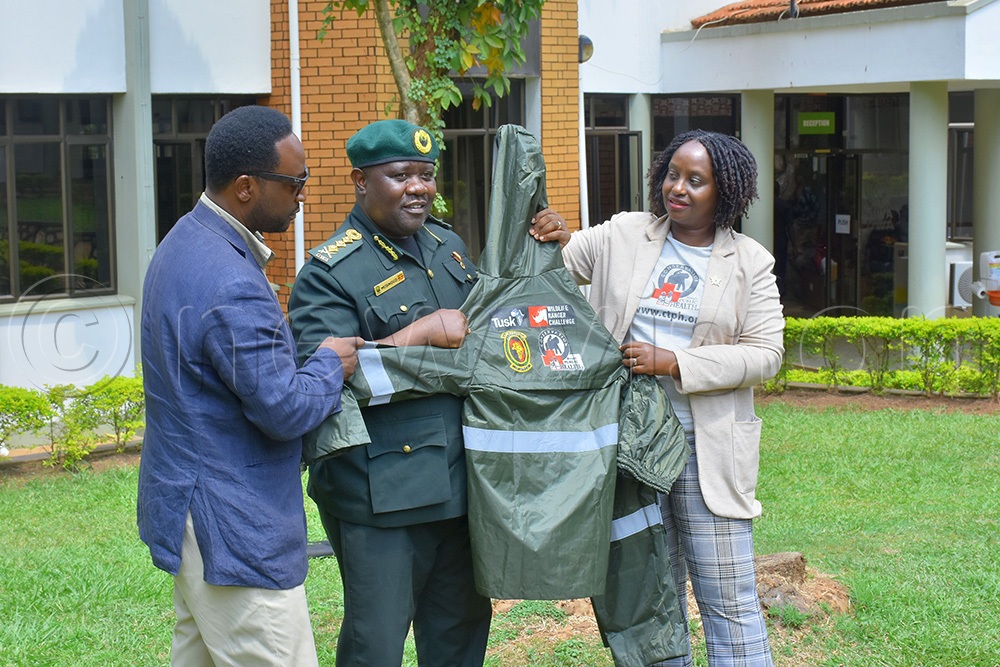
A total of 450 branded rain gear (jacket and trouser) were also donated towards the UWA rangers who monitor the wellbeing of gorillas in Bwindi and Mgahinga national parks. (Photo by Julius Luwemba)
Therefore, owing to the potential for reverse zoonosis, guidelines to minimise disease transmission between people and gorillas were instituted by UWA with support from the International Gorilla Conservation Programme (IGCP) when tourism began in 1993.
These rules included not being allowed to visit the gorillas when showing signs of illness, maintaining at least 8 metres distance, as well as wearing a mask while visiting any gorilla or chimpanzee family.
Gorilla numbers
The enhanced protective measures come on the heels of the gorilla census, where data is currently being analysed to ascertain the actual number of mountain gorillas that roam Bwindi and the greater Virunga landscapes. Meanwhile, Bashir Hangi, the UWA spokesperson, noted that over the last five years, Bwindi has recorded close to 110 gorilla births, which is a remarkable baby boom for the endangered species.
"Every gorilla birth is a testament to the success of long-term protection efforts, community support and resilience of nature," Hangi remarked.
Apes' contribution to Uganda's tourism
Gorillas and Chimpanzees contribute significantly to Uganda's tourism sector, which subsequently contributes to Uganda's gross domestic product (GDP).
According to the Ministry of Tourism, Wildlife and Antiquities, the tourism sector contributed sh6.99 trillion to the GDP in 2024, translating into 6.6%, with the number of people directly employed along the tourism value chain increasing to 876,512 (7.5% of the total population) in the same year 2024 from 573,508 (5.7% of the total population) in 2021.
A total of 45,562 tourists visited Bwindi National Park in 2025, and 9,091 visited Mgahinga National Park in the same year. Both parks are home to the famous mountain gorillas. A gorilla permit costs sh3m for an international tourist and sh250,000 for an East African resident.