
Uganda’s unemployment rate increases slightly from 10.2 to 11 percent
Findings from the Uganda Harmonised Integrated Survey (UHIS) released by the Uganda Bureau of Statistics (UBOS) show that unemployment among persons aged 15 years and above rose from 10.2% in 2021/22 to 11.0% in 2024/25.
Chris Mukiza Executive Director Uganda Bureau of Statistics (UBOS) signing on the dummy report as Vincent Fred Ssenono deputy Executive Director Uganda Bureau of Statistics (UBOS) look on. his was during the launch of the Uganda Harmonized Integrated survey report at Uganda Bureau of Statistics on May 21, 2026. (Photo by Nancy Nanyonga)ga)
______________
Uganda’s unemployment rate has recorded a slight increase over the past three years, a new government report has revealed.
Findings from the Uganda Harmonised Integrated Survey (UHIS) released by the Uganda Bureau of Statistics (UBOS) show that unemployment among persons aged 15 years and above rose from 10.2% in 2021/22 to 11.0% in 2024/25.
The results were presented during the release of the survey at Statistics House on Thursday (May 14).
According to the survey, employment in agriculture, forestry and fishing declined by 8.3 percentage points over the period, while the share of Ugandans engaged in subsistence agriculture dropped from 30.4% to 25.8%.
However, growth in non-farm wage employment remained limited, increasing by only three percentage points to 17.9%, indicating that job creation outside agriculture has not kept pace with labour shifts.
The report further shows that 5.5% of previously employed persons became unemployed by 2024/25, while 21.3% of the working-age population exited the labour force after stopping their job search.
The report, which tracks households and individuals over time, was disseminated online and broadcast live on national television and the UBOS YouTube channel due to the Ebola outbreak.
The survey provides key indicators on labour force participation, unemployment, housing conditions and household welfare, adding that the data is critical for tracking changes in economic wellbeing over time. They also announced that education findings will be released next week.
Senior statistician Stephen Barahirwa said the longitudinal survey, which began in 2021, follows the same households and individuals over multiple years to track changes in living conditions and economic status.
Principal statistician Audrey Kemigisha said the share of male-headed households declined over the period, while female-headed and single-member households increased.
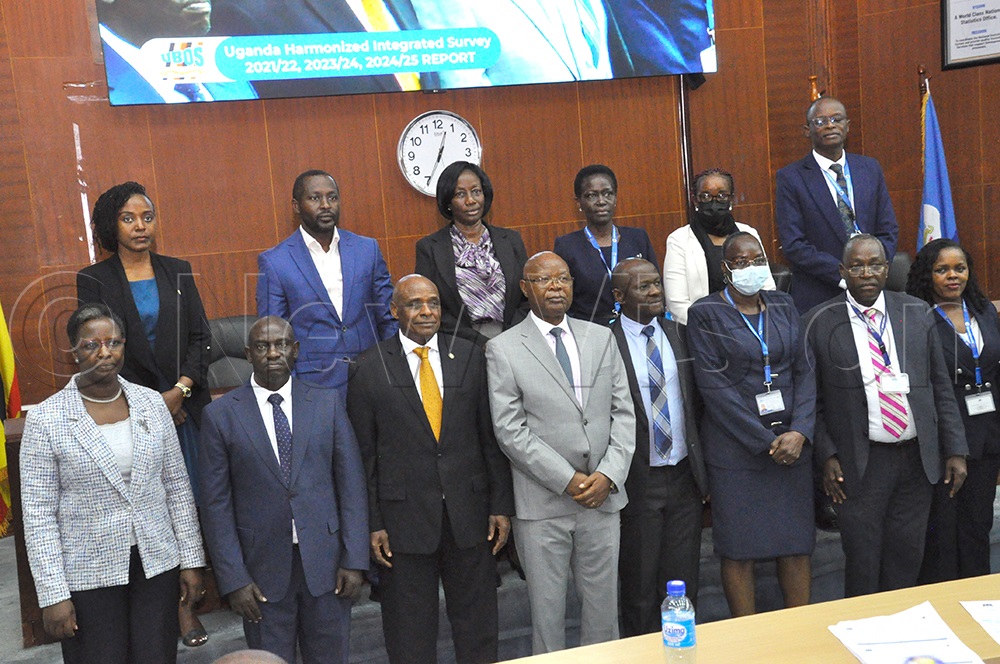
Officials who attended the launch of the Uganda Harmonized Integrated survey report at Uganda Bureau of Statistics on May 21, 2026. (Photo by Nancy Nanyonga)
In education, school attendance improved for both boys and girls, although enrolment declined at higher levels. The survey found that only 41% of learners remained in school by the final stages of education.
Literacy levels also improved, rising by 11 percentage points to 85%, with rural and urban combined literacy reaching 84.5%.
On employment trends, the report shows a gradual shift away from subsistence work, with more Ugandans moving into skilled occupations. While services and industry recorded growth, employment in fishing declined.
Despite these structural shifts, unemployment still rose slightly, underscoring concerns about the speed of job creation during Uganda’s economic transition.