
News
Uganda tables Sovereignty Bill with tight controls on foreign funding
The Bill treats violations as serious criminal offences. Offenders risk imprisonment of up to 20 years, fines of up to sh2 billion for individuals, and up to sh4 billion for companies. Any funds deemed in excess of the limit would be confiscated by the State.
Speaker of Parliament Anita Among insisted that soft copies had been circulated to MPs through parliamentary tablets. (Credit: Maria Wamala)
By: John Odyek, Journalist @New Vision
____________
Government has tabled the Protection of Sovereignty Bill, 2026, in the Parliament of Uganda, introducing strict controls on foreign funding, including criminal penalties of up to 20 years in prison for violations linked to undisclosed or “disruptive” financial support.
The Bill, presented for first reading by the State Minister for Internal Affairs, Gen. David Muhoozi, on Wednesday, April 15, 2026, seeks to regulate how individuals, companies, and organisations receive money or assistance from foreign sources.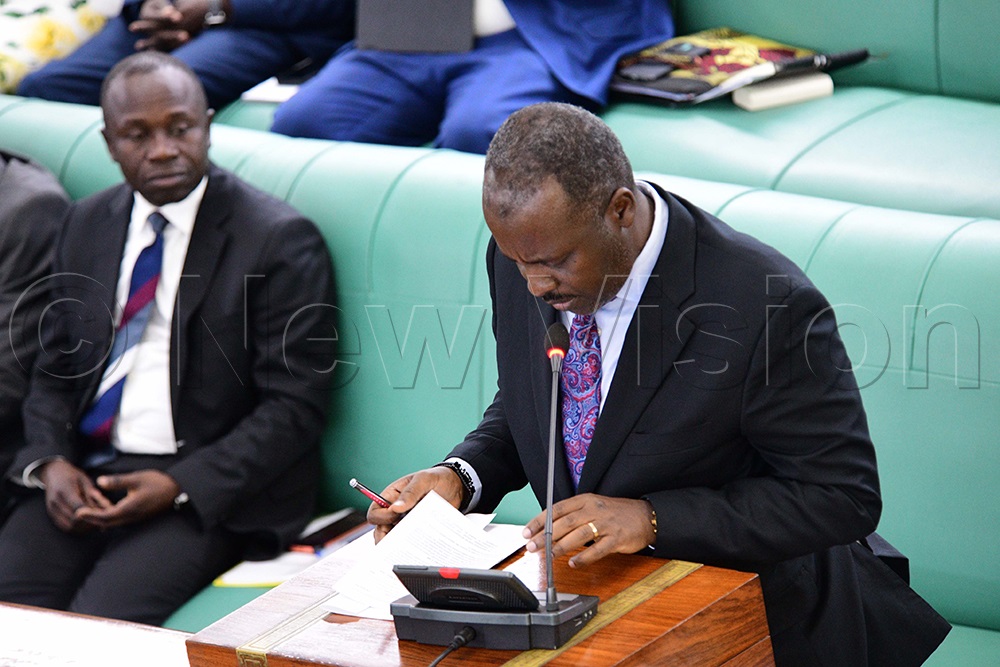
State Minister for Internal Affairs, Gen. David Muhoozi. (Credit: Maria Wamala)
Strict limits on foreign funding
Under the proposed law, any person or “agent of a foreigner” would be prohibited from directly or indirectly receiving financial support, donations, loans, or other assistance from a foreign source exceeding sh400 million within 12 months without written approval from the Minister responsible for Internal Affairs.
The Bill treats violations as serious criminal offences. Offenders risk imprisonment of up to 20 years, fines of up to sh2 billion for individuals, and up to sh4 billion for companies. Any funds deemed in excess of the limit would be confiscated by the State.
Mandatory disclosure of foreign funding
The Bill introduces strict disclosure requirements for all recipients of foreign funds. Section 21 requires individuals and entities to submit detailed declarations to the Minister, outlining the source, amount and purpose of any foreign funding received.
It further provides that such declarations will not be confidential and may be accessed by the public upon payment of a prescribed fee, a measure the Government says is aimed at promoting transparency and public scrutiny.
Failure to provide accurate information attracts penalties of up to five years in prison or fines of sh1.4 million.
Criminalising “disruptive funding”
One of the contentious provisions is Section 23, which criminalises what the Bill describes as “disruptive funding.” This refers to funds intended to destabilise government, influence political processes, or threaten national security.
It states that any person or organisation that receives or solicits funds from a foreign government, institution, or individual with the intent to promote unrest or undermine Uganda’s security commits an offence punishable by up to 20 years in prison or fines of up to sh2 billion, or sh4 billion for corporate entities.
Company directors and executives would be held personally liable for breaches committed by their organisations.
Foreign funding treated as public funds
Clause 24 provides that all foreign funding directed to Government institutions will be classified as public funds. Such resources would fall under the oversight of the Public Finance Management Act, 2015, subjecting them to standard budgeting, auditing, and accountability procedures.
However, the Minister retains discretion to exempt certain funding in consultation with the ministries of Finance and Foreign Affairs if deemed non-threatening to national interests.
Banking sector under new obligations
Failure to provide accurate information attracts penalties of up to five years in prison or fines of sh1.4 million.
Criminalising “disruptive funding”
One of the contentious provisions is Section 23, which criminalises what the Bill describes as “disruptive funding.” This refers to funds intended to destabilise government, influence political processes, or threaten national security.
It states that any person or organisation that receives or solicits funds from a foreign government, institution, or individual with the intent to promote unrest or undermine Uganda’s security commits an offence punishable by up to 20 years in prison or fines of up to sh2 billion, or sh4 billion for corporate entities.
Company directors and executives would be held personally liable for breaches committed by their organisations.
Foreign funding treated as public funds
Clause 24 provides that all foreign funding directed to Government institutions will be classified as public funds. Such resources would fall under the oversight of the Public Finance Management Act, 2015, subjecting them to standard budgeting, auditing, and accountability procedures.
However, the Minister retains discretion to exempt certain funding in consultation with the ministries of Finance and Foreign Affairs if deemed non-threatening to national interests.
Banking sector under new obligations
The Bill places significant compliance duties on financial institutions. Banks would be barred from processing transactions involving agents of foreign entities without proper declarations and approvals.
Under Section 25, banks must also submit monthly reports of all such transactions to the Minister. Non-compliance would attract fines of up to Shs4 billion.
Continuous reporting requirements
Section 26 introduces ongoing reporting obligations for recipients of foreign funds, requiring detailed returns on amounts received, sources, and expenditure. Failure to comply attracts severe penalties, including imprisonment of up to 20 years.
Political activity restrictions
The Bill prohibits engagement in activities deemed to promote foreign interests against Uganda’s national interest. Individuals and organisations found in breach face fines of up to sh2 billion or imprisonment of up to 20 years.
Parliamentary concerns over process
During debate in the House, MPs, including Patrick Nsamba Oshabe (Kassanda County) and Theodore Ssekikubo (Lwemiyaga County), said they had not received copies of the Bill in advance, contrary to standard parliamentary practice.
Ssekikubo criticised the process, saying the Bill appeared to have been “pushed” into Parliament without adequate consultation.
Speaker of Parliament Anita Among insisted that soft copies had been circulated to MPs through parliamentary tablets. She referred the Bill to the joint committees on defence and internal affairs, and legal and parliamentary affairs for scrutiny.
Under Section 25, banks must also submit monthly reports of all such transactions to the Minister. Non-compliance would attract fines of up to Shs4 billion.
Continuous reporting requirements
Section 26 introduces ongoing reporting obligations for recipients of foreign funds, requiring detailed returns on amounts received, sources, and expenditure. Failure to comply attracts severe penalties, including imprisonment of up to 20 years.
Political activity restrictions
The Bill prohibits engagement in activities deemed to promote foreign interests against Uganda’s national interest. Individuals and organisations found in breach face fines of up to sh2 billion or imprisonment of up to 20 years.
Parliamentary concerns over process
During debate in the House, MPs, including Patrick Nsamba Oshabe (Kassanda County) and Theodore Ssekikubo (Lwemiyaga County), said they had not received copies of the Bill in advance, contrary to standard parliamentary practice.
Ssekikubo criticised the process, saying the Bill appeared to have been “pushed” into Parliament without adequate consultation.
Speaker of Parliament Anita Among insisted that soft copies had been circulated to MPs through parliamentary tablets. She referred the Bill to the joint committees on defence and internal affairs, and legal and parliamentary affairs for scrutiny.