
Uganda seeks WIPO support to strengthen IP in the AI era
In today’s knowledge-based global economy, justice and constitutional affairs minister Norbert Mao said intellectual property has moved from the periphery to the centre of national development.
Norbert Mao, Justice Minister interacts with Daren Tang, World Intellectual Property Organization (WIPO), Director General during a meeting at the Ministry of Justice and Constitutional Affairs in Kampala on 4th December 2025. (Photo by Juliet Kasirye)
__________________
The Ministry of Justice and Constitutional Affairs has requested support from the World Intellectual Property Organisation (WIPO) to help prepare Uganda’s intellectual property systems for the challenges and opportunities presented by artificial intelligence.
According to the ministry, strengthening IP protection is essential for development, innovation and cultural preservation.
In today’s knowledge-based global economy, justice and constitutional affairs minister Norbert Mao said intellectual property has moved from the periphery to the centre of national development. He described it as a bridge between ideas and their impact, between creativity and commerce, and between tradition and the future.
Norbert Mao, (right), Justice Minister seeking partnerships with WIPO during a meeting at the Ministry of Justice and Constitutional Affairs in Kampala on 4th December 2025. (Photo by Juliet Kasirye)
“We propose to deepen our partnership in the promotion of geographical indications and prepare our IP systems for the challenges and opportunities of AI. I was honoured to have been invited by the Singapore IP office, and I noticed there was a lot of discussion about the role of artificial intelligence, digital content creation and e-commerce,” Mao said.
He added that Uganda hopes its partnership with WIPO will help mainstream AI, digital content creation and e-commerce into national systems. He also proposed strengthening enforcement mechanisms, improving coordination and expanding digital IP services to ensure nationwide accessibility.
Above all, he said, there is a need to increase public awareness.
Because many people remain unaware of the opportunities offered by intellectual property, Mao noted that the ministry is seeking WIPO’s support to build an ecosystem that turns creativity into sustainable livelihoods, competitive enterprises and national prosperity.
He made the remarks during an engagement with the director general of the World Intellectual Property Organisation, Daren Tang, held at the Ministry of Justice and Constitutional Affairs in Kampala on December 4 2025. The engagement brought together senior government officials, including the Registrar General, the URSB board chairperson, the Solicitor General and a WIPO delegation. It aimed to enhance collaboration and prepare Uganda’s IP systems for future demands.
During the three-day visit, Tang held discussions with the Ministry of Justice, the Ministry of Science, Technology and Innovation, the Ministry of Foreign Affairs and the Uganda Registration Services Bureau. The talks focused on Uganda's progress in strengthening its intellectual property ecosystem and advancing innovation and creativity.
Tang, a national of Singapore, has served as director general of WIPO since 2020. He is the first Asian to head the global body responsible for shaping international IP policy. His leadership has emphasised ensuring that innovation and creativity serve as inclusive engines of growth, particularly in developing countries.
“We are confident that this visit will strengthen our cooperation and open new pathways for innovation, creativity, and socio-economic development. Through your support, we have done a comprehensive review and reforms of our intellectual property laws, including the Copyright and Neighbouring Rights and the Trademarks Act, in order to align them with international treaties, and also the digital age,” Mao said.
According to Mao, these reforms now allow online filing, examination, search and management of IP applications. He added that capacity-building programmes such as IPaaS, WIPO Publish and WIPO Scan have enabled URSB to streamline processes, enhance transparency and serve clients more efficiently nationwide and beyond.
During the meeting, Mao also asked WIPO to support Uganda in fully implementing the national IP policy and deepening the use of intellectual property by small and medium enterprises. He said this would help formalise the informal sector, improve competitiveness, strengthen IP knowledge and encourage commercialisation of IP assets.
Mao added that Uganda’s colonial legacy still influences public attitudes, with many people believing that government registration requirements are intended for punitive purposes. He attributed this perception to the old legal language used in the past, which he said was difficult for the public to understand.
The URSB board chairperson, Francis Butagira, raised concerns about enforcement and the protection of IP assets, noting how easy it has become to infringe copyright in the digital age. “The challenge now is that with this world, how do you protect intellectual property which was designed focusing on physical, but now it has gone digital. We have challenges of piracy, cybercrime, among others,” Butagira said.
Addressing government officials, the WIPO director general said the organisation’s vision is to build an inclusive IP system that reaches small and medium enterprises and prioritises young people. Since youth are central to future innovation, Tang said WIPO aims to support young people in rural and local communities, as IP should not only benefit those in urban areas.
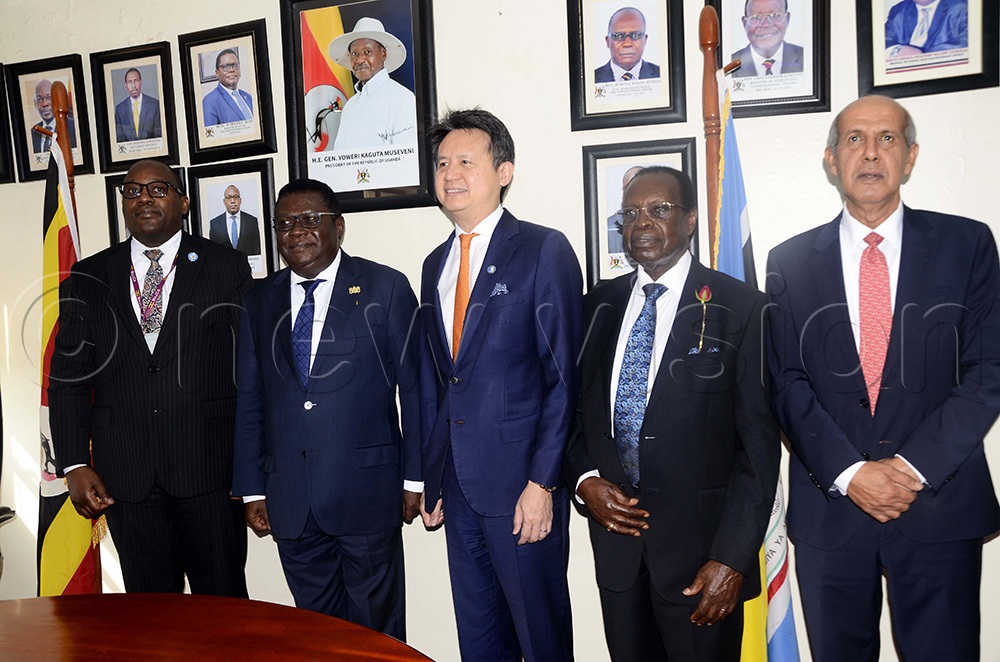
From left to right: Pius Perry Biribonwoha, Solicitor General, Norbert Mao, Justice minister, Daren Tang, World Intellectual Property Organization (WIPO), Francis Butagira, URSB Board chairman, Ambassador Hasan Kleib, Deputy director general regional and national development sector pose for a photo during a meeting at the Ministry of Foreign Affairs in Kampala on 4th December 2025. (Photo by Juliet Kasirye)
He noted that the registration of Rwenzori Coffee as Uganda’s first geographical indication demonstrates how IP can directly benefit farmers and local communities. “By leveraging this IP, combined with trademarks and designs, they can enhance marketing, packaging, and branding, ultimately improving their livelihoods," Tang explained.
Tang also highlighted a project implemented in Zimbabwe where 50 entrepreneurs were mentored in agro-technology, R&B, fashion and food processing. With support in marketing, packaging and branding, the project produced more than 100 trademark applications, created 50 jobs and increased revenue by 10 per cent within six months.
“IP has become a signal of quality and a way of attracting investments. It is very powerful, and I am happy to work with you to see whether we can deliver a similar project in Uganda as well,” Tang said.