
Uganda seeks sustainable emergency systems as Japan provides vehicles worth sh2b
The grant, valued at USD 584,965 (about shillings two billion), will fund the donation of nine ambulances to the health ministry and eight fire engines to the Uganda Police Force Fire Prevention and Rescue Services, to be deployed to selected cities and districts across Uganda.
On February 17, 2026, at the Embassy of Japan in Kampala, Ambassador Sasayama Takuya signed a grant contract with Uganda health ministry permanent secretary Dr Diana Atwine. (Credit: Annabel Oyera)
Calls for stronger equipment maintenance and human resource capacity building have been at the forefront during a ceremony that has seen Japan donate emergency vehicles worth over shillings two billion to strengthen the country’s disaster response systems.
On February 17, 2026, at the Embassy of Japan in Kampala, Ambassador Sasayama Takuya signed a grant contract with Uganda health ministry permanent secretary Dr Diana Atwine.
The grant, valued at USD 584,965 (about shillings two billion), will fund the donation of nine ambulances to the health ministry and eight fire engines to the Uganda Police Force Fire Prevention and Rescue Services, to be deployed to selected cities and districts across Uganda.
This initiative aims to strengthen emergency medical transport and firefighting capacity, addressing the increasing demand for rapid response services in both urban and rural areas.
Under the project, the vehicles will be deployed to the cities of Kampala, Hoima, Arua and the districts of Wakiso, Kiruhura, Mityana, Hoima District, Lira, Kapchorwa, Sironko and Busia.
While appreciating Japan’s continued support, Atwine emphasised that Uganda’s biggest challenge is not only acquiring equipment, but maintaining it.
“This is not the first time we have been here to receive grants from Japan. You have consistently supported our strategic needs,” she said.
Uganda currently has nearly 4,000 health facilities, many of which struggle with equipment breakdowns due to limited maintenance capacity.
Atwine called for strengthened collaboration in biomedical engineering, mobile workshops, and skills transfer to ensure sustainability.
“It is better to teach someone how to fish than to give someone fish,” she said, stressing the need to build local capacity so that donated equipment can be properly maintained and optimally utilised.
She pledged that the Government would ensure the vehicles are protected and used for their intended purpose.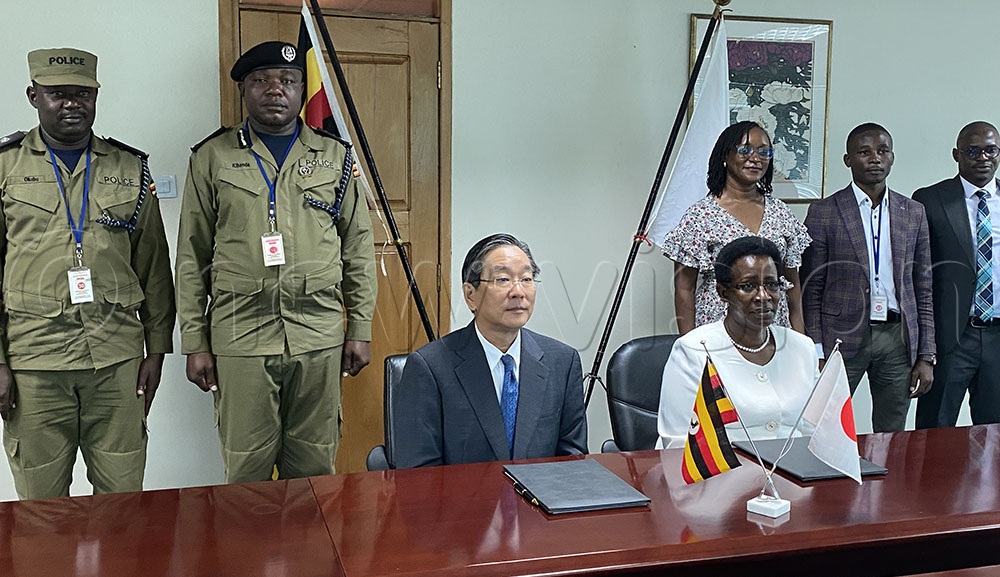
Sasayama said demand for emergency medical transport and fire response services continues to grow in rapidly developing countries like Uganda. (Credit: Annabel Oyera)
Rising demand for emergency services
Sasayama said demand for emergency medical transport and fire response services continues to grow in rapidly developing countries like Uganda.
“Through this project, we hope to bridge critical gaps and support Uganda’s efforts to strengthen emergency preparedness,” he said.
He noted that the donation is part of a three-year plan under which about 60 emergency vehicles will be provided to Uganda.
Police welcome firefighting support
Commissioner for Disaster Preparedness and Fire and Rescue Services, Hassan Kihanda, described the support as a boost to national disaster response efforts.
He said the partnership has gone beyond equipment donation to include practical training for Ugandan firefighters by Japanese experts, strengthening operational readiness.
Japan’s Grassroots Human Security Projects, launched in 1999, have supported 296 community-based initiatives across Uganda.
As Uganda expands its emergency fleet, government officials say the next critical step is ensuring that systems for maintenance, training, and sustainability are strengthened so that the investment translates into lives saved.