
UGANDA DECIDES: Police warn against election violence
Why would you be threatened by security deployment? Police is supposed to be proactive, not reactive. Do you wait for chaos to ensue and then the Police steps in?
Security authorities have directed fuel dealers to immediately halt the sale of petrol and other flammable products to people carrying plastic containers
Police have warned the public against engaging in any form of criminal activity on polling day, saying elections do not provide justification for violence, disorder or intimidation.
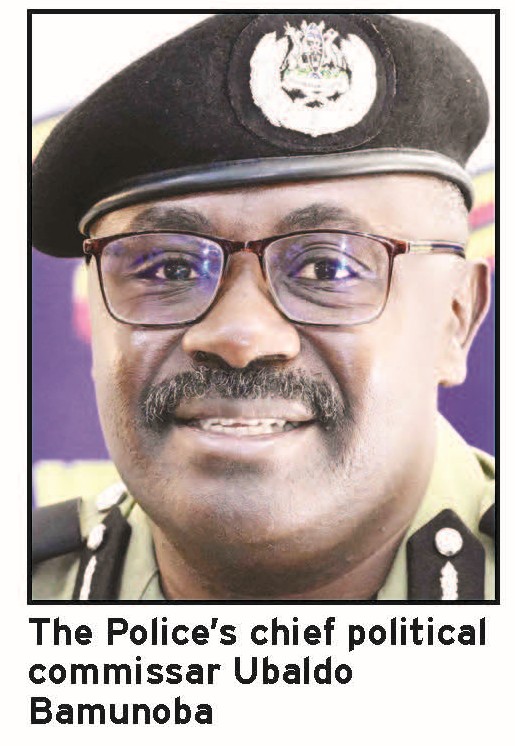
Speaking to journalists during a police briefing at Naguru in Kampala on Monday, the Police’s chief political commissar, Ubaldo Bamunoba, defended the heavy deployment of personnel ahead of the January 15 elections.
“The deployments are preventive rather than reactionary and are aimed at guaranteeing the safety of all Ugandans as the country enters the most critical phase of the electoral process,” he said.
Security agencies have in recent days intensified patrols in major towns, transport corridors and identified hotspots as campaigns wind down and attention shifts to polling day.
Bamunoba dismissed claims that the increased presence of uniformed personnel signaled impending insecurity, arguing that proactive policing was essential to maintaining public order during elections.
“Why would you be threatened by security deployment? Police is supposed to be proactive, not reactive. Do you wait for chaos to ensue and then the Police steps in?” he asked.
Bamunoba said acts of criminality disguised as political activism would not be tolerated, stressing that peace must remain the defining value before, during and after elections.
“Elections are not a justification for criminal acts. Citizens must exercise restraint and reject violence, even when provoked,” he said.
Bamunoba was flanked by Police spokesperson Rusoke Kituuma, hisdeputy Diana Nandawula and the Kampala Metropolitan Police spokesperson, Racheal Kawala.
Asked about reported incidents of violence linked to the campaign period, Bamunoba said cases had been recorded and handled, although comprehensive data was still being compiled.
“I don’t have the data of registered cases here, but certainly some cases were reported. They have been handled as expected,” he said, adding that the Police public relations office would release verified figures once compilation is complete.
While cautioning against exaggeration of incidents, Bamunoba said the Police strongly condemn all forms of indiscipline associated with the electoral process.
“If there are those wreaking havoc, that is very unfortunate.
We condemn all indiscipline in the strongest terms possible,” he said.
COMPLAINTS AGAINST SPCS
Bamunoba also addressed concerns over the conduct of auxiliary forces, including special police constables (SPCs), who have been deployed to supplement regular officers during elections.
He said the recruitment of auxiliary personnel is provided for under the law and necessitated by manpower limitations within the force.
“These are mandated by law to be recruited so that they can supplement the efforts of the Police, bearing in mind our minimum numbers.”
However, Bamunoba acknowledged complaints that some SPCs may have acted outside their mandate, describing such conduct as unacceptable.
“If they are misbehaving, that is very unfortunate. What we can do now is tighten supervision and intensify oversight so that they do not act out of order,” he said.
Bamunoba urged members of the public to report any misconduct, saying the Police leadership had the capacity to identify and discipline errant personnel.
GUIDELINES
Bamunoba reminded voters and candidates to strictly observe electoral guidelines, particularly provisions governing activities at polling stations.
Citing the Presidential Elections Act, he said candidates were permitted to monitor voting and tallying either physically or through accredited agents, not by crowding polling stations.
“A candidate can be at the polling station directly or indirectly through his or her agent. The agent participates in tallying, receives results and forwards them to the National Tally Centre,” Bamunoba said.
He questioned the presence of voters who remain at polling stations after casting their ballots.
“So, what is the work of the voter at a polling station after he/she has already cast their vote?”
Bamunoba urged the public to comply with the 20-metre rule and other security guidelines to allow election officials and security personnel to work without interference.
“Kindly follow the security guidelines so that an enabling environment prevails,” he said.
Responding to concerns about civilians in uniform, including alleged gang members or ghetto youth, Bamunoba said the recruitment of auxiliary forces was nationwide and not selective. “We recruited all over Uganda. We are not selective,” he said, adding that any lawfully recruited and deployed person duty.
“Unless they involve themselves in criminal acts, then they will be dealt with accordingly,” he added.
Bamunoba urged the public to report incidents of violence, intimidation or abuse rather than confronting security personnel in the field.
He said district and regional police commanders have been instructed to strengthen supervision to prevent rogue actions by individual officers.
“The district, regional police commanders and all other supervisors will be on the ground to ensure discipline and proper conduct.”
SAFETY OF JOURNALISTS
Bamunoba also addressed concerns about the safety of journalists, acknowledging past incidents in which media personnel were caught up in chaotic operations.
“You are part of us. We work together very well. Wherever your safety has been compromised, we are very sorry. We have reflected internally and realised how important you are. Your safety is very critical,” he said.
Bamunoba said Police’s leadership, including the Police chief, had issued assurances that journalists would be protected as they carry out their work.
“Be assured that your security is guaranteed. Work closely with the public relations officers and remain professional,” Bamunoba said.
However, he cautioned journalists to exercise judgment in volatile situations and avoid getting entangled in violence.
Speaking at a function organised by the Electoral Commission to brief observers about election guidelines at Mestil Hotel on Monday, January 12, 2026, Inspector General of Police Abas Byakagaba reaffirmed their unwavering commitment to ensure a peaceful and secure environment for elections.
“The role of providing the basic security for the electoral process is with the Police, but it can’t do this in isolation of other general security concerns. You will not expect to see other agencies inside the polling station because we have prepared for this. Where we shall be found wanting, maybe we shall have a prison warder,” he said.
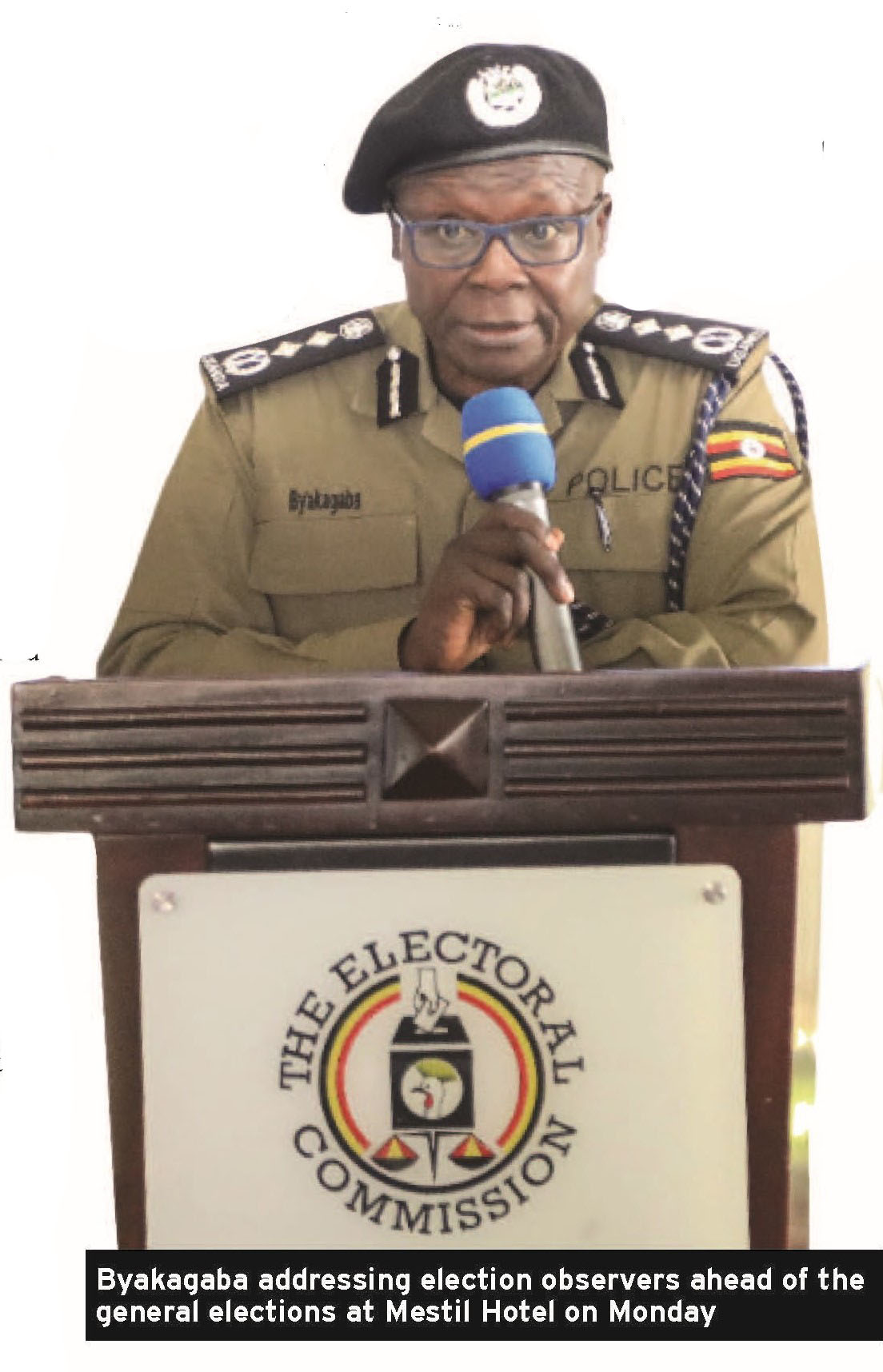
“But the presence of other sister forces outside the other spaces should be an assurance to all our people that there is security around led by the Uganda Police Force because it is important that as we look at the security of the electoral process, we must also look at the security of the country and of other activities,” the IGP added.
FUEL SALE RESTRICTED
Security authorities have directed fuel dealers to immediately halt the sale of petrol and other flammable products to people carrying plastic containers, as part of heightened measures ahead of the polling day.
The directive follows a regional threat assessment meeting that reviewed potential security risks linked to the misuse of petroleum products during a politically tense period.
In Wamala region, Police spokesperson Lameck Kigozi said the decision was taken to prevent ill-intentioned individuals from exploiting flammable substances to cause harm to the public. Wamala region comprises five districts — Kassanda, Kiboga, Kyankwanzi, Mityana and Mubende.
In the Albertine region, Emmanuel Ssempijja, the Albertine regional police community liaison officer, said police will not hesitate to arrest fuel station managers found selling fuel in containers without a genuine reason. “There must be a clear and genuine reason for selling fuel in containers, and the seller must be able to justify it,” Ssempijja said. “This is an order we are implementing as part of our policing efforts during the election period.”
Security advised motorists and other legitimate fuel users to ensure they draw fuel directly into their vehicles or motorcycles at fuel stations.
Additional reporting by Wilson Asiimwe