
Uganda, China commission food aid handouts to vulnerable refugees
The launch on May 8 was held at Kabazana Reception Centre in Nakivale Settlement in Isingiro district. The event was witnessed by officials from various government entities, the Embassy of China in Uganda, refugees, and leaders from Isingiro district.
Zhang Zaoping, the Second Secretary at the China Embassy, represented the Chinese Ambassador to Uganda who was the chief guest at the function that was also attended by refugees’ leaderships from Nakivale and Kyangwali settlements. (Photo by Abdulkarim Ssengendo)
________________
The governments of Uganda and China have commissioned the distribution of food assistance to refugees under the China Emergency Humanitarian Assistance Project.
The China Emergency Humanitarian Assistance Project is executed by the Office of the Prime Minister, with funding support from the People’s Republic of China.
The project worth $1 millon (about sh3.7b) is being implemented through Finn Church Aid.
The launch on May 8 was held at Kabazana Reception Centre in Nakivale Settlement in Isingiro district.
The event was witnessed by officials from various government entities, the Embassy of China in Uganda, refugees, and leaders from Isingiro district.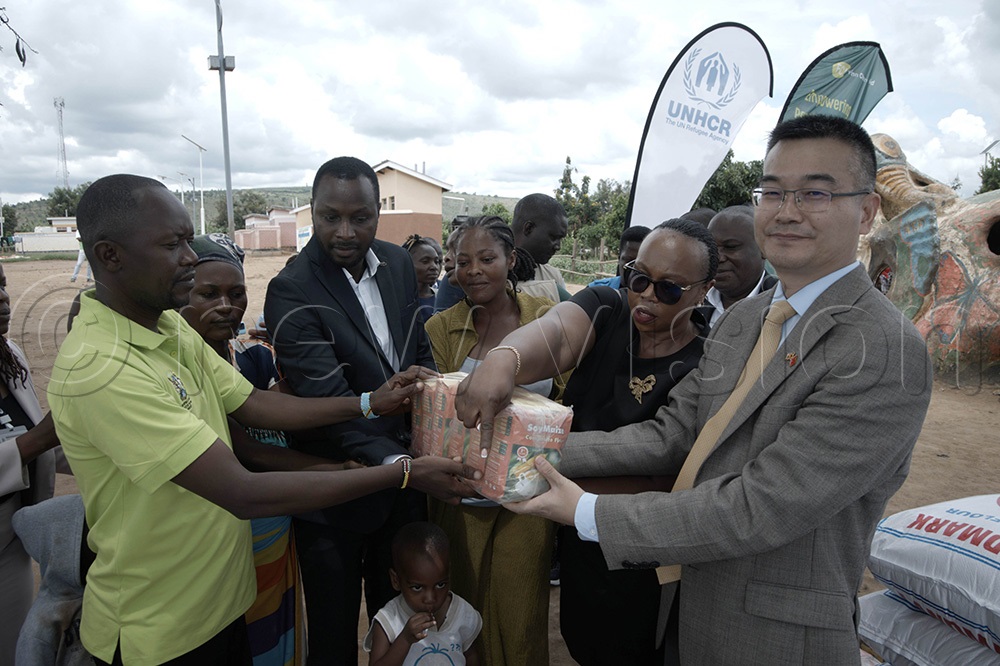
Zhang Zaoping, the Second Secretary at the China Embassy, accompanied by Finn Church Aid, UNHCR and OPM officials launch the China Emergency Humanitarian Assistance Project. (Photo by Abdulkarim Ssengendo)
Zhang Zaoping, the Second Secretary at the Chinese Embassy, represented the Chinese Ambassador to Uganda, who was the chief guest at the function, which was also attended by refugee leadership from the Nakivale and Kyangwali settlements.
The one-year project, commencing in May 2026, will focus on supporting new arrivals and the most vulnerable refugees in Nakivale, Kyangwali, and Nyakabande Reception Centre.
The total grant was given to the government of Uganda through the office of the Prime Minister, and Finn Church Aid is charged with the responsibility of implementing the project.
The project targets about 26000 refugees, mainly looking at children, mothers who are breastfeeding and also the elderly who need food nutrients to boost their energies.
It will provide supplementary food, daily necessities and hygiene supplies to vulnerable refugee groups, effectively alleviating their hardships and improving their living condition.
In his speech, read by Zhang Zaoping, the Second Secretary, the Chinese Ambassador to Uganda, noted that the China Emergency Humanitarian Assistance Project is a concrete step to implement the outcomes of the 2024 summit of the Forum on China-Africa Cooperation and a vivid practice of building a China-Africa community with a shared future.
“Today, we move from commitment to the front lines. By commissioning this distribution, we are ensuring that China’s promise is delivered directly into the hands of those in greatest need,” Fan Xeucheng, China's Ambassador to Uganda, said in his speech.
“This project not only meets immediate needs, but also strengthens social cohesion and lays a foundation for long-term resilience," he added.
Xeucheng urged the international community to prioritise promoting ceasefire and political settlements, and provide stronger support to refugee-hosting countries like Uganda.
He commended Uganda’s remarkable humanitarian efforts and deeply appreciated the progressive open-door refugee policy, which sets a shining example of humanitarian leadership and a benchmark for international solidarity.
He also hailed Uganda for standing out as a powerful voice for the Global South, championing peace, stability and common development. He expressed his country’s commitment to continue supporting Uganda in playing an even greater role in international affairs and global governance.
In his remarks, Stephen Ssenkima, the deputy country director for Finn Church Aid in Uganda, extended heartfelt thanks to the People’s Republic of China for standing with Uganda in addressing challenges faced in the refugee population.
“We don’t take this for granted because we have had a long, deep-rooted partnership with the People's Republic of China and the government of Uganda,” Ssenkima stated.
“By choosing us, we want to take advantage and demonstrate our global mandate as a humanitarian organisation to support those in need, and I want to reaffirm our commitment that we will do this with utmost faith, with open accountability, and the food will reach those in need, “He added, noting they will follow global humanitarian standards.
Jane Nantale, who represented the Permanent Secretary at the function, expressed sincere appreciation to the United Nations family, particularly UNHCR and the World Food Programme, for their continued partnership and steadfast support in the response to refugees.
She affirmed that Uganda’s commitment to host refugees is deliberate and grounded in strong political will and is deeply rooted in cultural values of humanity, which calls up everybody to show companionship and solidarity with those who are distressed.
She hailed the People’s Republic of China for its generous and timely support, which she said came at a critical time when many refugees are facing challenges in accessing sufficient food and where nutrition is a challenge; therefore, the support is a strong message of solidarity to humanity.
OPM, UNHCR decry funding crisis hitting refugee settlements
Represented by Titus Jogo, the Commissioner for Refugee Management noted that Uganda continues to experience a steady increase in its refugee population.
He reported that from approximately 1.7 million refugees in mid-2024 to 1.9 million in mid-2025, Uganda now hosts over 2 million refugees from 35 countries.
Daily, Uganda receives asylum seekers, particularly from Sudan, South Sudan and the DRC. Nakivale Refugee Settlement receives an average of 100 new arrivals per day, while Kyangwali receives approximately 70.
The magnitude of the current funding crisis is evident across sectors. A majority of refugees have seen drastic reductions in food assistance, with rations reduced to as low as USD 0.30 per person per day, and nearly one million refugees have been completely weaned off food support.
In the education sector, he reported that funding cuts have resulted in a reduction of teachers from over 4,200 in 2024 to fewer than 80% in 2026. In the health sector, up to 87% of health workers are at risk of being laid off.
Roger Hollo, the UNHCR country representative, called for continued donor support, noting that it is crucial to ensuring that vulnerable populations receive essential services and resources during a challenging period.