
Sovereignty law should not hurt journalism, media scholars appeal
They are calling for safeguards to protect good journalism during the implementation of the Protection of Sovereignty Act, 2026, which was assented to by President Yoweri Museveni on May 17, 2026.
Dr Gerald Walulya, a senior lecturer in the Department of Journalism and Communication at Makerere University, says the law risks increasing self-censorship if the implementers do not put in safeguards to protect journalism. (File photo)
__________________
For many years, Ugandan journalists have received cash grants from local and international organisations to pursue stories that highlight issues of national importance, especially in the environment, health, security, business and labour sectors.
Some of the organisations that have been giving such grants to journalists include The African Centre for Media Excellence and the Nile Basin Initiative.
Although some stories annoyed some people, especially high-ranking officials in the Government and private sector, they checked impunity and fostered shared societal interests such as transparency and environmental protection.
However, with Parliament’s recent passing of the Sovereignty Bill, which seeks to punish agents of foreign powers that spread misinformation with the intention of causing change in government policy, media scholars fear that good journalism could innocently suffer.
They are calling for safeguards to protect good journalism during the implementation of the Protection of Sovereignty Act, 2026, which was assented to by President Yoweri Museveni on May 17, 2026.
Dr Gerald Walulya, a senior lecturer in the Department of Journalism and Communication at Makerere University, says the law risks increasing self-censorship if the implementers do not put in safeguards to protect journalism.
“The Bill’s broad provisions may heighten the risk of self-censorship. In highly regulated environments, journalists may increasingly avoid sensitive but necessary reporting on governance and public accountability due to fear of legal or administrative consequences,” he said.
He further stated that for people who work for international media houses such as the BBC, RT and Al Jazeera, the proposed law makes their job hard because their activities can easily be described as foreign-sponsored to entrench selfish interests, which exposes them to imprisonment.
Dr Sam Kazibwe, a senior lecturer at Uganda Christian University (UCU), also agreed with Walulya and warned that the broad definitions and stiff penalties may deter legitimate reporting on governance, the economy and international affairs.
“Provisions on foreign influence blur the line between professional collaboration and criminal liability,” he said.
“It will discourage partnerships between Ugandan journalists and global media. It will significantly constrain journalism, particularly for correspondents working with international networks,” he added.
Dr Joel Isabirye, the head of the Journalism and Media Studies department at Kampala International University, said the law will affect foreign-linked investment in Uganda’s media sector.
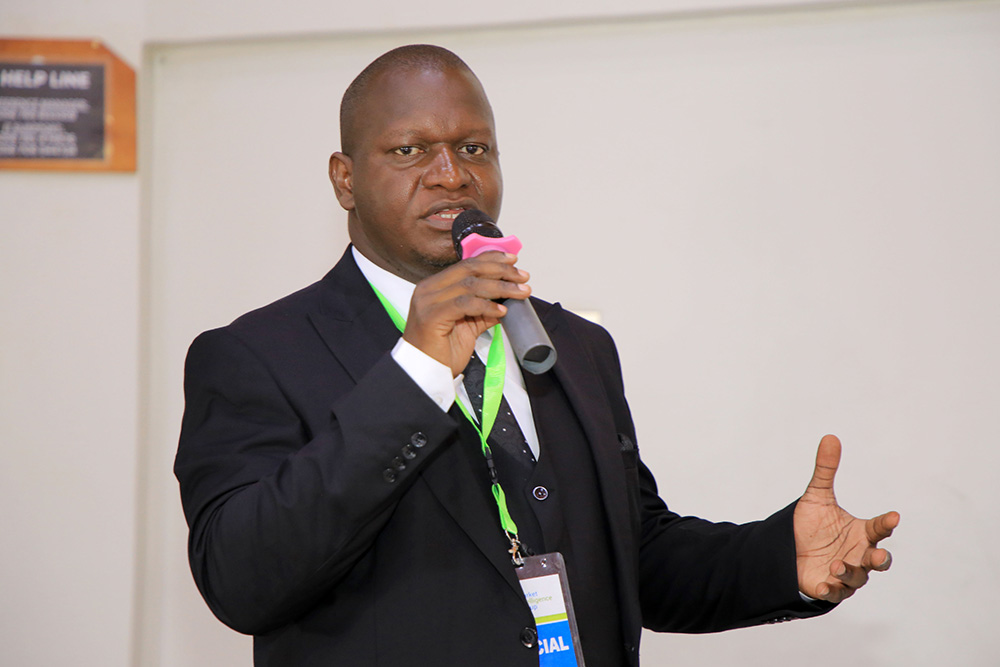
Dr Joel Isabirye, the head of the Journalism and Media Studies department at Kampala International University and Managing Director, Market Intelligence Group. (Photo by Miriam Najjingo)
“The law with broad definitions of foreign influence risk creating uncertainty for international media partners and investors. Such measures could erode the international community’s confidence in Uganda’s media and communication space,” he said.
Foreign influence versus journalism
While defending the law, the National Resistance Movement (NRM) director of legal affairs, Enock Barata, said Uganda needed to safeguard itself in an era where external influence is no longer subtle, but overt, coordinated and increasingly technological.
“Today’s global order is marked by open contestation over national autonomy. We are witnessing direct interference in the governance of states, overt geopolitical manoeuvring over territories and explicit support – financial, military and informational – for regime change aligned with foreign interests.
“Influence is no longer exercised through sanctions or trade policy; it is embedded in digital ecosystems, funding structures and transnational networks that shape public discourse and policy outcomes,” Barata stated.
In his interface with the MPs, the Attorney General said the current law had been drafted to combat negative foreign influence, which has evolved with the rapidly evolving digital world. In his defence of the Bill, he cited countries such as Canada, the UK and the US, which he said had adopted similar legislation to protect them from foreign interference.
To activists such as Sarah Bireete, the chief executive officer of the Centre for Constitutional Governance, the law is taking away the citizens’ freedom.
“In the justification of the Bill, the Government mentions the need to control the influence of foreign funding, social media platforms that are used negatively, and to control civil society. But we already have the Anti-Money Laundering and Anti-terrorism Acts. These laws are strong enough to deal with those issues,” she said.
Uganda’s legislation against foreign influence comes at a time when Africa is facing a growing problem of misinformation cells sponsored by foreign powers to influence governance and election outcomes.
While delivering a paper recently, Ugandan media scholar Prevor Mukasa said online misinformation had become a major tool of foreign interference.
“The propaganda content has shifted from the traditional media to online influencers,” she said.
A recent investigative report by a consortium of media agencies unveiled a network of disinformation and propaganda cells that operates under a code-name Africa Politology or The Company with links to Russia’s Africa Corps.
The investigation by a consortium of investigative networks consisting of Forbidden Stories, The Continent, All Eyes On Wagner, Dossier Centre, openDemocracy, iStories and several independent Russian-speaking journalists and journalists examined 76 internal documents from a disinformation network named the “Company”.
The report indicated that Africa Politology spent $7.3m across Africa, funding information operations characterised by online manipulations to promote foreign agendas.
“Verified by the investigators as real, the leaked documents reveal a vast network of propaganda agents under the control of Russia’s Foreign Intelligence Service, spanning three continents and 34 countries, with Africa at the heart of these operations,” the report read.
The investigation unveiled internal documents, comprising 1,431 pages of strategic plans, employee biographies, operational reports, accounting records and summaries of disinformation campaigns. The leaked documents revealed a vast network of propaganda agents under the control of Russia’s Foreign Intelligence Service, spanning three continents and 34 countries, with Africa at the heart of its operations. The major countries of focus are Guinea, Mali, Burkina Faso, Niger, Chad, Sudan, Eritrea, Somalia, and Ethiopia to build a belt of regimes friendly to the Russian Federation.
According to the report, the funds are managed by exchanges between two Russia-based companies, Intertechtrade LLC and JSC Inter, with transfers deliberately capped to avoid detection by Russian tax authorities and international regulators.
The report further indicates that Ksenia Valeryevna Soboleva, the head of Africa Politology’s media department in 2024, made payments to pro-Russian Telegram accounts, including Sovereign, Arab Africa, Galloping Across Africa, Algeria Today, SHARQ and one run by the journalist Abbas Djuma, who was sanctioned by the US and has 61,175 followers.