
Sovereignty Bill sparks fears of crackdown on civic space and foreign aid
Internal affairs minister Kahinda Otafiire said the country currently has no specific law upholding sovereignty, resulting in "continuous interference in the Government's policies and programmes by foreign countries and agents of foreigners".
Led by the Centre for Health, Human Rights and Development (CEHURD), the non-state actors under the health sector revealed on Wednesday that they sent a memorandum consisting of recommendations to Parliament, with a halt in legislation of the piece of legislation among the top priorities. (Credit: Derrick Muduku)
KAMPALA - Civil society organisations (CSOs) in Uganda have expressed worry over what they consider the stringent nature of the proposed Protection of Sovereignty Bill, 2026, stating that it undermines the civic space contributions towards realising service delivery in the country.
The remarks were made at a civil society engagement of health sector organisations at Skyz Hotel in Kampala to deliberate on the proposed Bill.
The Protection of Sovereignty Bill, 2026, sponsored and tabled by the Government through the internal affairs ministry, seeks to regulate foreign funding and influence in Uganda.
Internal affairs minister Kahinda Otafiire said the country currently has no specific law upholding sovereignty, resulting in "continuous interference in the Government's policies and programmes by foreign countries and agents of foreigners".
Led by the Centre for Health, Human Rights and Development (CEHURD), the non-state actors under the health sector revealed on Wednesday that they sent a memorandum consisting of recommendations to Parliament, with a halt in legislation of the piece of legislation among the top priorities.
“We have analysed the Bill and feel that it does not look deeply into the value of civil society in advancing the right to health. Our recommendation is to put aside the legislation of this Bill,” said Noor Nakibuuka Musisi, the deputy executive director of CEHURD.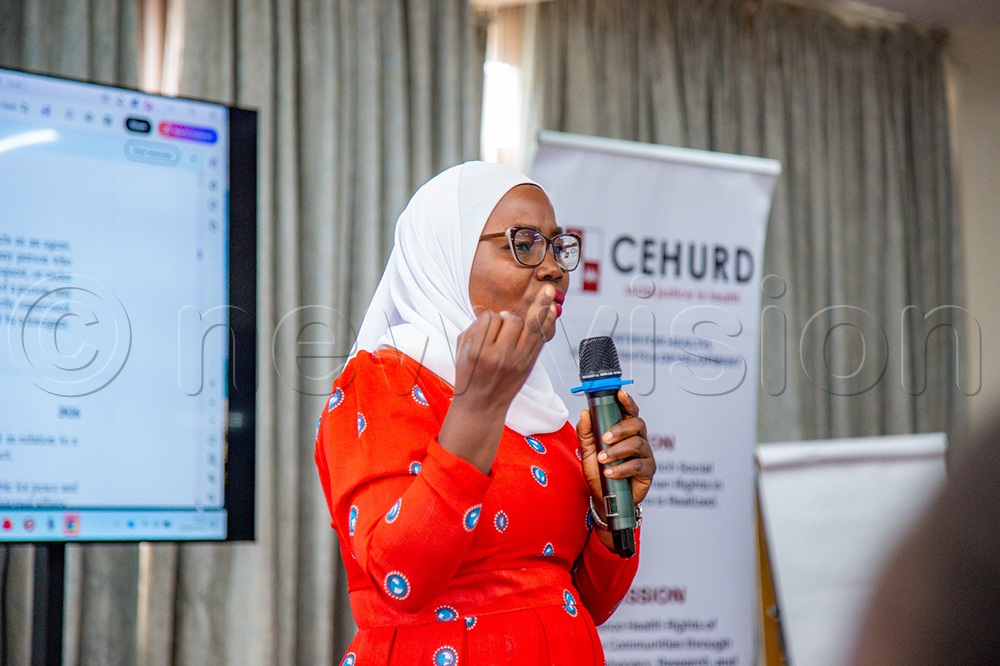
Nakibuuka highlighted that limiting entities which get foreign funding to sh400 million annually stifles the operations of many non-governmental organisations (NGOs), with the fear of the bureaucratic government systems delaying processes like renewal of company registration. (Credit: Derrick Muduku)
Nakibuuka highlighted that limiting entities which get foreign funding to sh400 million annually stifles the operations of many non-governmental organisations (NGOs), with the fear of the bureaucratic government systems delaying processes like renewal of company registration.
She said the claims of inadequate regulation of civil society are false, with the Bill inhibiting an element of duplication of laws.
“We already have the Companies Act, which makes us register with the Uganda Registration Services Bureau (URSB). We are also registered via the NGO Bureau. Now, we have a third layer of registration."
According to the civil society players, the stiff fines for breach of the Bill, like a payment of sh4 billion and a prison sentence of up to 20 years, will lead to automatic closure of many NGOs.
The CSOs are looking forward to going to Parliament and addressing their issues directly to legislators.