
Sh92.5m funding to boost gender-responsive climate action
UN Women Country Representative, Dr Paulina Chiwangu, said the deal represents a shared commitment to ensure Uganda’s climate laws, budgets, and oversight mechanisms reflect the realities and leadership of women and girls.
A key focus of the partnership is ensuring that climate financing translates into tangible results at community level.
KAMPALA - Despite growing climate financing commitments, many Ugandan women remain cut off from the benefits, prompting UN Women to commit Shs92.5 million to strengthen gender-responsive climate action.
The funding, announced on March 17, 2026, during the signing of a Memorandum of Understanding (MoU) between UN Women and the Parliamentary Forum on Care and Climate in Naguru at the UN Women offices, is expected to strengthen climate financing oversight, data systems, and grassroots interventions targeting women most affected by climate shocks.
The support, equivalent to about $25,000 from UN Women headquarters, alongside additional backing from its regional office, will fund technical work, training of Members of Parliament, and coordination of stakeholders in advancing gender-sensitive climate policies.
UN Women Country Representative, Dr Paulina Chiwangu, said the deal represents a shared commitment to ensure Uganda’s climate laws, budgets, and oversight mechanisms reflect the realities and leadership of women and girls.
Chiwangu noted that climate change impacts are far from gender-neutral, with women disproportionately affected through food insecurity, displacement, and increased unpaid care work.
“When we lose livelihoods, women are impacted more than anybody else. We are seeing high levels of food insecurity, and women and girls are the most affected,” she elaborated.
“Climate shocks also increase unpaid care work, heighten risks of violence and disrupt girls’ education.”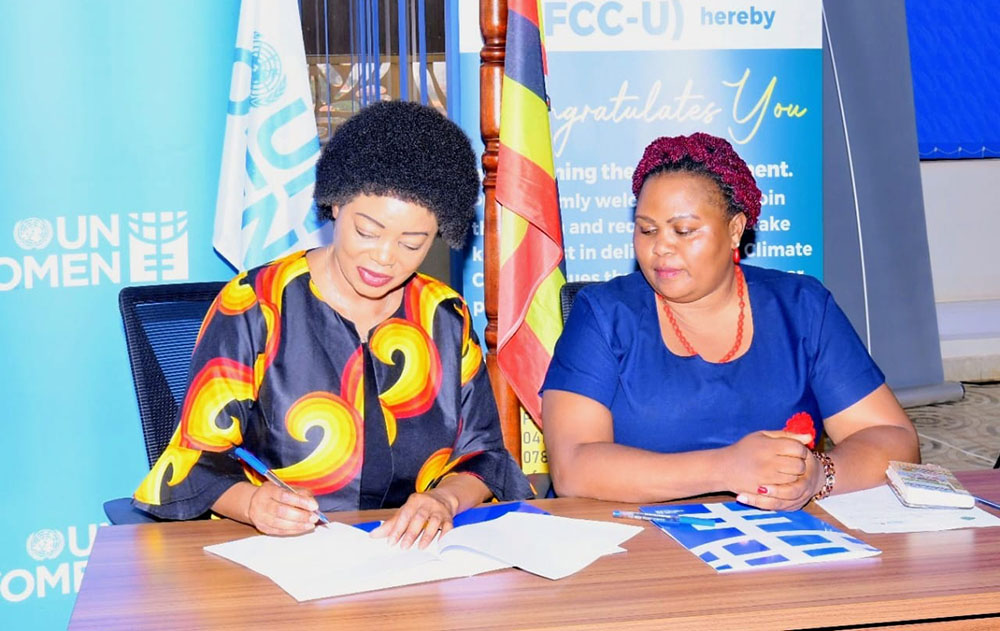
UN Women Country Representative signs the deal as Christine Nakimwero looks on.
Tracking the money
A key focus of the partnership is ensuring that climate financing translates into tangible results at community level.
UN Women Deputy Country Representative Adekemi Ndieli said the organisation will support Parliament to track climate-related budgets and commitments.
“We keep hearing about climate financing, but we’re not seeing tangible results in the lives of women and girls,” she noted.
“It will be about identifying where government has committed resources and whether those resources are reaching where they should.”
Ndieli further stressed that tools for budget tracking and technical support will help Parliament strengthen oversight and improve climate mitigation and adaptation at community level, especially in vulnerable regions like Karamoja.
Data and grassroots voices
Part of the funding will also go towards strengthening data systems through initiatives such as citizen-generated data, where communities use mobile phones to report climate impacts.
Yusrah Kuteesa Nagujja, a Programme Specialist at UN Women, said the initiative will support the collection of sex- and age-disaggregated data and the development of policy briefs to guide decision-making.
“The priority will include training MPs to integrate gender into climate legislation, budgeting and oversight, as well as coordinating a technical working group that brings together government, civil society and development partners,” she said.
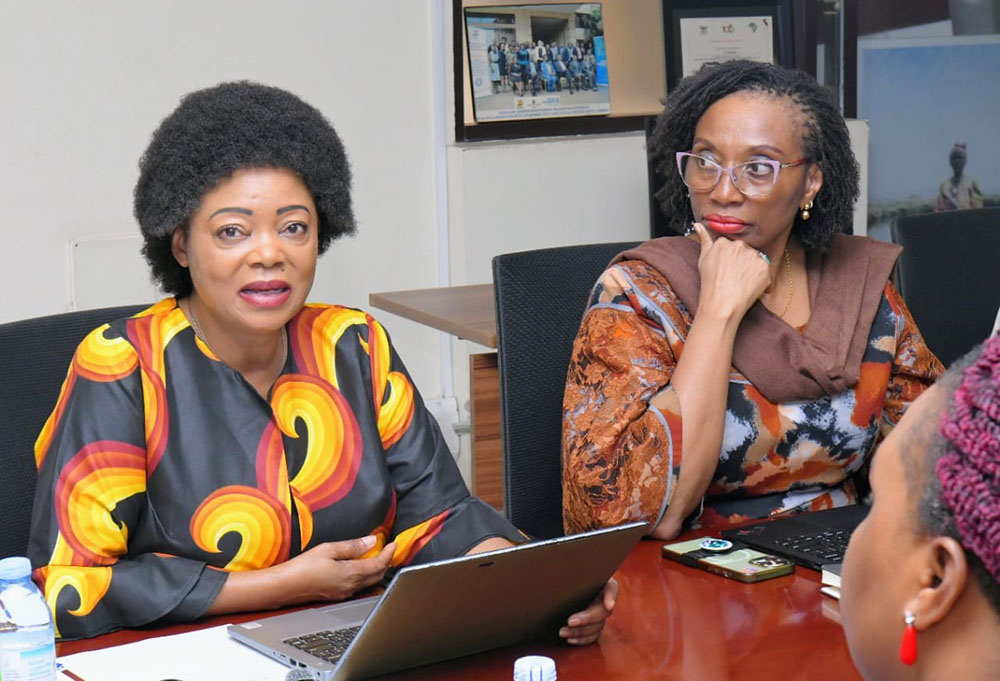
UN Women country representative with her deputy.
Parliament steps in
Leaders in the Parliamentary Forum on Climate Change welcomed the partnership, saying it provides a critical platform to bridge information gaps and push for increased funding.
Forum chairperson Christine Nakimwero said MPs will play a key role in translating climate and gender policies into local languages to help communities understand and participate in implementation.
“As members of Parliament, we must simplify these strategies and ensure communities appreciate the urgency so that they can prioritise them in budgeting and planning,” she said.
Bungokho North MP Dr John Magolo described the partnership as an opportunity to amplify awareness and drive resource allocation.
“Awareness is knowledge. When we narrow the information gap, resources will follow to address the needs,” he said.
Meanwhile, Michael Ayepa, MP-elect for Labwor, said Parliament’s roles of oversight, appropriation, and legislation will be critical in integrating gender concerns into climate action.
Why this deal matters
Uganda has in recent weeks experienced floods, landslides, and erratic rainfall, clear signs of intensifying climate stress.
Experts warn that without deliberate inclusion of women in climate strategies, response efforts risk falling short.
“Uganda cannot build lasting climate resilience without centering women’s rights, agency and leadership,” Chiwangu emphasised.
With fresh funding now on the table and Parliament drawn into closer collaboration, the success of the initiative will largely depend on whether the money is tracked, targeted, and felt where it matters most, at the grassroots.