
‘Sh2.1 trillion World Bank-funded Greater Kampala Road projects at 90% Completion’
The Undersecretary at the Ministry of Kampala Capital City and Metropolitan Affairs, Monica Edemachu Ejua, said the flagship road projects were advancing at a satisfactory pace and would largely be completed on schedule.
Minister in charge of Kampala, Minsa Kabanda (C), led the ministry’s team during a multi-site oversight tour by Parliament’s Committee on Presidential Affairs. The delegation assessed the implementation, value for money, and community impact of the $566 million (about Sh2.1 trillion) GKMA-UDP projects.
Major infrastructure works under the World Bank-funded Greater Kampala Metropolitan Area Urban Development Programme (GKMA-UDP) are nearing completion, with several key road projects in Mukono and Kira municipalities now between 80 and 90 percent complete, officials said Friday.
The progress was revealed during a multi-site oversight tour on Friday by Parliament’s Committee on Presidential Affairs, which assessed the implementation, value for money and community impact of the $566 million (about sh2.1 trillion) programme.
The Undersecretary at the Ministry of Kampala Capital City and Metropolitan Affairs, Monica Edemachu Ejua, said the flagship road projects were advancing at a satisfactory pace and would largely be completed on schedule.
“We are not doing badly. So far, the progress is good,” Ejua said, noting that Cathedral Rise Road, Anthony Kame and Nabuti Roads in Mukono have reached between 80 and 90 percent completion and will not require contract extensions.
She acknowledged that Seeta–Bajjo–Nakabago Road had experienced minor delays but stressed that these would not significantly affect the overall project timeline.
“We are likely to have a small delay on Seeta–Bajjo–Nakabago Road, but it will not be so much. I believe we will move well with the work,” Ejua said.
In Mukono Municipality, the officer in charge of environment, George Masengere, Masengere said the municipality received Sh749 million in the first year under the Integrated Support Grant (ISG), followed by Sh3.9 billion in the second year, and is currently implementing works worth about Shs3.7 billion under the Metropolitan Program Grant (MPG), which is funding major road construction.
“The funding has enabled us to implement flagship road projects and maintain steady progress across the municipality,” Masengere said.
He noted that stakeholder engagement has played a critical role in facilitating project implementation, particularly in securing right of way.
“We engaged stakeholders to accept and provide the right of way, and our community and staff have supported the project to proceed smoothly,” Masengere said, commending institutions such as the Church of Uganda for their cooperation.
On environmental management, Masengere said the municipality is prioritising mitigation of risks associated with land acquisition, vegetation clearance, storm water management, waste disposal, noise, vibration and occupational health and safety.
“Our focus has been on protection, restoration and reducing risks to communities, workers and existing utilities,” he said.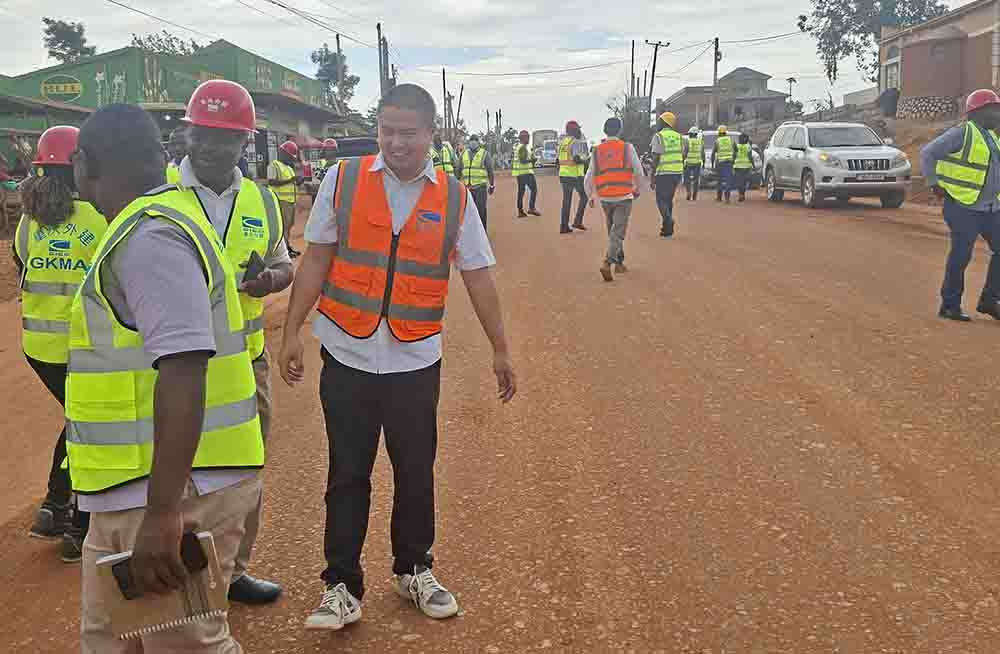
Masengere acknowledged that a few safety incidents have occurred during construction, but said corrective measures have been strengthened to improve site safety.
He added that stabilised sections of the roads are already undergoing landscaping and vegetation restoration, while workers, including traffic flaggers, have received specialised safety training to minimise accidents.
Masengere acknowledged that a few safety incidents have occurred during construction, but said corrective measures have been strengthened to improve site safety.
“We have improved our monitoring and collaboration with the ministry to address environmental and safety concerns,” he said.
A key highlight of the project, according to Members of Parliament, has been the smooth acquisition of land, which has avoided the prolonged compensation disputes that often delay infrastructure projects in Uganda.
The chairperson of the Parliamentary Committee on Presidential Affairs, Alex Byarugaba, praised residents and local leaders in Wakiso, Mukono and Kira for voluntarily giving up small portions of land to allow road expansion without demanding compensation.
“The local leaders went out of their way to convince landowners that their land would have no value if the roads remained dusty and impassable. The people bought into this,” Byarugaba said, describing the gesture as an act of patriotism that should be emulated nationwide.
He said government had identified about 25 properties that are acutely affected by the works and will require compensation, adding that the total bill is estimated not to exceed sh20 billion.
“It is not a lot of money for the entire project, and it is something government can manage,” Byarugaba said.
Contractors, including China Communications Construction Company (CCCC) and Stirling, are also implementing measures to manage noise, vibration and occupational health and safety risks.
The GKMA-UDP aims to ease traffic congestion, reduce travel times and improve living standards for residents across the Greater Kampala Metropolitan Area through upgraded road networks, drainage systems and urban infrastructure.