
SEATINI wants EAC investment treaty reviewed to safeguard workers’ rights
“We have Members of Parliament representing workers but the issue of minimum wage didn’t pass through in Parliament. And our minimum wage in Uganda is shillings 6,000 per month. The dollar rate is shillings 3,500. So, it is less than $2,” Nalunga added.
An EALA MP raising a point as Amongin looks on. (Credit: Dedan Kimathi)
Fatuma Ndangiza addressing journalists on Monday. (Credit: Dedan Kimathi)
The race to woo investors is eroding human rights standards, New Vision Online has heard.
“The way we are handling our FDI [foreign direct investment], our investments are not really good. I agree with an honourable who said it cuts across for labour rights for men and women. But for women, it is our bodies on the line. So, it makes it worse. What a man suffers, a woman suffers even more than double,” Southern and Eastern Africa Trade, Information and Negotiations Institute (SEATINI–Uganda) executive director Jane Nalunga says.
Officials from SEATINI–Uganda, led by Nalunga, sounded this warning on December 4, 2025, during a policy dialogue with the East African Legislative Assembly (EALA) Women Caucus at the Uganda Parliament’s Conference Hall in Kampala city.
Statistics
According to the United Nations Conference on Trade and Development (UNCTAD) 2020 World Investment Report, FDI into Uganda, Kenya and Tanzania rose by 11.2 per cent in a five-year period commencing 2014.
Increasing from $3.296 billion (about shillings 11.95 trillion) in 2014 to $3.710 billion (about shillings 13.49 trillion) in 2019.
While this expansion has created employment, particularly in tea plantations, flower farms and other land-based investments, SEATINI, in its concept paper, noted that women employed in these sectors were bearing the brunt of labour and human-rights abuses.
Many of these, it said, are hired as permanent casuals, are often denied job security, protective equipment, maternity protections and access to social benefits. Additionally, they are disproportionately exposed to sexual harassment and wage discrimination, among others.
“We have seen the casualisation of labour. The company is formal, but they don’t give contracts; they give per day. So, it’s formal sector, but there is informalisation. You don’t go on leave; you don’t have maternity and annual leave. When you fall sick, you don’t earn, yet it is a formal sector,” she said.
Weak trade unions
Worse still, she noted that trade unions are weak and have increasingly become politicised, causing them to lose sight of the grand prize.
“We have Members of Parliament representing workers but the issue of minimum wage didn’t pass through in Parliament. And our minimum wage in Uganda is shillings 6,000 per month. The dollar rate is shillings 3,500. So, it is less than $2,” Nalunga added.
EAC Investment treaty
Fast forward to mitigate the above maladies, Nalunga urged the eight East African Community (EAC) member states: Somalia, Uganda, Kenya, South Sudan, Democratic Republic of Congo (DRC), Burundi, Tanzania and Rwanda to take a leaf out of South Africa's book.
“One of our expectations, apart from raising awareness, is for you, the Members of Parliament, to reconsider reviewing the EAC model investment treaty. To look at the gaps and amend them and also ensure that it becomes binding on all partner states,” Nalunga implored.
According to SEATINI–Uganda programmes manager Herbert Kafeero, the current EAC Investment Model Treaty is voluntary, and there is a need to make it mandatory.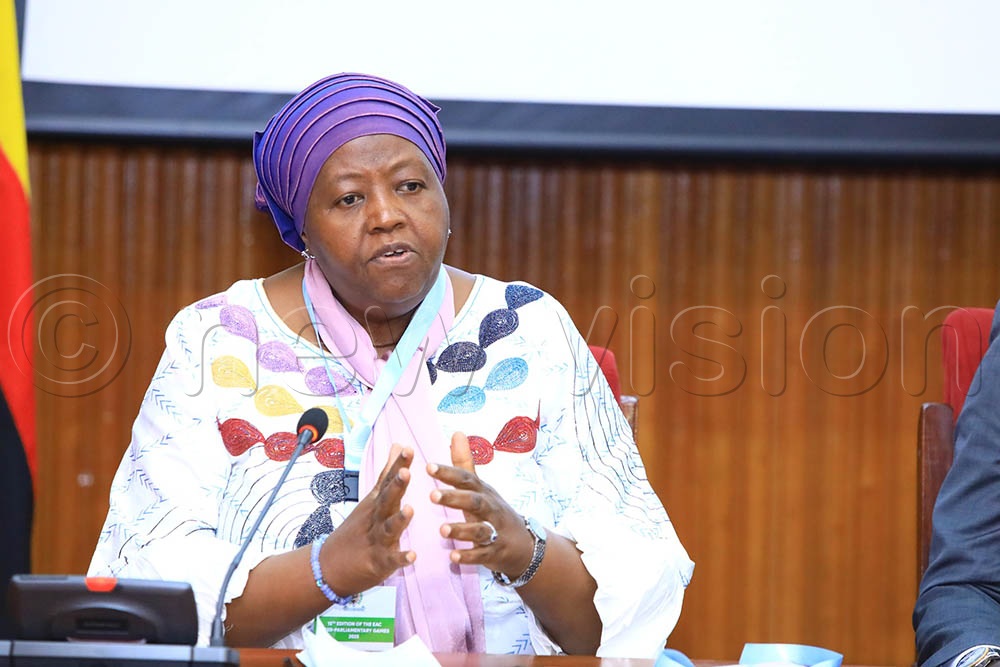
“We need to look at this as EAC, we join efforts in having a greater bargain as we attract investors, so that we are not selling our people cheaply as casual workers. But rather, negotiating to ensure that some rewarding jobs can be taken up by our people. Because it is not a question of education. I think it is a question of choice,” Kafeero said.
Amb. Fatuma Ndangiza, who was standing in for Francine Rutazana, the chairperson of EALA’s committee on communication, trade and investment (CTI), lauded the presenters.
She, however, noted that further engagement would be needed on the issue of reviewing the treaty.
“We need to consult with those members, and CTI, of course, should take a lead in collaboration with the other standing committees of the EALA. But also, the EALA Women Caucus to ensure that the gender perspective and the rights of women are also taken care of. But also brought on the experience of the SADC countries, especially South Africa, that are doing well in this area, especially on the issue of decent jobs for their people, but also the human rights approach,” Ndangiza said.
Most importantly, she noted a clear correlation between vulnerability and gender-based discrimination. A phenomenon, Ndangiza says, has been exacerbated by structural stereotypes and patriarchy.
“Because every time you see a woman, why should you feel that this person is a sexual object and I have to touch. You know, we have just become like an attraction," she added.
"Don't even think it is only uneducated or vulnerable women. Even these high-level women, classy women, today we are in the area of investment. But I am sure even when you open in politics, there are some who have to leave these positions because they have to do something,” Ndangiza added.
EALA MPs speak out
Uganda’s representative, Jacqueline Amongin, lauded the move as timely, noting that many companies in the region are multinational. And yet workers often have nowhere to turn in cases of rights violations.
“We have investors who are having businesses across East Africa, MTN, Roofings and all that. What if there is a violation? How are our people protected? Most people have gone silent. I remember in our previous parliament in Uganda here, we had a case of a woman who was sexually harassed,” Amongin said.
Mary Mugyenyi called for the domestication of international labour laws and instruments to which member states are signatories.
“Because in Sweden, you will find that the labour rights are generally observed. First of all, the laws are in place, the protections are there, and the minimum wage is in place. You can go to court, take on an employer and easily get compensated. Which in the East African region cannot easily happen,” Mugyenyi said.