
Property worth millions destroyed in Katwe market fire
Twaha Mutebi, a 50-year-old trader, said the fire started from two old electric poles. He explained that around midnight flames began slowly on the poles before they fell onto one of the kiosks, which caught fire and spread rapidly to other parts of the market.
Racheal Kawala, the Kampala Metropolitan Police spokesperson, said investigations are ongoing to establish the exact cause of the fire. (Photos by Badru Mugenyi)
________________
Frustration, anguish and hopelessness are words that best describe what traders at Katwe Market are currently going through. At midnight, when most people were asleep, the market was gutted by a devastating fire that destroyed property worth millions of shillings.
On the evening of Sunday, March 15, 2026, Aminah Namanda, a mother of four, left the market exhausted, expecting to return the next day to continue selling. Instead, she was shocked by the news that a raging fire had engulfed the market.
Namanda deals in herbal medicine and had brought in new stock that day. Crying and throwing her hands in the air, she told this publication that of the sh10m she had left in her lockup, she managed to rescue only sh3000.
“When the fire started, I was notified, so I ran quickly to pick up my money. The fire was burning in flames, and I only picked up sh3000 in coins; the notes were burnt to ashes,” she said while tears rolled down her cheeks.
Namanda has been trading in Katwe Market for eight years. She started modestly and later grew into one of the well-known herbal dealers in the market. She now wonders how she will repay the loans she acquired from different banks.
“Is there anyone who can help me? Please come and rescue me, I will soon be arrested,” she cried for help.
Namanda is not the only trader who suffered losses in the Katwe Market fire. Hundreds of traders lost property worth millions of shillings. Farouq Wasswa Luyimbazi, an electrical dealer, also lost valuable stock. He said one of the electric stabilisers that burnt was worth sh20m.
“I had about 10 of these, electric cookers, and many more. I had just got the stock from an Indian, moreover, on credit. How am I going to pay back?” he asked.
Origin of the fire
Twaha Mutebi, a 50-year-old trader, said the fire started from two old electric poles. He explained that around midnight flames began slowly on the poles before they fell onto one of the kiosks, which caught fire and spread rapidly to other parts of the market.
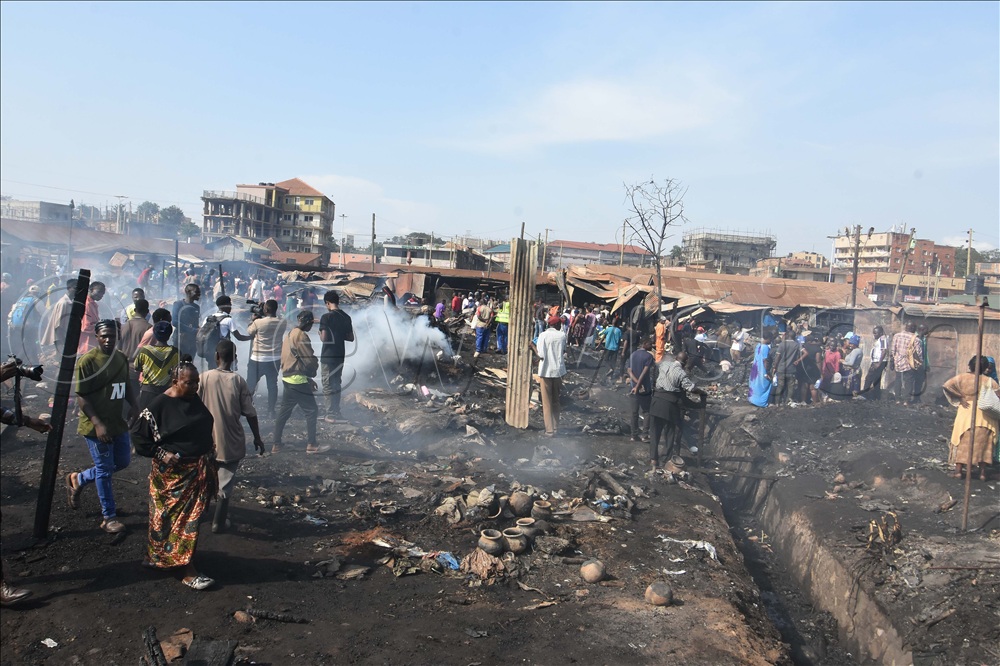
Much of Katwe Market was burnt to ashes. The remaining items were mostly metallic materials, now reduced to scrap. Traders dealing in food items, charcoal, local herbs, electrical appliances and sorcery items lost almost everything.
It is also reported that when the fire broke out, some traders rushed to the market to save their property. However, the market guard had already closed the gate and initially did not allow them to enter.
Abdul Hakim, a fishmonger, said the guard delayed opening the gate because he feared that robbers might take advantage of the chaos to loot traders’ goods.
“The guard thought that by opening the gate he would give access to looters,” Hakim said.
Ssenkungu Levis, the chairman of traders at Katwe Market, commended the guard’s actions, saying he was trying to prevent looting. However, he added that by the time access was allowed, much of the property had already been destroyed by the fire.
Levis also noted that although the fire brigade arrived in time, they faced challenges accessing the market because the road leading to it is too narrow.
“Even when the market is burnt to ashes, soon we shall start rebuilding again and start our businesses as usual. So, we welcome well-wishers to come and help,” he said.
Sarah Mukisa, the lord woman councillor for Makindye West, said the road leading to the market should be widened and the government should invest more in the fire brigade department. She noted that fires in markets and workshops have increasingly become a major threat to people’s businesses.
Mukisa suggested that Uganda could learn from countries such as China that use modern technology, including drones, to fight fires.
Zahara Luyirika, the Member of Parliament-elect for Makindye East, also visited the affected market. She observed that most of the structures had been burnt to ashes, and little could be salvaged. She urged the government to intervene and help traders who are struggling with loans.
Many traders told the legislator that they operate their businesses using bank loans and fear arrest if they fail to repay them.
Luyirika said there is a need to sensitise traders on how to handle fire outbreaks whenever they occur.
Police speak out
Racheal Kawala, the Kampala Metropolitan Police spokesperson, said investigations are ongoing to establish the exact cause of the fire. By press time, more police officers had been deployed at the scene.
Katwe Market is one of the oldest traditional markets in Kampala. It was established in 1937 during the British colonial period to organise trade in the rapidly growing town. The land was donated by the late Sir Edward Muteesa.
At the time, Kampala’s population was increasing, and authorities established several markets to provide organised spaces where traders could sell goods and residents could easily buy food and other necessities.
Initially, Katwe Market mainly served the meat trade in the area. Farmers and traders brought livestock products such as beef and other fresh foods to the market for sale. The market was built on a relatively small piece of land of about four acres, but quickly became an important trading centre for people living in the southern parts of Kampala.
As the city expanded in the 1940s and 1950s, the market also grew. Traders began selling a wider variety of goods, including fresh produce, grains, household items and other daily necessities. The market attracted many small-scale traders and helped stimulate economic activity in the surrounding Katwe area.