
News
Private security firms decry 'overregulation and high taxation'
Industry players cited multiple levies, licensing requirements and operational costs, which they said have made it increasingly difficult to sustain businesses and improve the welfare of private security guards.
Moses Byaruhanga, Senior Presidential Advisor in charge of Political Mobilisation, addressing members of the Private Security Service Savings and Credit Co-operative Society (SACCO) at Kitante Primary school in Kampala, Saturday, Jan. 3, 2026. (Photo by Wilfred Sanya)
By: Rhyman Agaba, Journalists @New Vision
____________________
Private security companies in Uganda have stated that excessive regulation and high taxation are harming their industry, which employs over 100,000 Ugandans, the majority of whom are low-income earners.
They raised the concerns on Saturday (January 3) during a meeting of private security service providers held at Kitante Primary School in Kampala, attended by company directors, senior officers, security guards and government officials.
Industry players cited multiple levies, licensing requirements and operational costs, which they said have made it increasingly difficult to sustain businesses and improve the welfare of private security guards.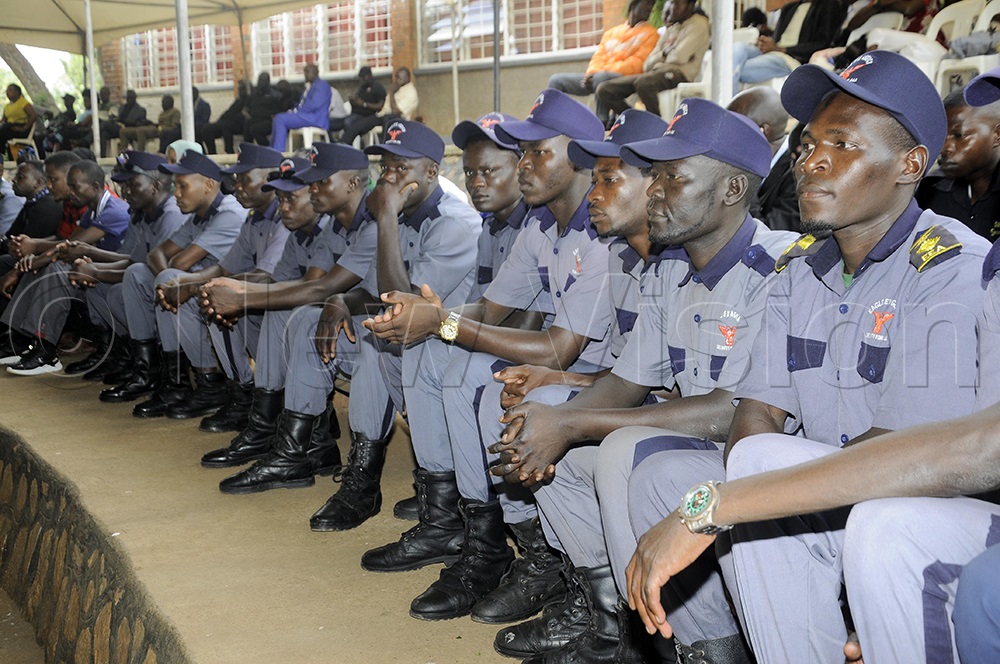
(Photo by Wilfred Sanya)
The meeting was organised by State House officials and was graced by Moses Byaruhanga, the President’s senior adviser on political affairs, who represented President Yoweri Museveni as the chief guest.
Byaruhanga acknowledged the sector’s complaints, stating that the government was reviewing certain taxes and charges imposed on private security firms and guards.
“There are issues that have been raised regarding taxes and regulation, and the government will look into them. If there are unnecessary charges, they should be removed," he said.
Among the contentious issues raised was an alleged 5,000 shilling monthly charge per guard reportedly levied by Kampala Capital City Authority (KCCA), in addition to other costs related to firearms licensing and vehicles used to transport guards.
“When I asked about this charge, even the technical people present said they were not aware of it. If it is true, such a tax is really useless, and it should go.”
He added that the government would also examine the levies imposed on firearms and operational vehicles to ensure that private security firms are not unfairly burdened.
'Small and insignificant'
The private security industry is one of the most regulated sectors in Uganda, with companies required to comply with licensing, training, firearms control and labour regulations, while also paying multiple taxes and fees.
Several company directors said the regulatory environment has contributed to low wages for guards, as firms struggle to balance compliance costs with payroll obligations.
“This sector employs over 100,000 people, but it is treated as if it is small and insignificant,” said David Alex Tabaro, an administrator at Ureka Security and chairperson of the Private Security Service Providers (PSSP) SACCO.
“When regulation and taxation are too heavy, the burden is eventually transferred to the guard, who earns very little,” he said.
Tabaro emphasised the need for reforms that allow firms to operate sustainably while improving guards’ welfare through alternative income opportunities such as SACCOs.
'Not realistic'
Peter Kiswabuli, director of ECCOZ Security Company, said most guards earn between 200,000 and 300,000 shillings per month, making it difficult for them to save or invest meaningfully.
“With the current level of regulation and taxation, companies cannot increase salaries significantly. Yet the guard is expected to survive, educate children and build a future.
“It is not realistic to expect someone earning 200,000 shillings to save millions without support."
Responding to the claims of excessive taxation, KCCA deputy director Benon Kigenyi clarified that the authority only collects taxes that are legally mandated.
“KCCA collects taxes as an authority, and the taxes we collect are well known. Private security organisations pay for trading licences because they are businesses."
Kigenyi explained that companies owning property may be charged property rates, but dismissed claims that KCCA levies gun-related taxes or charges vehicles transporting guards.
“The other taxes mentioned, such as gun-related taxes or charges on vehicles, are not collectable by KCCA,” he told New Vision.
Much-needed shot in the arm
Despite the concerns, the government used the meeting to signal possible relief for the sector. Byaruhanga announced that President Museveni had pledged between one and two billion shillings to support a SACCO for private security guards.
The funds, he said, are part of the ruling National Resistance Movement (NRM) manifesto commitment to expand the Emyooga wealth creation programme to include private security guards.
“We said in our manifesto that among the Emyooga groups, we shall add one for private security guards. “The money will be processed and disbursed following the required principles.”
Under the proposed arrangement, either the guard or their spouse would be able to access loans from the SACCO to start small businesses and supplement household incomes.
Grace Matsiko, chairperson of the Uganda Private Security Association (TUPSA), said while the government pledge was welcome, long-term reforms were needed to stabilise the sector.
He said high staff turnover remains a major challenge, as many guards leave the industry in search of better-paying opportunities.
“If regulation and taxation are streamlined, companies will be able to retain workers and improve conditions."
Matsiko said strengthening internal financing mechanisms such as SACCOs would help make the sector more self-reliant.
Private security firms represented at the meeting included G4S, Pinnacle Security, Tiger Security, 7 Guardian Security, Askar Security Services, Cyclops Defence Systems, Arrow Security, Falcon Security Group, Tight Security, Rangers Security, APS Protective Services, Able Security, Ureka Security, Absolute Guard Services, Ultimate Security and the Bouncers Association of Uganda.