
'Prioritise local engineers to manage water and sanitation challenges'
National Water and Sewerage Corporation (NWSC) managing director Eng. Silver Mugisha says in terms of human resource, Uganda has its own capacity to handle its water, sanitation and hygiene challenges
Dr Felix Twinomucunguzi, Assistant Commissioner Sewerage Services Division, Catherine Nassuna, Under Secretary of Finance and Administration, Beatrice Anywar, State Minister for Environment, Eng Silver Mugisha, NWSC managing Director pose for a photo during the inaugural Uganda Annual Water Utilities-Regulator’s conference. (Photo by Juliet Kasirye)
___________________
Instead of spending a lot of money on hiring consultants, importing IT solutions, development partners have been asked to give local engineers a chance to manage water and sanitation challenges.
National Water and Sewerage Corporation (NWSC) managing director Eng. Silver Mugisha says in terms of human resource, Uganda has its own capacity to handle its water, sanitation and hygiene challenges and that all the information technology (IT) solutions they have at NWSC were created by local engineers.
Uganda's approach or thinking, according to Mugisha, should be that if the Chinese can develop a solution, why not Ugandans?
“We all go to the same schools to study these things. Why should we think that someone else must develop these solutions, not ourselves? The only solution that we imported from South Africa was a financial management system, and we are 95% complete as far as that system is concerned,” Mugisha says.
Besides the financial management system, Mugisha emphasised that, they shall never rely on an imported system because when they were hacked two years ago, they were not threatened as the people who had built those systems were internal and it was easy to come back into service within 24 hours.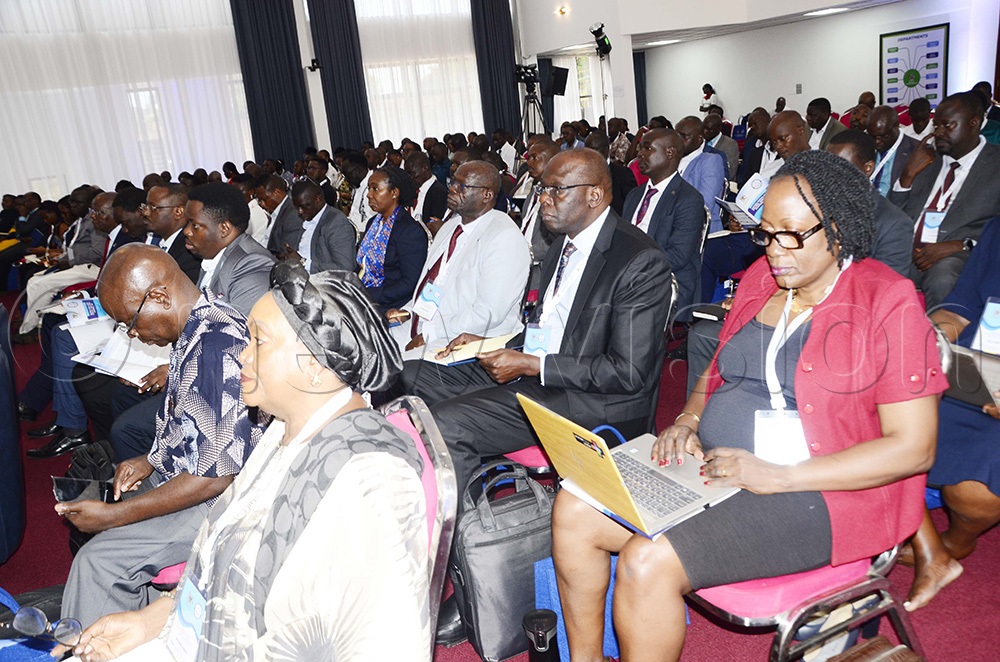
Across section of participants during the inaugural Uganda Annual Water Utilities-Regulator’s conference at the Water ministry headquarters in Luzira on 8th December 2025. (Photo by Juliet Kasirye)
“So, even if all logs had been destroyed, we would still have created them in a very short time. Some of you have not been hacked. If you are hacked and all systems are imported, you will really see business discontinuity at a glance,” explained Mugisha.
Additionally, Mugisha said, “Even its financing itself, as long as we address the inefficiencies we have in our activities, for example, by digitalising all the business processes, we should be able to generate our own money, be able to go to the market finance, get money, and be able to pay back.”
He made the remarks while giving a keynote address during the inaugural Uganda Annual Water Utilities Regulator’s conference organised by the Water Utility Regulation Department at the Water ministry headquarters in Luzira, Kampala city, on December 8, 2025.
The three-day conference is being held under the theme: Accelerating Inclusive and Resilient water and sanitation services for sustainable development.
The conference that has attracted heads of regional regulatory bodies, representatives of development partners, heads of water utilities from across Africa, diplomats, permanent secretaries present and their representatives, heads of agencies and departments of government, private sector partners, academia focused on reviewing the performance of regulated utilities and also agree on practical undertakings and regulatory priorities.
Mugisha said, the effectiveness of a regulator is seen from the performance of the sector. Before 2010, he noted that national water had relatively low service coverage, limited financial sustainability, weak infrastructure, low automation, and minimum customer centricity.
However, from 2010 to 2025, they have had deliberate transformation driven by efficiency, innovation, expansion, and commercial viability, attributing their service coverage growth to internal financing and operational efficiency.
Environment state minister Beatrice Anywar said this year’s theme is a direct reflection of the Government’s commitment that water is a driver of growth, health, and dignity for all.
“As Uganda prepares for the 2026 General Election, this sector remains a testament to stability, planning and results. Under the leadership of President Yoweri Kaguta Museveni, water is not a promise, it is a measurable, deliverable right.” Anywar stated.
Challenges
During the meeting, the acting commissioner for water at the utility regulation department, Dr Frank Kweronda, expressed concern about the inconsistency in utilities’ performance data.
Although reliable data is the backbone of effective regulation, Kweronda said, without integrity in reporting, their planning, monitoring, and decision-making becomes compromised.
“As a department, we will intensify efforts to improve data collection, verification, and digital reporting systems to ensure accuracy, transparency, and accountability across all water utilities.” Kweronda told utilities.
On the issue of sanitation, Kweronda revealed that they continue to face systemic limitations. The sewer network coverage in most urban areas remains extremely low, with over 95% of the customers relying on non-sewered sanitation technologies such as pit latrines and septic tanks.
Though these systems play a critical role, they remain largely unmonitored, insufficiently regulated, and poorly integrated into utility planning.
“As regulators, we must prioritise baseline assessments, develop robust sanitation service standards, and champion a holistic planning and management approach that brings both sewered and non-sewered sanitation into a unified regulatory framework.” Kweronda concluded.