
Pokot elders to develop cultural guidelines on tackling gender violence
“We believe these interventions will boost resilience and confidence in the justice system,” Kimani observed, adding that traditions were never meant to harm women and children.
Elderly Pokot women during the launch of the global survivor network at Hotel Africana Moroto. (Credit: Olandason Wanyama)
KARAMOJA - Efforts to tackle gender-based violence in Karamoja are increasingly turning to cultural leaders, with plans underway to develop community guidelines that separate issues traditionally handled by elders from criminal offences that must be dealt with through the formal justice system.
The move is expected to strengthen accountability in communities while addressing harmful cultural practices that expose women and children to violence.
Speaking on May 6, 2026, at Hotel Africana during the launch of the Global Survivor Network Karamoja chapter, the country director for International Justice Mission (IJM) Uganda, Wamaitha Kimani, said they had embarked on engaging Pokot elders to develop gender and family guidelines.
She said the initiative will help define issues that can be resolved culturally, while others will be referred to the formal justice system, specifically cases involving defilement and domestic violence.
The sub-region now joins an international network of survivors advocating for justice for vulnerable people affected by violence.
So far, the Karamoja chapter joins counterparts in the Uganda Survivor Network, also known as “The Voice.”
The nationwide movement has different local chapters launched over the past few years, including Kasese for the western region, Gulu for northern Uganda and Tororo for eastern Uganda.
Other chapters include Kampala, which was launched last week, and now Karamoja.
“The guidelines will help promote positive cultural practices,” Kimani said, adding that they will also identify harmful practices that place women at risk of violence.
However, Kimani noted that IJM has focused on interventions aimed at bringing justice closer to communities.
She added that court open days, mobile courts, police engagements and community dialogues have been conducted.
“We believe these interventions will boost resilience and confidence in the justice system,” Kimani observed, adding that traditions were never meant to harm women and children.
“So let’s use culture to promote accountability and strengthen pathways to justice,” she noted.
Kimani expressed optimism that working together as leaders, elders, communities, law enforcement agencies, partners and survivors would help build a Karamoja where families are safe, children are protected, and justice is accessible to all.
Survivor network
Speaking at the same event, Samuel Lokong, the assistant chief administrative officer, said he was pleased that IJM was launching a solution while identifying a problem.
“For too long, we designed programmes for survivors without their participation,” he noted, adding that child marriage, female genital mutilation, defilement and impunity were issues overwhelming the sub-region, especially Moroto.
Lokong said he was hopeful that the network would help heal Karamoja when survivors come together, adding that unhealed trauma becomes a cycle of violence.
On behalf of the district local government, he committed to lobbying for or ring-fencing sh5m in the 2026/27 financial year budget for survivor transport, medical examinations, and legal aid.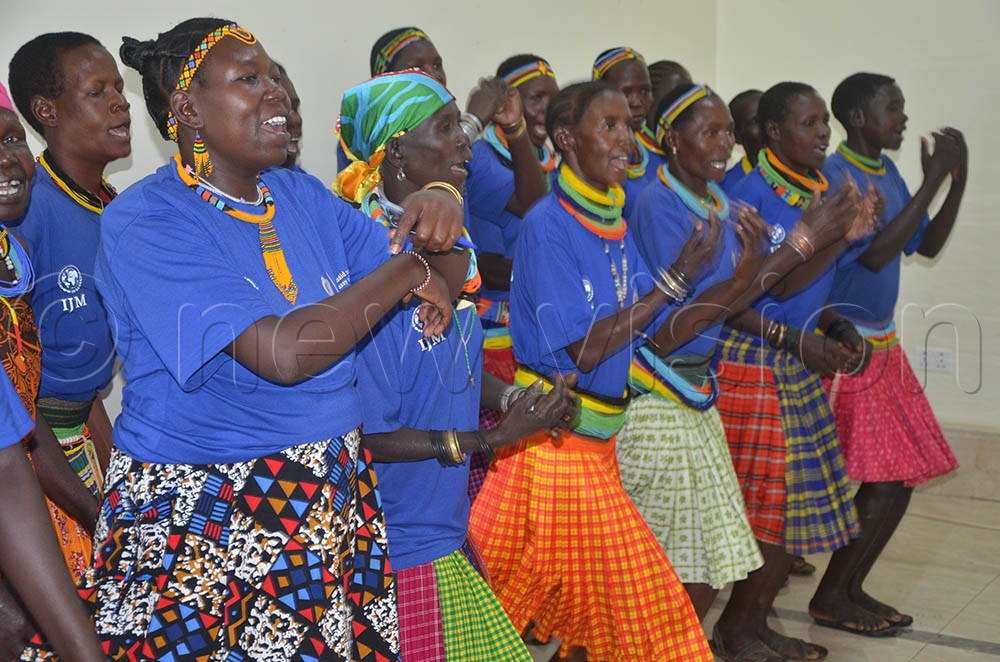
GBV survivors perform at the launch of the global survivor network at Hotel Africana in Moroto. (Credit: Olandason Wanyama)
He also pledged to support the enactment of a by-law, provide office space, establish an accountability forum and ensure staff protection, adding that whoever frustrates the efforts would be disciplined.
However, Lokong urged IJM to not only launch the network, but to continue walking with Karamoja in the fight against GBV.
“A conviction could reduce some of these offences in the sub-region,” he said, adding that the law works when enforced.
Addressing cultural leaders, Lokong said elders are custodians of culture, but if culture becomes destructive, then it is not a good belief.
He encouraged survivors to embrace the network and use it to uplift others.
“Thus, it’s a new era for Karamoja where survivors lead, and justice thrives,” Lokong said.
Survivor speaks
Alice Moru, 39, from Ejok-Kip village, Loregai subcounty in Nakapiripirit district, said life was difficult before she joined the network.
She said her husband, whom her family had opposed her marrying, became abusive.
“I was battered, but I had to stay because I did not want to abandon my children,” Moru, now a mother of eight, noted, adding that growing food for the family was difficult because all the harvest was sold to buy alcohol.
However, she said joining the survivor network helped transform her family through several dialogue sessions with her husband.
“Today he drinks only soda, and we live happily, having built a family house.”
Chief guest speaks
Presiding over the launch, Moroto resident district commissioner Benon Kwikiriza said his office would fast-track the initiative to ensure the system benefits survivors.
“We do not want to see criminal cases handled by families anymore,” he noted, adding that handling crime informally under trees is unacceptable.
Background
According to the 2024 national baseline report by IJM titled "Strengthening the Criminal Justice System, Protection of Women and Children in Uganda".
Six in 10 (55%) partnered women have experienced sexual or physical violence.
Six in 10 children (58.6%) in Uganda have experienced sexual abuse.
Sexual violence against children is three times more prevalent among girls (77%) than boys (24%).