
NSSF’s Ayota calls for coaching culture in Ugandan workplaces
“When you coach and empower your staff, they begin doing things that even you as a leader had not thought about,” Ayota said.
Patrick Ayota, the NSSF managing Director addressing stakeholders during the Imagine Me Africa coaching programme launch at Sheraton Hotel in Kampala on May 14, 2026. (Photos by Juliet Kasirye)
________________
National Social Security Fund (NSSF) Managing Director Patrick Ayota has called on Ugandan organisations to embrace coaching culture in workplaces to improve leadership, innovation and employee productivity.
Speaking during the launch of Uganda’s first internationally accredited coaching programme by Imagine Me Africa’s 12th anniversary celebrations, Ayota said many organisations still operate under outdated management systems where leaders believe they must provide all the answers instead of empowering employees to think independently.
“What we have as a gap in our leadership and management style is that people think because I’m a manager, I must come up with the answers. But you have brilliant minds around you. The problem is that you do not know how to tap into those minds,” Ayota said.
Ayota, who has led NSSF Uganda since August 2023, revealed that he initially resisted the idea of getting a coach after becoming managing director because he believed coaching was only meant for people struggling with problems.
“I thought coaching was not for me. In my mind, coaching was for everybody else. But coaching starts with the leader,” he said.
He explained that the NSSF board later convinced him to work with a coach to help him navigate the pressures and complexities of leading one of Uganda’s largest public institutions.
“There are things you face as a leader that you have never seen before. Coaching gave me somebody to think through those challenges with,” Ayota said.
According to Ayota, coaching has since become an important part of NSSF’s workplace culture, helping the organisation strengthen staff engagement, leadership development and innovation.
He pointed to the fund’s women leadership programme known as Pathfinders, which was introduced to support female employees who were struggling to rise into senior leadership despite strong performance at lower levels.
“We realised that as we moved into middle management, the number of women reduced,” he said. “So we created a space where women could encourage each other, grow together and support each other.”
Ayota said many women who participated in the programme have since been promoted into leadership positions within the fund.
He added that coaching has also helped shift the organisation from a command-and-control leadership style to a culture where workers feel empowered to contribute ideas and solutions.
Grace Mary Amule (centre) poses for a photo as Malcolm Fielles (left), Regional Director of ICF, Europe and Africa and Joan Mugenzi (right), head coach look on during Imagine Me Africa coaching programme launch at Sheraton Hotel in Kampala on May 14, 2026. 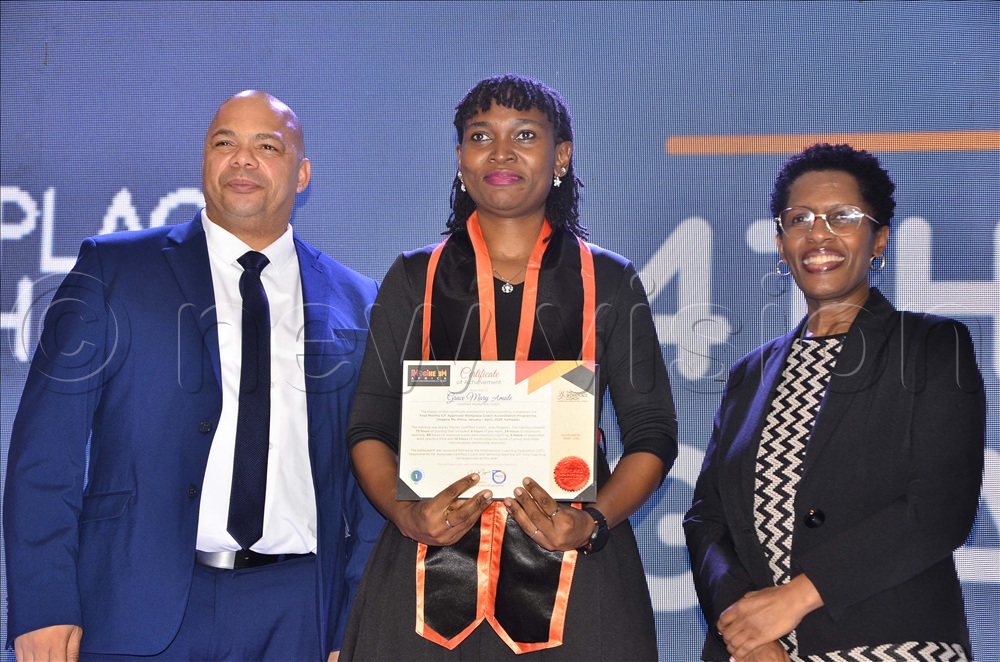
“When you coach and empower your staff, they begin doing things that even you as a leader had not thought about,” he said.
The event also marked the official launch of Uganda’s first coaching programme accredited by the International Coaching Federation. The accreditation was awarded to Imagine Me Africa, after a year-long evaluation process, making it the first Ugandan programme to receive international recognition.
Joan Mugenzi, lead coach at Imagine Me Africa, said coaching is increasingly becoming necessary in modern workplaces where employees are demanding supportive leadership and meaningful engagement.
She reported that many Ugandans, previously sought coaching certification from countries such as the United Kingdom, South Africa and Kenya because accredited programmes were unavailable locally.
“Coaching is not about telling people what to do. It is about helping people unlock solutions from within themselves. We are excited because we have now gotten the global endorsement that this is a programme anybody can trust,” Mugenzi said.
Imagine Me's journey
“It has been a year of back and forth with the International Coaching Federation. It is a very rigorous process, but we are happy Uganda now has a programme that meets international standards,” she added.
The organisation also graduated its latest cohort of coaches during the event. Since the programme began, more than 60 people have completed the training.
Mugenzi said the programme is aimed at equipping leaders, managers and professionals with coaching skills that can improve communication, productivity and workplace relationships.
“Even a home can become a workplace because parents also need meaningful conversations with their children. What we are doing is equipping people with transformative coaching skills that they can apply anywhere,” she said.
Mugenzi said Uganda still has a small number of trained professional coaches but expressed optimism that the industry would grow over the next decade.
“For us, this is the beginning. We believe coaching will become part of how organisations lead, communicate and grow their people,” she said.
Malcolm Fiddes, the Regional Director for Europe and Africa at the International Coaching Federation, who was the chief guest said Africa’s young workforce and rapidly changing work environment make coaching increasingly important for organisations.
“We are living in a world of uncertainty, burnout and rapid change. Coaching helps people navigate complexity and adapt to change,” Fiddes said.
He warned organisations against relying on untrained social media personalities posing as coaches without formal coaching education and accreditation.
“When people experience coaching, they should experience transformation, not just motivation. We are living in a world of uncertainty, burnout and rapid change. Coaching helps organisations lead through ambiguity and helps employees adapt,” Fiddes said.
He noted that globally, the International Coaching Federation has more than 60,000 credentialed coaches and is working to promote professional coaching standards worldwide.
Fiddes warned organisations against relying on untrained social media coaches without proper certification.
“When people experience coaching, they should experience transformation, not just motivation,” he said.