
New management tool to boost NGO transparency, ease service delivery
The quality assurance management tool will strengthen capacity, accountability and trust in the locally led humanitarian and development sector.
Apollo Gabazira, country director for Care International in Uganda addressing journalists during the breakfast meeting at Sheraton Hotel Kampala on April 29, 2026. (Photo by Juliet Kasirye)
___________________
To enable the Government and other stakeholders to conduct due diligence on non-government organisations (NGOs) instantly, civil society organisations (CSOs) have developed a digital tool that is expected to enhance efficiency, credibility and transparency within the humanitarian and development sector.
The quality assurance management tool will strengthen capacity, accountability and trust in the locally led humanitarian and development sector.
According to CSOs, QuAMPlus, a national passporting system, will advance the civil society’s journey toward a national framework for sustainable localisation.
Previously, for NGOs to secure funding, the country director for Care International in Uganda, Apollo Gabazira, said, stakeholders did a due diligence on NGOs and CSOs' systems, finance, human resources, and IT programs manually.
Working with stakeholders, Gabazira said, “We have developed a due diligence process called QuAMPlus. We have put it online, digitised it, and tapped into the power of artificial intelligence. Someone who needs a due diligence assessment will go online and do that in minutes, instead of hours, weeks, among others.”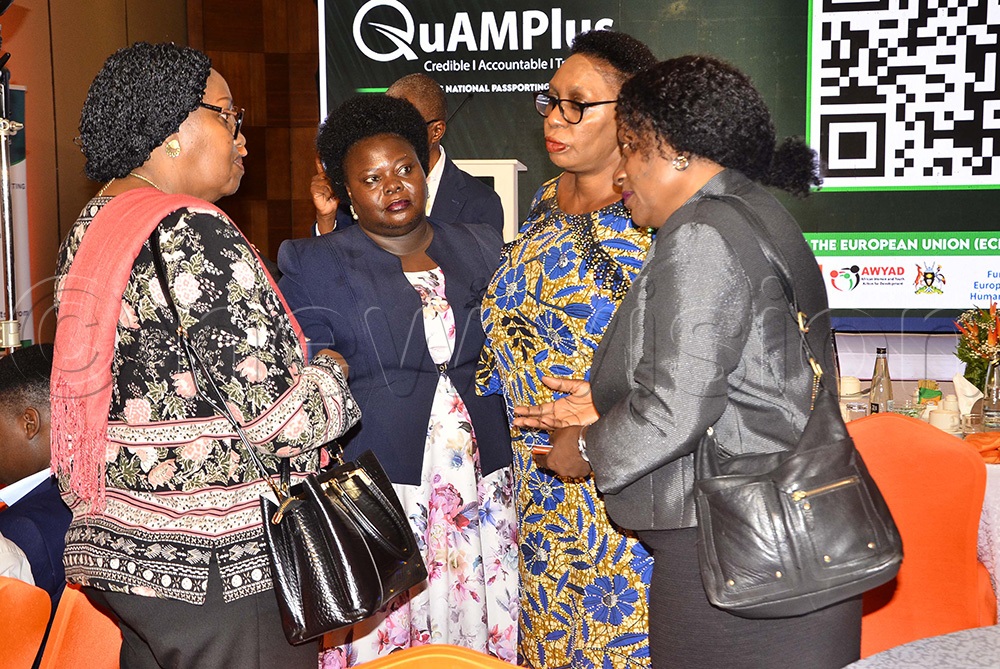
Helen Bugaari (left), Director of Comprehensive Refugee Response Framework Uganda at the Office of the Prime Minister interacting with executive directors during the QuAMplus digital tool at Sheraton Hotel. (Photo by Juliet Kasirye)
He made the remarks during the launch of the QuAMPlus digital platform organised by Care International Uganda at the Sheraton Hotel in Kampala on April 29, 2026.
The digital platform works as a practical resource for finding credible and fundable local and national actors.
The tool was developed with support from the European Commission Humanitarian Aid office (ECHO) in partnership with QuAm promoters and the National civil society Fraternity.
This platform, according to Gabazira, uses the power of AI and digital to do certain checks on you to be sure that whatever you are submitting on the QuAM tool is credible, passes the test for quality and authenticity.
“We are calling all people who are still doing manual due diligence, whether you are a donor, the government, or an NGO, to embrace this online tool. It is a public good that should be used by everyone to check on the organisational health of the agencies they are supporting. Basically, the tool deals with organisational checks and adopting global standards,” requested Gabazira.
The Director of the Comprehensive Refugee Response Framework Uganda at the Office of the Prime Minister, Helen Bugaari, said the refugee response in Uganda is the biggest humanitarian crisis in Africa, and the biggest humanitarian response in Uganda.
This, according to Bugaari, means that the strategies and policies that the government develops, even though they tend to be refugee-centred, pave the way for bigger national strategies.
“I know the QuAMplus is a national tool, but the biggest users will be in the refugee response. For us, it makes our work easy knowing that localisation will happen because of this tool. If it is embraced and accepted, there is no reason why we don’t achieve our target of at least 25% of funding going to the global entities.” Bugaari stated.
When localisation strategies are completed, Bugaari added that, “we shall take it through the government approvals through cabinet so that it becomes a government policy so that we all know that when you come as an investor in the country, you must know that you need to engage local responders.”
During the breakfast meeting, the Director of the Uganda Humanitarian INGO Forum, Ryan Duly, advised all stakeholders to embrace the tool because it not only reduces duplication but legitimises and gives confidence to local actors on what they do here in Uganda.
According to the head of the European Union, Kelly Liam, sustaining this progress will require more than tools. It will depend on continued collaboration, shared commitment to systemic change, and sustainable approaches to the operation of the system.
Food Rights Alliance chief executive officer Agnes Kirabo said, “We welcome this system because, as local organisations in Uganda, we are swimming through very turbulent waters in terms of accessing funding, building systems, and compliance with so many regulations. We spend almost 40% of our time either complying with the various regulations or looking for funding or surviving in these hard times.”
Since the government and development partners are considering adopting it, Kirabo said, the system is giving CSOs self-censorship and challenging them to be accountable.