
Minister Omona orders probe into stalled sh30.8b Agoro irrigation project
During a site visit on May 8, 2026, Omona found that only two out of the scheme’s nine irrigation blocks were receiving water, while rehabilitation works on the remaining seven blocks had either stalled or not yet begun.
Speaking during an inspection visit to the scheme on May 8, 2026, the Minister of Northern Uganda, Dr Kenneth Omona expressed concern over what he described as persistent contractor failures and poor implementation of a project. (Photo by Christopher Nyeko)
________________
State Minister for Northern Uganda, Dr Kenneth Omona, has demanded a comprehensive accountability report on the delayed rehabilitation of the Agoro Irrigation Scheme in Lamwo district after expressing frustration over the slow progress of works despite billions of shillings invested in the project.
During a site visit on May 8, 2026, Omona found that only two out of the scheme’s nine irrigation blocks were receiving water, while rehabilitation works on the remaining seven blocks had either stalled or not yet begun.
The rehabilitation project, implemented by the Ministry of Water and Environment under the Water for Production initiative, has consumed sh30.8 billion since it began in 2011.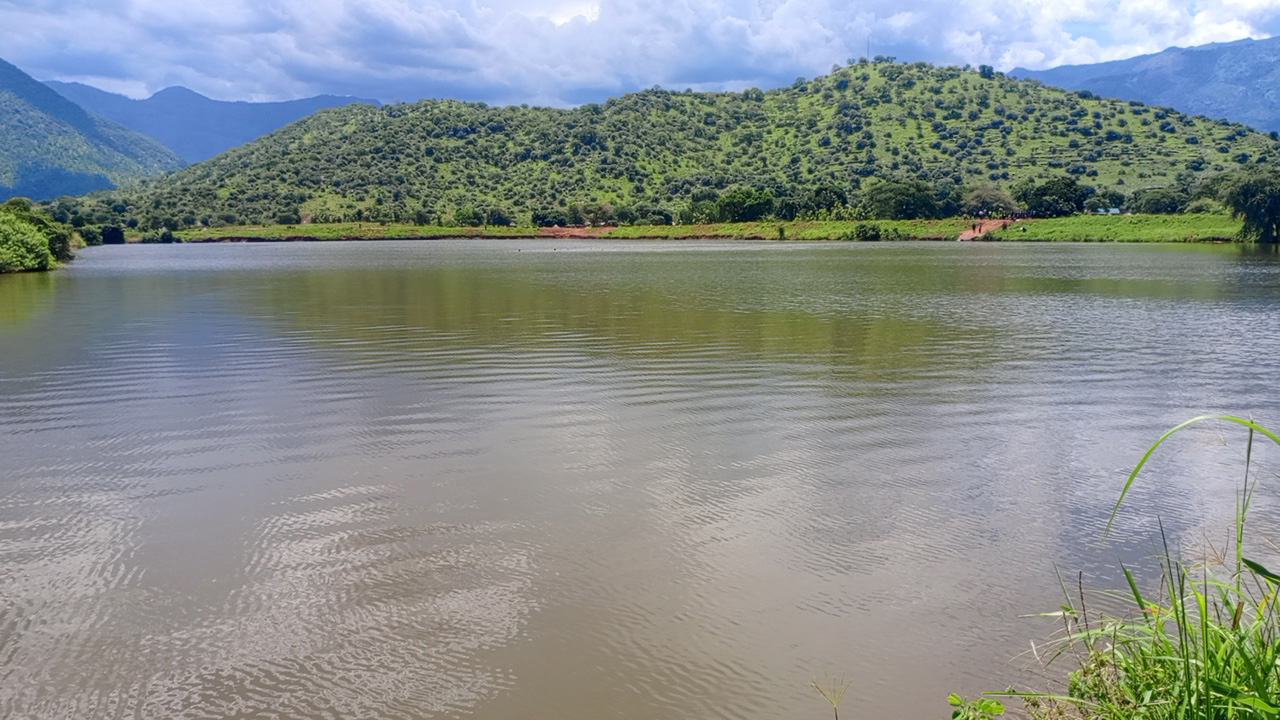
The project’s technical design was faulted with arguments that the reservoir was constructed in a low-lying area, making it difficult for water to flow effectively to all blocks. (Photo by Christopher Nyeko)
The works include topographical studies, construction of a reservoir dam, hydraulic system improvements, underground water tunnel connections to all nine blocks, modification of the dam, and construction of six concrete corner culverts.
However, the prolonged delays have sparked outrage among local leaders and farming communities who have depended on the irrigation scheme for decades.
Addressing farmers, district officials, contractors and ministry representatives during a community meeting, Omona ordered the water ministry to submit a detailed report within three weeks explaining the progress of the project, how the funds were spent, challenges affecting implementation, and recommendations for government intervention.
“We need full accountability for the sh30.8 billion invested in this project,” Omona said, warning that government would take action based on the findings of the report.
The minister also directed police to arrest staff from Vedas Engineering Services, accusing them of operating without proper coordination with local authorities and stakeholders.
“Even at your home, nobody can just enter and start working without the owner’s knowledge,” Omona said, emphasising the need for community involvement in public projects.
He further criticised what he described as repeated contractor failures and poor implementation of a project considered critical for the socio-economic transformation of the Acholi sub-region.
Farmers lament lost livelihoods
The Agoro Irrigation Scheme, located in Tumanun village in Agoro sub-county, was established in 1950 for horticulture farming on eight hectares before being expanded into a full irrigation system in 1970.
Over the years, it became a major rice production hub serving northern Uganda and parts of South Sudan.
The scheme currently covers 1,650 acres managed under the Agoro Self-Help Irrigation Scheme Cooperative Society Limited (ASHISCO), with 147 registered members organised into 26 farmer field school groups.
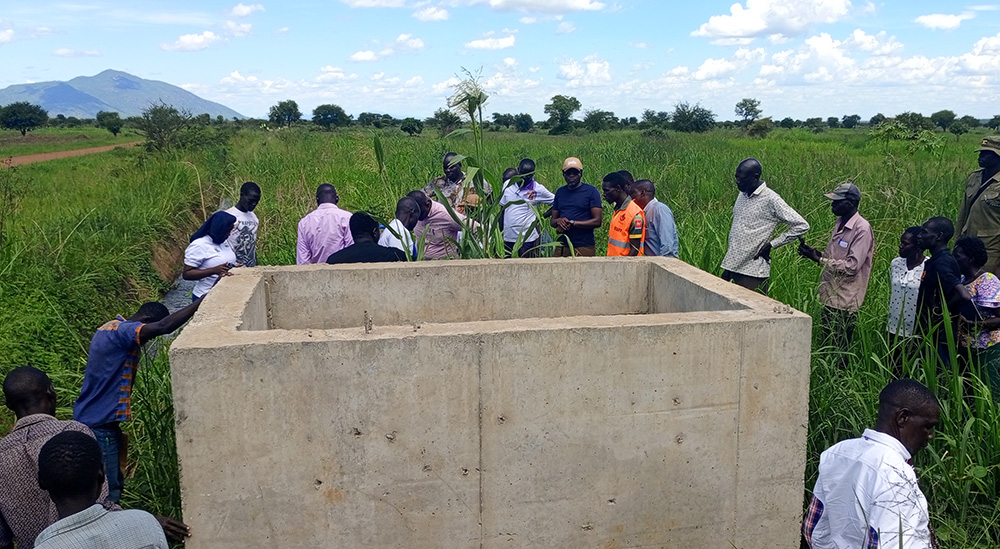
Agoro sub-county Chairperson George Onek listed multiple technical and administrative concerns, including delayed works, poorly buried pipes, siltation of the reservoir dam and lack of engagement. (Photo by Christopher Nyeko)
Farmers cultivate rice, maize, beans, groundnuts, soya beans and vegetables under the irrigation system, which was expected to support year-round production and shield communities from unpredictable weather conditions.
However, many farmers say the prolonged rehabilitation has devastated their livelihoods.
Residents emotionally recounted how the disruption of the irrigation system forced them back to traditional farming methods, drastically reducing productivity and income.
Once prosperous rice farmers supplying markets in South Sudan, many now struggle to pay school fees and meet basic household needs.
“We have suffered for over 16 years because the water is not reaching our gardens,” said Denis Ocan, chairperson of rice growers in Agoro since 1996.
Ocan criticised the project’s technical design, arguing that the reservoir dam was constructed in a low-lying area, which makes water distribution difficult across all blocks.
“The traditional irrigation system worked better than this modern one,” he said, adding that contractors ignored local farmers’ advice before dismantling the old infrastructure.
Moses Ochola, the LC1 chairperson of Tumanun village, accused contractors of poor workmanship, saying some pipes were improperly buried and had been exposed and damaged by bushfires.
Florence Angee, a farmer in Block Six, said areas declared complete by contractors still lacked a sufficient water supply.
Another farmer, Simon Otim, questioned why rehabilitation works had not started on blocks Seven to Nine despite years of funding allocations.
Local leaders raise concerns
Agoro subcounty chairperson George Onek listed numerous technical and administrative concerns, including delayed implementation, poorly laid pipes, siltation of the reservoir dam and lack of engagement between contractors and local leaders.
“When it was rehabilitated, it became more useless,” Onek said. “If this system cannot be completed, we would rather return to our traditional irrigation methods.”
Lamwo chief administrative officer Moses Chuna Kapolon said the district expects the scheme to eventually benefit at least 16,000 farmers in a district hosting more than 265,000 residents and over 80,000 refugees.
Kapolon called for increased agricultural mechanisation and the establishment of agro-processing facilities to help farmers add value to their produce instead of selling raw products.
He also highlighted a severe shortage of agricultural extension workers, noting that one officer currently serves up to three sub-counties.
Lamwo LC5 vice chairperson and secretary for production and marketing Justin Odur Tic, questioned why government had repeatedly changed contractors on the same project without achieving results.
“How can government switch contractors multiple times and have all failed?” he asked.
Odur appealed to President Yoweri Museveni to personally inspect the project, arguing that the continued delays reflected neglect of Lamwo district and the Acholi sub-region.
Lamwo resident district commissioner William Komakech blamed poor coordination between the Ministry of Water and Environment and the Ministry of Agriculture, Animal Industry and Fisheries, saying agricultural activities lacked proper technical supervision.
Komakech revealed that only 50 plots out of the scheme’s 1,650 acres currently receive irrigation water, representing just three percent coverage.
“There is laxity among extension workers in training farmers despite the availability of irrigation water,” he said.
Ministry defends progress
Responding to the criticism, Eng. Charles Bwire, senior engineer for the Northern Region in the Ministry of Water and Environment’s water for production department, attributed the delays to late government funding releases.
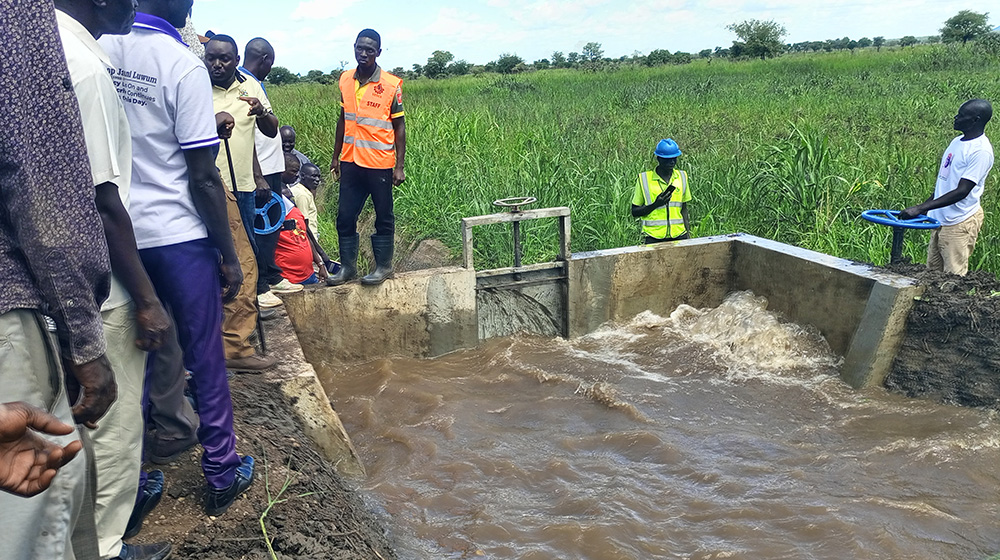
Farmers accuse contractors of shoddy work, delayed implementation and failure to restore water flow. (Photo by Christopher Nyeko)
Bwire said Vedas Engineering Services had completed 85 percent of the current rehabilitation works and was expected to finalise the project by the end of June 2026.
According to him, topographical studies, hydraulic improvements, concrete works and installation of six corner culverts had already been completed, with only minor modifications remaining on the reservoir dam.
He also welcomed Omona’s directive for a detailed accountability report on the utilisation of the sh30.8 billion invested in the project.
Records show that Dott Services previously received sh27 billion for rehabilitation works, while Gate Construction was awarded sh1.5 billion, but both contractors reportedly failed to complete the project as required.
The water ministry later awarded Vedas Engineering Services a sh2.3 billion contract to continue the rehabilitation works.
Despite assurances from government engineers, farmers remain sceptical and continue demanding restoration of reliable water flow across all nine blocks of the irrigation scheme.