
Luwero older persons demand affirmative healthcare
“It is really humbling to see these older persons here scrambling like us. Government should really plan for their affirmative healthcare. These senior citizens have done a lot for this country. Some of them fought during the bush war that brought the NRM (National Resistance Movement) government,” Muzamir Mukibi, a resident of Tokekulu, said.
(L-R) Peter Bukenya (84), John Kalule (80) and Michael Kitimbo (68) from Tokekulu Luwero are demanding affirmative healthcare. (Credit: Nelson Kiva
LUWERO - Peter Bukenya, aged 84, together with his colleagues John Kalule and Michael Kitimbo, anxiously sat on a bench waiting for treatment during a medical camp at Tokekulu trading centre in Luwero district.
The recent camp had been organised by the North India Cultural Association to screen and offer eye treatment. Kalule and Kitimbo are aged 80 and 68, respectively.
Anxiety and agony were evident on the faces of the elderly. The medical challenge they all share is related to eye complications, and they were faced with the reality of scrambling for treatment alongside relatively younger people.
Bukenya attributed his eye complications to a mental condition he has struggled with for a long time. His challenges are not only medical, but he also lacks basic necessities such as food at home.
“I had an announcement on the village public speaker about this medical camp, and I came here to seek treatment. Let government ensure that we are treated, and we are able to get what to eat and drink,” Bukenya said.
Despite qualifying for the government’s Social Assistance Grant for Empowerment (SAGE), which caters for the welfare of the elderly, Bukenya said he has never been enrolled.
The government, through SAGE, pays an allowance of sh25,000 to older persons aged 80 and above who are not pensioners to support their welfare.
The gender ministry has since communicated a government decision to increase the allowance to sh35,000 and reduce the beneficiary age to 65.
Gaps in support
The village LC1 chairperson, Wilberforce Owere, pledged to follow up with government structures to ensure that Bukenya is enrolled on the programme.
Bukenya’s wife, Bridget Nandawula, is aged 75. “All our children are married, and we stay alone at home,” Bukenya said.
“It is really humbling to see these older persons here scrambling like us. Government should really plan for their affirmative healthcare. These senior citizens have done a lot for this country. Some of them fought during the bush war that brought the NRM (National Resistance Movement) government,” Muzamir Mukibi, a resident of Tokekulu, said.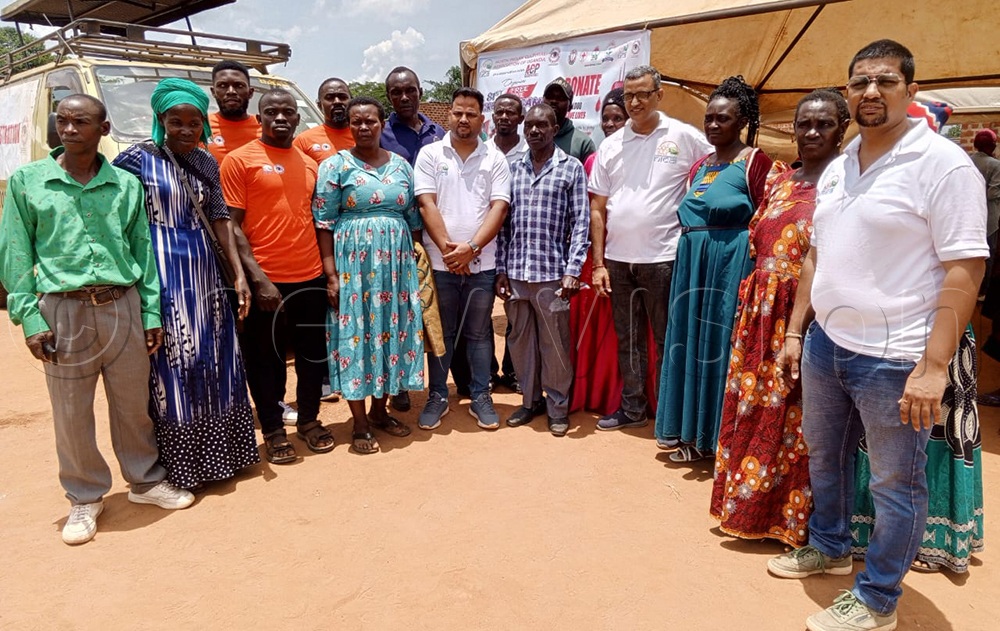
Members of North India Cultural Association with residents of Tokekulu in Luwero district during a recent medical camp. (Credit: Nelson Kiva)
According to the 2024 National Population and Housing Census conducted by the Uganda Bureau of Statistics (UBOS), five per cent of Uganda's total population, approximately 2.3 million people, are aged 60 years and above.
Despite the government’s expanding social protection programme, advocates for older persons are calling for more support to ensure dignity in old age.
The chairman of the North India Cultural Association, Ram Gulshan, said they organised the medical camp under their corporate social responsibility and offered treatment to people of all ages.
“This was our 81st medical camp, and in all those rural and urban areas, we get a lot of patients who actually cannot go to the hospitals and get the treatments for eyes,” Gulshan said.
Access and cost barriers
Gulshan said many people in villages cannot read or write due to eye-related complications, a problem worsened by long distances to health facilities.
“Here where we are to a hospital is between 40-45kms. It means it is difficult for these people to access a hospital. So, we decided to come deep in the village to offer our support. In our previous camps, we have screened about 36,000 people, and our target in Tokekulu was 2500 people,” Gulshan said.
He said the most common eye disease in villages is cataract.
“Almost 10% of the people you screen, you will find they have cataract disease. To address the problem, we conduct surgeries. When a person develops cataract, it doesn't allow him or her to see clearly,” Gulshan said.
Gulshan added that, besides financial constraints, lack of awareness also contributes to poor eye health in rural areas.
According to Dr Najib Nkwanga, an optometrist clinical officer at Mulago Hospital, the government needs to bring eye care services closer to villages.
He said many older persons are suffering from eye complications with limited support.
“Some lost their partners and their children; some are not working, making it difficult to support their parents,” Nkwanga said.
Nkwanga said, apart from cataract, other common eye diseases in Uganda include glaucoma, which can cause permanent blindness, and polyopia, a condition where a person sees multiple images of a single object.
He emphasised that treatment is expensive for most people. “For instance, the basic treatment for cataract goes for about sh1.5m. But in most cases, it goes for about sh5m,” Nkwanga said.
Scovia Mbabazi, a resident of Tokekulu, said she started experiencing pain in her eyes as if sand had been poured into them.
“The eyes were itching, and I could persistently scratch them. I went to the hospital, and they gave me medicine. I would get some little relief after applying medicine, but then the problem resurfaces,” Mbabazi said.
She said the problem affected her reading. “After reading two lines, fog covers my eyes, making it difficult for me to read. They have given me medicine and eyeglasses,” Mbabazi said.