
'Lake Victoria pollution raising water treatment costs'
Because of pollution, National Water and Sewerage Corporation (NWSC) Public Relations director Samuel Apedel says they spend shillings 1.5 billion every month on chemical costs to treat water in the Greater Kampala Metropolitan, including the districts of Kampala, Mukono and Wakiso.
A vessel carrying goods sailing on contaminated water at Port bell in Luzira. (Photo by Juliet Kasirye)
______________
Water quality experts have expressed concern about the worsening pollution of Lake Victoria, warning that the government's failure to implement drastic measures will hike water treatment costs.
Because of pollution, National Water and Sewerage Corporation (NWSC) Public Relations director Samuel Apedel says they spend shillings 1.5 billion every month on chemical costs to treat water in the Greater Kampala Metropolitan, including the districts of Kampala, Mukono and Wakiso.
This amount, Apedel says, would be lower if it were not for the poor quality of raw water caused by pollution. According to him, without the current level of pollution in Lake Victoria, the costs could be reduced by 30%.
“One of the biggest challenges that we have as a corporation is the poor quality of raw water. The pollution that is happening at the source where we are getting the water is overwhelming. Since a number of people have constructed around the lake shores, all this natural vegetation which was protecting the water bodies has been removed,” disclosed Apedel.
Another challenge, according to Apedel, is that some factories, which lack waste management systems, engage in practices that harm the environment.
As a way of quality assurance, Apedel said, “in Kampala alone, we have over 500 sampling points where we test the quality of water. We test the quality of the water in Lake Victoria, in the treatment plant and in the pipes. We also test the water in people’s homes to ensure that the water that reaches our customers is fit for human consumption.”
NWSC supplies a total of 330 million litres of water daily, with 240 million from Ggaba and 90 million litres from Katosi.
He raised the concern during an interview with the New Vision Online about the changing colour of Lake Victoria on Monday.
Green water and foul smell
Currently, the water in Lake Victoria, especially around Port Bell, Munyonyo, and Ggaba, has a green foul smell caused by severe eutrophication, which leads to dense blooms of harmful algae.
According to water analysts from the water ministry, when the algae from the blooms die and decompose, they consume oxygen and release gases such as methane, hydrogen sulphide and ammonia, which are a source of the smell and unpleasant odours. These conditions also result in less oxygen in the water, which is detrimental to aquatic life, and could lead to fish and other fauna kills.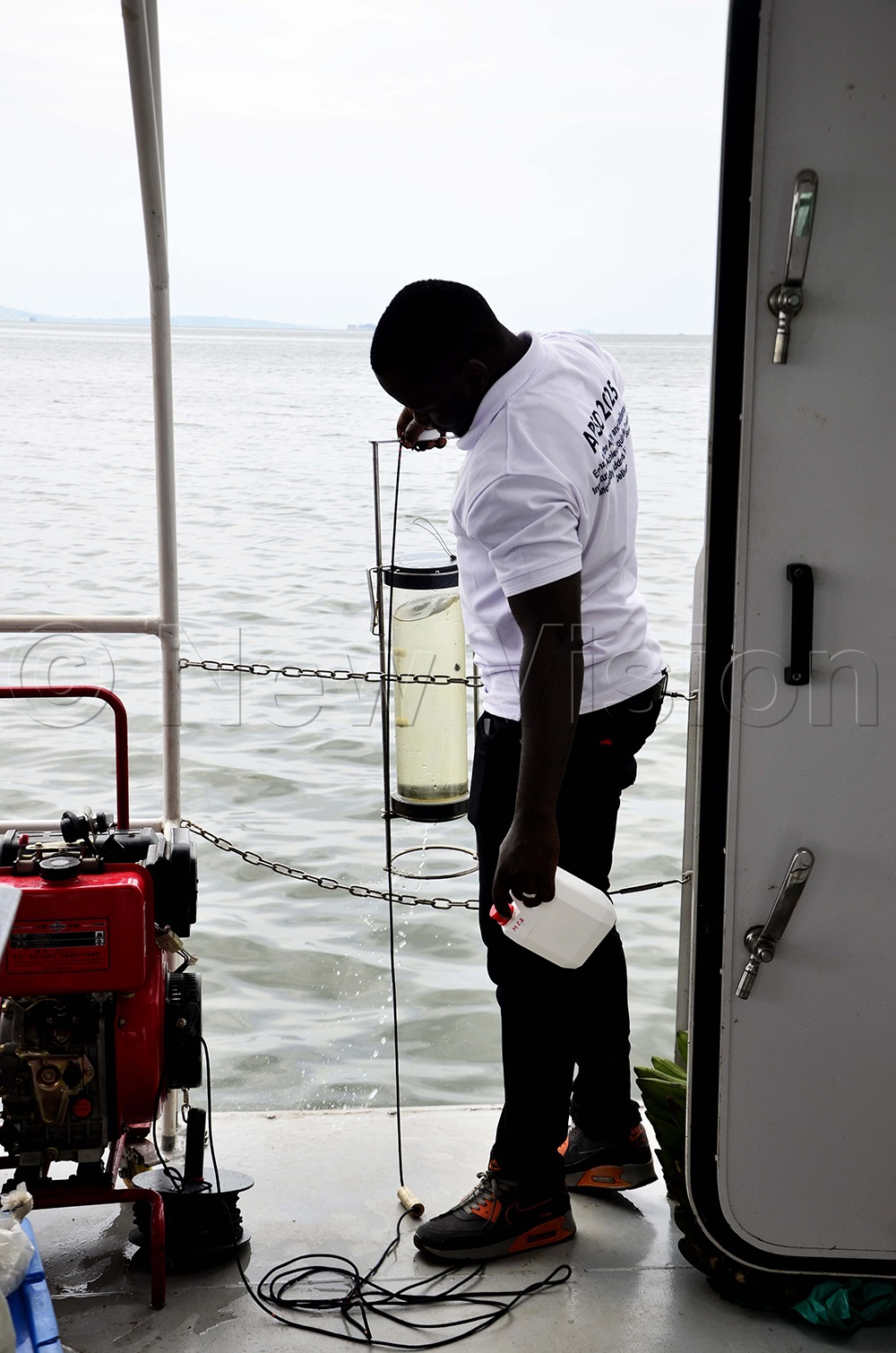
Water analyst collecting water samples to analyze the level of contamination in the Lake Victoria. (Photo by Juliet Kasirye)
Since these blooms are fuelled by high nutrient loads from sewage, urban runoff, agricultural runoff, and industrial waste, the water ministry, together with a delegation from BOKU university are conducting research, specifically looking at accumulated pollution in the lake.
To ascertain different contaminants in Murchison Bay, on February 12, 2026, water analysts spent four hours in the bay taking onsite measurements and also collecting several samples, including sediment, algae(phytoplankton) and water samples for analysis.
The Commissioner for Water Quality Management Department at the water ministry, Lillian Idrakua, said that, since pollution has accumulated in the water sources over the years, they want to see the impact of the nutrients that have been discharged into Lake Victoria.
“How is it contributing to the persistent green lake water we see? How much is it contributing to the smell people have been experiencing around the lake? especially the communities in Luzira. As part of the research, we are conducting feasibility studies to propose cost-effective options for cleaning the lake and restoring good water quality.” Idrakua stated.
According to Idrakua, pollution of water sources not only compromises water quality but also affects the tourism industry. If beaches or recreational spots are closed because of contamination, this will lead to a decline in the number of tourists.
Observation
During the collection of water samples, the head of the Institute on Hydrobiology and Aquatic Ecosystem Management at Boku University in Vienna, Austria, Professor Thomas Hein, said, Uganda is facing quite an intense algal bloom, which is certainly the effect of high plant nutrient (mainly phosphorus and nitrogen) loading into the system.
“This leads to an accumulation of enormous high biomass. If there is low oxygen content, especially in deeper layers, this is not only harmful to many fish species but also contaminates fish biomass for consumption as well as for use of drinking water,” explained Hein.
To save Lake Victoria, Hein advised Uganda to mitigate the amount of pollution originating from the catchment, especially from the urban areas of Kampala suburbs, noting that an improved wastewater treatment plant that can eliminate such plant nutrients would be key to reducing these impacts.
“You should look closer into the lake environment and understand what the internal loading effects on the ecosystem are, what comes from outside, what is already inside and how this creates these frequent algae blooms. These algae blooms are certainly impacting the whole aquatic environment.” Hein stated.
Fish cage farming
Besides pollution, Hein also warned Ugandans to be cautious about cage fish farming, saying that if not managed well can further compromise the quality of water in Lake Victoria.
Much as Uganda is looking at the economic benefits, Hein said, there is a need to strike a balance between economic benefits and environmental management because failure to manage the density of the fish farms and manage fish feeds could directly add nutrients into the lake and worsen the eutrophication of the lake.
He added that, much as fish cage farming in the lake is an economic project, it is not good to have too many of the fish farms in one area because poor feed management can lead to serious environmental consequences.
According to the lecturer in the department of Zoology, Entomology and fisheries sciences at Makerere University, Dr Ronald Semyalo, though the Murchison Bay is a recipient of wastewater and storm water from Kampala city, unfortunately, the increase in paved surfaces and channelisation of Nakivubo channel has increased amounts of waste and storm water ending up in the Murchison Bay.
To deal with the influx of wastewater, Semyalo stated that there is a need to restore the Nakivubo wetland, identify pollution sources and enforce treatment of the wastewater even before it gets to the wetland.
Water ministry permanent secretary Dr Alfred Okot Okidi said that though Uganda has abundant water resources, it faces a dual challenge.
“On one hand, we have a responsibility to ensure that our growing population has access to clean and safe drinking water. On the other hand, we must protect our precious water bodies and ecosystems from pollution, preserving them for future generations while simultaneously harnessing their potential for sustainable development,” explained Okidi.
To improve the quality of water, Okidi said, protection of ecosystems from pollution is a crucial component of sustainable development.
According to the water ministry statistics, as of June 2025, Safe water coverage in Uganda stood at 70%. About 20% of the villages, or roughly about 30% of the population, do not have access to safe and clean water.
To address water quality challenges, the Rector of BOKU University, in Vienna, Eva Schulev-Steindl, pledged to support the ministry through human capacity development.
To provide safe, clean water for the people, the Rector of BOKU University in Vienna, Eva Schulev-Steindl, pledged to enhance the human capacity development of water professionals.