
Lack of crime scene vans affecting govt analytical laboratory operations
This played out on February 25, 2026, during a meeting between Members of Parliament (MPs) on the Public Accounts Committee (Central), chaired by Goretth Namugga and DGAL officials, led by director Kepher Kuchana Kateu.
Lawmakers have raised grave concerns over the quality of forensic investigations conducted by the Directorate of Government Analytical Laboratories (DGAL). (Credit: Parliament)
________________
Lawmakers have raised grave concerns over the quality of forensic investigations conducted by the Directorate of Government Analytical Laboratories (DGAL).
This played out on February 25, 2026, during a meeting between Members of Parliament (MPs) on the Public Accounts Committee (Central), chaired by Goretth Namugga and DGAL officials, led by director Kepher Kuchana Kateu.
AG's observations
The backlash followed a series of observations by Auditor General (AG) Edward Akol in his 2024/25 report on the entity.
Akol noted that although the acquisition of crime scene vans was provided for in the entity’s 2020/21–2024/25 strategic plan with the intention of strengthening secure evidence collection and transfer to laboratory, among others, in line with ISO/IEC 17025 standards, the item had not been prioritised.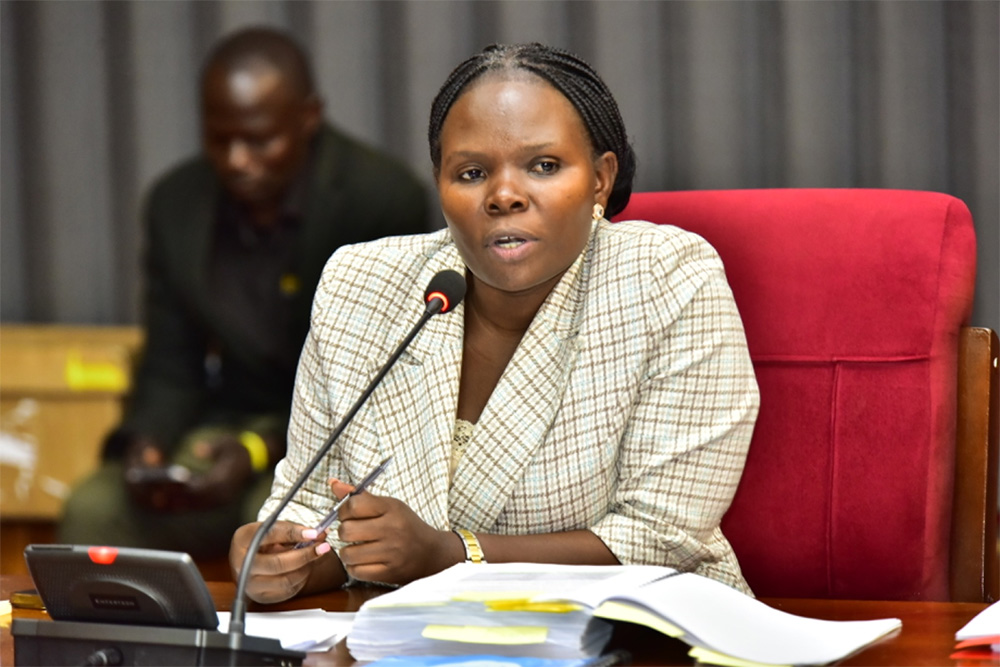
Goretth Namugga, the chairperson Public Accounts Committee (Central), speaking during the committee engagment with the Directorate of Government Analytical Laboratories (DGAL) officials. (Credit: Parliament)
“By the time of the audit in September 2025, the planned crime scene response vans had not been acquired. A discussion with DGAL staff and top management revealed that in the absence of dedicated response vans, ordinary pick-up vehicles are being used to transport exhibits from scenes of crime and regional laboratories to the central laboratory,” AG observed.
Adding that improvised means are not customised for this and lack essential features such as temperature-controlled storage and contamination prevention systems required to preserve the integrity of forensic exhibits.
Budget constraints
However, in response, Kateu attributed the lacuna to funding constraints.
“It is very important to note that we had budgeted for the mobile forensic vans to help us respond to the scenes of crime and pick exhibits. But also, we had put forward the proposition to acquire in this current financial year, but we have not had a budget for that. It has remained unfunded. Even the next financial year, we have already put it there,” he explained.
Adding that where samples require cold storage, DGAL uses boxes packed with ice blocks, while samples such as marijuana are transported at room temperature.
Kepher Kuchana Kateu, however, clarified that most of the samples handled by the Directorate are submitted to them by the Police. Furthermore, he pointed out that DGAL only goes to crime scenes in limited circumstances, such as fire incidents, where its officers are invited to deploy their kits to help identify critical forensic traces.
Such as determining whether hydrocarbons were used to accelerate the fire and establishing the likely cause.
MPs react
While some MPs appeared satisfied with the explanations, others, such as Kassanda North’s Patrick Guma Oshabe Nsamba (NUP), remained unconvinced.
“This institution was given money. But the money that was given to it cannot be accounted for. Chair, these people in the financial year under review used Sh5.6 billion to improve on laboratory safety, including training scientists. The auditor is saying, he cannot trace that money properly,” Nsamba raised.