
Labour firms to deposit sh100m return bond for migrant workers
“We now require a company externalising any Ugandan to pay sh100m as a guarantee held by a commercial bank so that in case you fail to bring back any Ugandan you have externalised, we get that money from the bank to bring those Ugandans back home,” Amongi said.
Labour firms are to deposit sh100m with commercial banks as a guarantee for safe return of externalised Ugandans. (New Vision/Files)
BUIKWE - The gender ministry has reformed the labour externalisation licensing framework, among others, requiring labour firms to deposit sh100m with commercial banks as a guarantee for safe return of externalised Ugandans.
The gender minister, Betty Amongi, reported to President Yoweri Museveni, during the Labour Day celebrations at Nkoyoyo Boarding Primary School Grounds, Matale, Buikwe district, that this made labour companies more accountable.
“We now require a company externalising any Ugandan to pay sh100m as a guarantee held by a commercial bank so that in case you fail to bring back any Ugandan you have externalised, we get that money from the bank to bring those Ugandans back home,” Amongi said.
She added, “Many of the people were opposing this, and we stood firm. This has increased and strengthened labour companies being more accountable and ensuring that those who travel abroad are returned, or when there is an issue, they resolve it.”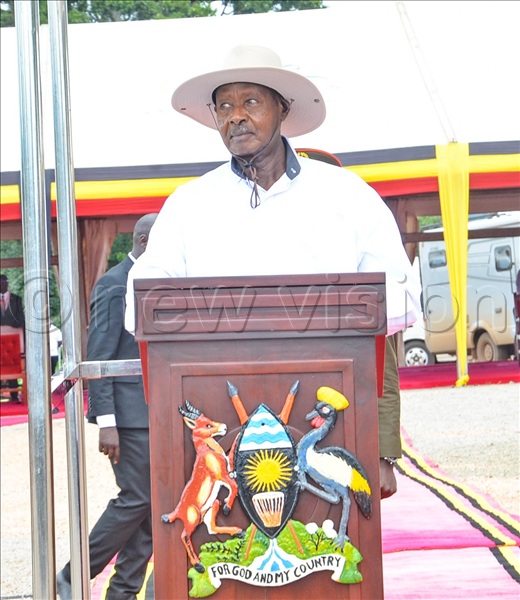
President Museveni cautioned citizens against rushing into business without proper planning, advising them to avoid high-interest commercial bank loans. (All Photos by Emmanuel Balukusa)

However, the unfortunate part is that the minister reported to the President that many Ugandans travel without going through the gender ministry or licensed companies.
“Majority of those are the ones who will always have problems. They are trafficked, they move through Nairobi, they go without a license, and unfortunately, when they reach where they are going, there is nothing the government can do except to negotiate through foreign affairs,” Amongi said.
She also used the occasion to brief the President on the progress of the wide consultations on the minimum wage.
“Over the last year, after your directive, we have consulted widely, and the workers and employers’ representatives who have been here have hinted at this matter. Your Excellency, the progress is that the Minimum Wage Advisory Board and Wage Councils have been put in place and structured around sectors; industries, services, ICT and all the other sectors to discuss and come up with a minimum wage based on their industry,” Amongi said.
She said that a cabinet paper is ready for the Minimum Wage Advisory Board composition and has written to the cabinet secretary to give a slot so that cabinet can discuss and approve it.
“The board will be able to receive reports from councils and the committees that are already working,” Amongi said.
She said under the decent work country programme, they are implementing efforts to improve workplace safety, increase social security fund coverage and promote social dialogue.
“We know you cannot handle labour issues without dialogue with the workers, with the employers, with those in the private sector. So, this decent work country programme is analysing, dialoguing and coming up with reforms that are necessary in the labour sector,” Amongi said.
She added, “To curb casualisation of work, we brought the Employment Amendment Bill 2025, which is now an Act of Parliament. That Act has now supported and given direction on how to enforce contracts between the employers and the employees.”
Under the Jua Kali programme, Amongi said, the gender ministry is supporting formalisation of businesses in the informal sector through availing them of equipment.

“So far, we have given 13,282 equipment benefiting 35,000 people in 199 constituencies,” she said.
The other beneficial move, she said, has been the National Apprenticeship Programme (NAP) implemented in two ways, including work placement, where the government negotiates with companies, industries, and service providers.
“Following the advertisement, successful applicants are placed in those companies, work and gain experience so that they can go and start their own businesses or expand if they already have businesses,” Amongi said.
The other component of the programme, Amongi said, is a graduate volunteer scheme where fresh graduates from the university are given a upkeep stipend by the gender ministry.
“They apply to be placed in companies, in districts and organisations, and we pay them. We have been piloting this with a few companies, and the retention of graduate volunteers where they are placed stood at 71%. We are now expanding it to place graduates in districts, cities and municipalities,” Amongi said.
Amongi reported to the President that the major issue curtailing business growth, especially the small and medium enterprises (SMEs), is the issue of high business rates, which leads to many collapsing.


“Many are formed, and they employ people, and they collapse because of high interest rates,” Amongi said.
However, the President cautioned citizens against rushing into business without proper planning, advising them to avoid high-interest commercial bank loans.
Instead, he encouraged borrowing from the Uganda Development Bank, which offers lower interest rates at 12%.
He also highlighted other soft government funds, such as the Parish Development Model (PDM), which can help Ugandans reveal plans to double the fund.
Representatives of the workers thanked the President for the Public Service Pension Scheme taking off this year.
“We also thank the President for accepting to raise the threshold for payee as you earn to sh350,000. At least that will allow the least worker to go home with some money. I also thank you for the reforms in Kampala Capital City Authority. However, there is little that needs to be done about the lowest worker in KCCA who still earns sh6000 a day, which totals to sh180,000 in a month,” Musa Okello, chairman general of the National Organisation of Trade Unions, said.
The workers also commended the President on the concept of the industrial parks, which are currently eight, with 5200 factories so far.
“Out of those, almost 1.3 million workers are already employed, and we thank you. However, we want to request that these young people report for work as early as 4am and leave as late as 8pm, and they walk through dark places. Most of them are young girls. We want to request that there should be a plan to provide affordable accommodation for these young workers who work in these factories,” Okello said.
To address the issue of employment, the workers appealed for reforms in the education sector to ensure that people qualify with qualifications which are relevant in the field.
Fred Bamwesigye, the chairperson Federation of Uganda Employers, “Today we celebrate a vital partnership between capital and labour that drives our nation to social-economic transformation. We thank the President for the launch of a third decent work programme, which steps alongside the Parish Development Model and has scored the vision for a dignified workforce, which we have always discussed all the time.”
“We specifically appreciate your promise to double the PDM funding by allocating more sh200m per parish. This move will reduce the proportion of our people outside the money economy,” Bamwesigye said.