
Jinja suspends eviction of traders over fears of costly lawsuits
Whereas the ongoing enforcement exercise across Uganda’s urban local governments is aimed at restoring trade order, Jinja district councillors petitioned Nakamatte to slow down the process in this specific area.
Lillian Nakamatte, the Jinja district CAO during a council meeting where she announced a temporally halt to the ongoing trade order enforcement to reorganise themselves. (Photo by Jackie Nambogga)
__________________
Jinja district chief administrative officer (CAO) Lillian Nakamatte has temporarily halted the eviction of traders operating in illegal structures and kiosks along streets and road reserves in Kakira town council.
Whereas the ongoing enforcement exercise across Uganda’s urban local governments is aimed at restoring trade order, Jinja district councillors petitioned Nakamatte to slow down the process in this specific area.
During a council meeting presided over by deputy speaker Moses Lwochaza at the Jinja district headquarters on March 27, 2026, Abdurahman Mujoma, the male youth councillor, expressed concern that the district risked being dragged to court over a 2014 arrangement between the town council and traders.
Under this arrangement, Mujoma said Kakira town council permitted and allocated space to traders, who have since been paying ground rent and trading licences.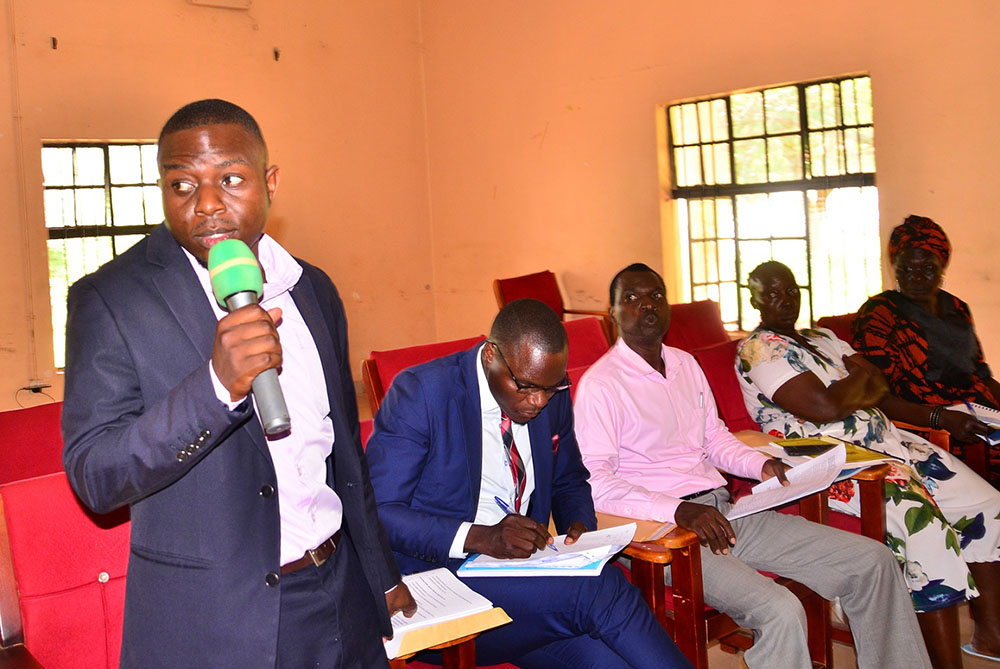
Abdurahman Mujoma said enforcing trade order in Kakira town council breaches its initial agreement with vendors which would lead to a court suit resulting into compensation. (Photo by Jackie Nambogga)
He said the traders also complied with the town council’s requirement to erect metallic structures in line with allocation slips.
“The allocation slips clearly stipulate that traders should erect permanent metallic structures, they have since been paying ground rent and trading license,” he said.
Paul Odunde, the area district councillor, said the town council had issued a three-day ultimatum requiring traders to vacate, with enforcement set to begin on Monday, March 30, 2026.
He noted that the ultimatum, which expired on March 27, 2026, caught many traders off guard as they had no alternative places to relocate to.
“I am worried, there was a bidding agreement that allowed traders to erect metallic facilities, which they did, but they have been given three days to vacate. What answer should I tell them?” he wondered.
Mujoma said it was contradictory for the same authority that permitted the structures to now move to demolish them.
He urged the council to carefully consider the legal implications of its actions and to follow due process.
Accordingly, Mujoma warned that forceful evictions could amount to a breach of contract, given that traders have been paying ground rent and licence fees.

Paul Odunde, the Kakira town council councilor said he needed answers from the CAO because traders had bidding agreement with Kakira town council. (Photo by Jackie Nambogga)
He said this could expose the council to legal action and costly compensation claims.
Trade order concerns
Nakamatte explained that after the general elections, urban managers were summoned to Bushenyi and tasked with implementing measures to restore trade order.
“We are aware there is a lot of influx from the villages coming to urban areas, yet the majority were not in formal employment,” she explained.
She said many residents had resorted to petty trade to survive.
As a result, urban managers were directed to restore order, beautify towns, and remove banners and election posters, among other directives issued in Bushenyi.
She added that the exercise is being implemented nationwide, not only in Jinja.
“Trade order involves not operating on streets and along road reserves, face-lifting buildings, ensuring no garbage littering, beautification, including greening such as planting trees to offer shade as part of the recommendations,” she said.
Nakamatte said the exercise involved multiple stakeholders and that traders had been sensitised through radio announcements to vacate voluntarily rather than face enforcement.
Samuel Akalyamawa, the councillor for Buyengo town council, described the implementation as inhumane, saying enforcement officers had acted with impunity in areas where the exercise had already been carried out.
He said this was putting livelihoods at risk, particularly for vulnerable groups such as single mothers.
“The directive was on implementing trade order, it doesn’t spell out the brutality and inhumane conduct that we are seeing among enforcement agencies,” he lamented.
Akalyamawa said the timelines were impractical, given the lack of alternative spaces for traders, and questioned the legality of collecting taxes from traders operating in contested conditions.
He noted that Jinja district has seven lower local governments, five of which are town councils, including Kakira, Buyengo, Buwenge, Kagoma and Namagera, all of which depend on revenue from traders.
He added that his own butcher kiosk in Buwenge had been removed before he could secure alternative space.
Annet Kubonaku, the councillor for Butagaya, also condemned the brutality of enforcement officers, prompting Lwochaza to task the resident district commissioner’s office to address the matter.
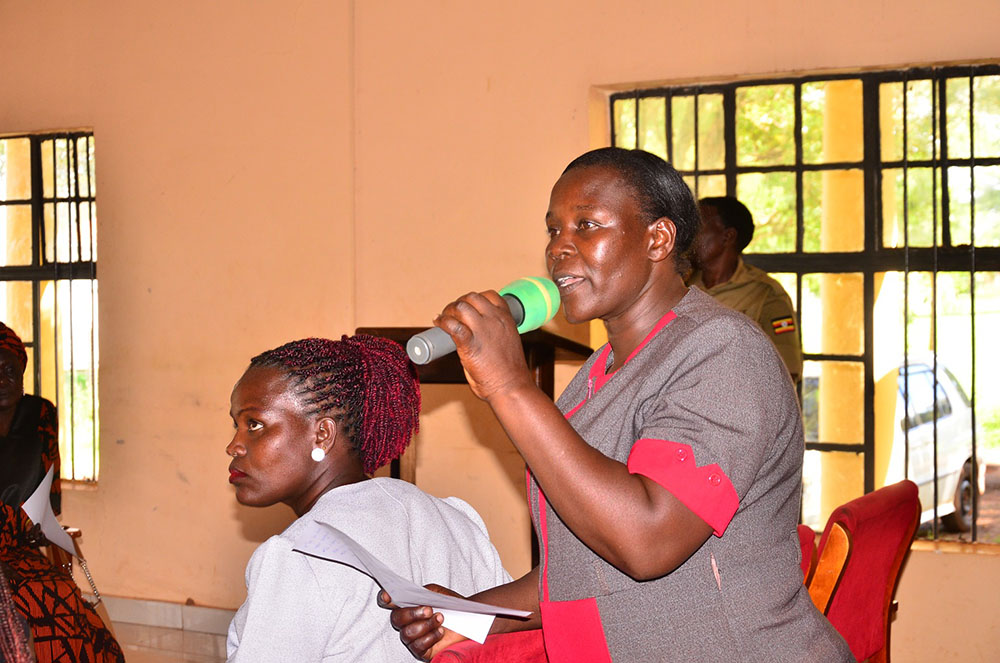
Annet Kubonaku (Butagaya) said this was a national issue affecting communities that required their area legislators to attend for further discussions in parliament. (Photo by Jackie Nambogga)
She criticised the council for failing to involve Members of Parliament in such discussions, saying their input would be valuable on a matter of national importance.
“Our MPs seem to be distanced from us, yet we work in a chain; it would be good for them to appreciate such plights and feedbacks for further discussion since this is a national issue affecting urban authorities,” she said.
Evictions halted
Nakamatte said that although she is mandated to oversee the exercise, lower local governments had been implementing it independently without seeking her direct involvement.
Following guidance from the permanent secretary in the Ministry of Local Government, which requires sensitisation and provision of alternative spaces, councillors resolved that enforcement be temporarily halted.
They tasked Nakamatte with writing to all town clerks to suspend evictions and to convene a meeting with enforcement teams to agree on a more humane and lawful approach.
Councillors also called for a clear plan on timelines and relocation spaces before enforcement resumes.
Although the exercise is nationwide, Akalyamawa urged Jinja to adopt a more measured approach.
“We need to agree on a proper procedure on the timeframe given, the alternative space and what it would take for their relocation,” he suggested.
Councillors welcomed Nakamatte’s decision to temporarily halt the enforcement of the trade order to allow for reorganisation and consultation.