
How training is changing young Ugandan welders' lives
Trainees learn how to identify and prevent common welding defects such as porosity, slag inclusion and lack of fusion, as well as basic non-destructive testing techniques, including visual inspection (VT).
Arinitwe Grace (L) and Okot Geoffrey get hands-on training on how to operate the automatic welder.
When Grace Arinitwe graduated from Kiryandongo Technical Support Institute, his plans were simple: Returning to his home area in Hoima city-based Kigorobya.
After returning, he planned to start a small welding workshop in the village, making doors, window frames and basic metal structures for the community. Working in Uganda’s oil and gas sector was never part of that dream.
“I never imagined I would work on a big project like this,” Arinitwe says, adding: “Success for me meant opening a small workshop and serving people in my village.”
Today, however, Arinitwe’s life has taken an unexpected and transformative turn.
He is now one of the 10 local welders working with China Petroleum Pipeline Engineering Co. Ltd (CPP), undergoing specialised automatic welding training at the Tilenga Main Camp (TMC) on the Tilenga Feeder line Pipeline, constructed by CPP Uganda.
CPP, the key Feeder Line and above-ground installation Contractor for the East African Crude Oil Pipeline (EACOP) project, initiated a comprehensive training programme that aims to enhance and impart skills to local trainees for the betterment of pipeline construction.
Spanning 1,443 kilometres from Kabaale in Uganda to Tanga, in Tanzania, EACOP Project promises substantial economic benefits for the region.
For the first time, Arinitwe is operating advanced CPP G 1990 series automatic welding machines, technology normally reserved for large international pipeline projects.
This exposure has placed him among a small group of Ugandan welders acquiring high-end industrial skills that are rarely accessible at community level.
The training programme is structured to combine theory with intensive hands-on practice. Grace and his colleagues are learning how to start up and debug automatic welding machines, recognise equipment components, and correctly set and centre welding torches.
They are also trained in single-pass and multi-pass welding, especially in the demanding 5G position, which requires welding fixed pipes in all directions—a critical requirement in pipeline construction.
For Arinitwe, the difference between what he learnt in school and what he is learning now is worlds apart.
“At school, we mainly used manual welding. Here, I am learning automatic welding, which is completely different. I now understand how to control weld quality, inspect my own work and meet industrial standards. This puts me at a different level compared to many welders in my area,” he says.
Trainees learn how to identify and prevent common welding defects such as porosity, slag inclusion and lack of fusion, as well as basic non-destructive testing techniques, including visual inspection (VT). They also practice weld cleaning and interlayer inspection to ensure consistency and compliance with international standards.
In the oil and gas industry, where safety and precision are critical, these skills are not optional they are essential. For Grace, this knowledge has fundamentally changed how he sees his profession.
“Before, I just welded and hoped the job was strong. Now I understand why a weld can fail and how to prevent it. I feel more professional and more confident in my work,” he adds.
Once Arinitwe successfully passes radiographic inspection, a globally recognised quality test, he will receive a training completion and job qualification certificate.
This certification gives him a powerful professional edge and positions him for long-term employment not only on the Pipeline project, but also on future oil, gas and infrastructure developments across Uganda.
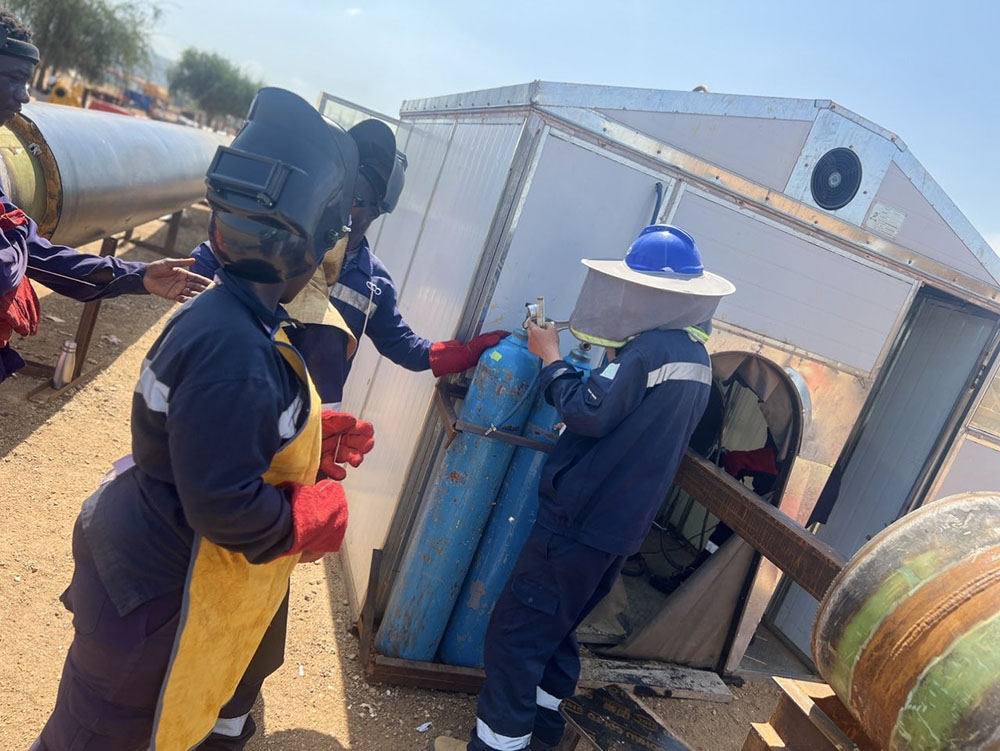
Local trainees get hands-on exposure to the automatic welding machine for the first time.
Equipping local people
According to CPP Uganda National Content Manager Haitao Zhang, the goal of the programme is to ensure that local people are equipped with skills that remain valuable long after the project ends.
“Our commitment to local content goes beyond numbers. We focus on real skills transfer. Automatic welding is a specialised and highly demanded competence in oil and gas. When young Ugandans like Grace acquire these skills and certification, they gain a significant advantage in the labour market and a real pathway into the industry. I will be able to work anywhere in the world.”
Arinitwe is not alone in this journey. Another trainee, Geoffrey Okot from Nwoya district, also sees the training as a rare and life-changing opportunity.
For Okot, being part of the pipeline project carries both professional and personal meaning.
Like Arinitwe, Okot had never imagined working with automatic welding technology. He believes the training has given him a competitive advantage over many other welders in his community.
“Many welders only know manual welding but here, we are learning automatic welding, quality inspection and international standards. These skills give us more chances for serious industrial jobs,” Okot adds.
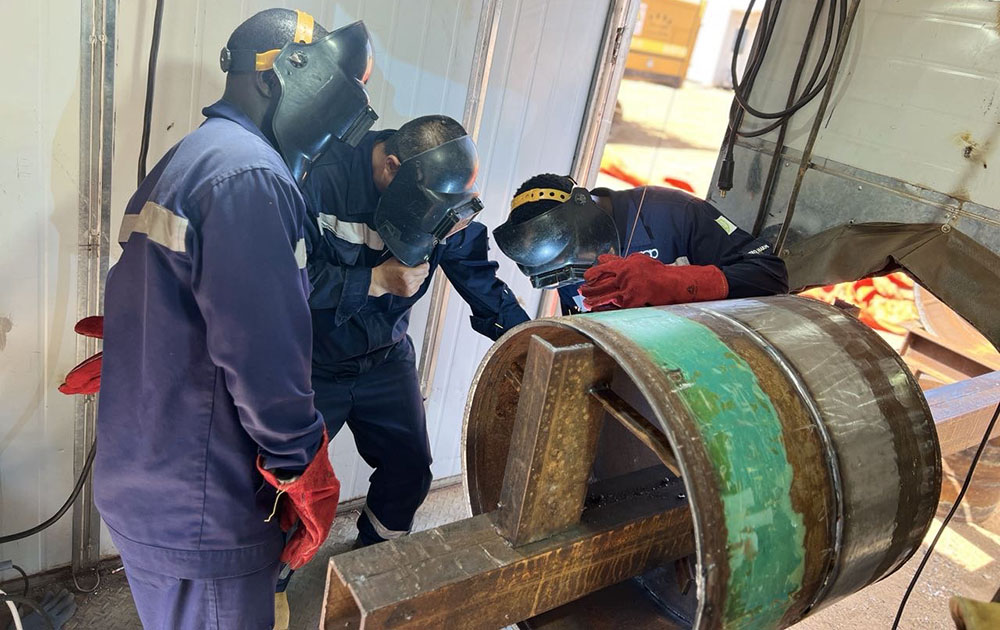
Arinitwe Grace (L) and Okot Geoffrey get hands-on training on how to operate the automatic welder.
Industry-ready welders
For both young men, the training represents more than employment; it represents mobility, dignity and future security. In Uganda, welding is a common trade, but most practitioners rely on informal experience, outdated tools and limited certification.
This often restricts them to small, low-paying jobs with little opportunity for growth.
Through the automatic welding programme, Arinitwe and Okot are now entering a different category of professionals, industry-ready welders with exposure to modern equipment, international standards and recognised certification.
As Uganda moves closer to becoming an oil-producing nation, demand for skilled technical workers is expected to increase sharply. Welders who can operate automatic systems, apply quality control and pass radiographic inspection will be among the most sought-after in the sector.
What began as a modest village ambition has evolved into a career rooted in national development.
Through automatic welding training, young Ugandans like Arinitwe Grace and Okot Geoffrey are not only building a pipeline they are building futures, proving that community-based skills development can turn local talent into drivers of Uganda’s industrial transformation.
About EACOP
The EACOP project is being undertaken by the main contractor CPP, which is a subsidiary of the China National Petroleum Corporation (CNPC) that specialises in the construction and engineering of oil and gas storage and transportation infrastructure. The pipeline passes through 10 districts in Uganda.
This project is implemented by EACOP Ltd, formed by shareholders: TotalEnergies, CNOOC, Uganda National Oil Company (UNOC) (on behalf of the Government of Uganda), and Tanzania Petroleum Development Corporation (TPDC) (On behalf of the government of Tanzania).