
How magistrate Ssemwogerere got entangled in an LDC exam scam
Nearly 16 months later, Lira chief magistrate Joe Fay Adoko delivered a detailed judgment that has placed Ammaari Musa Ssemwogerere, 30, and Irene Mutonyi, 41, at the centre of a complex web of alleged forgery, personation, uttering false documents and conspiracy.
Musa Ammaari Semwogerere and Irene Mutonyi, both lawyers are in the dock at the Chief Magistrates Court of Lira, where they are to answer several counts of forgery, uttering false documents, criminal trespass, among others.
When invigilators at the Law Development Centre (LDC) Lira Campus walked into Lecture Room Two on 26 July 2023, they expected a routine examination day.
Instead, they found themselves unravelling one of the most startling exam impersonation scandals to reach a Ugandan courtroom in recent years—a case involving a newly appointed Magistrate Grade I-designate, forged academic documents and a suspected conspiracy spanning Kampala and Lira.
Nearly 16 months later, Lira chief magistrate Joe Fay Adoko delivered a detailed judgment that has placed Ammaari Musa Ssemwogerere, 30, and Irene Mutonyi, 41, at the centre of a complex web of alleged forgery, personation, uttering false documents and conspiracy.
The duo is due to return to court on December 4, 2025, for sentencing.
What emerged in court is a story of planning, deceit, digital manipulation, and a dramatic escape that ended in a Lira hotel.
A Mysterious Student Called “Anthony Mukisa”
The prosecution’s case revolved around one key question:
Who is Anthony Mukisa?
According to LDC officials who testified, the answer was simple: He does not exist.
On the morning of the Land Transactions examination, invigilators noticed a man whose name was missing from the official list of the 74 candidates booked to sit in Lecture Room Two.
When the invigilator, PW2 Atyang Christine Lubega, queried the anomaly, the man wrote his name, Mukisa Anthony—on the attendance sheet.
But something felt off.
When staff checked the digital system, no such student existed. And yet, the man held an LDC student Identity Card and Examination Permit bearing the name Anthony Mukisa, complete with a QR code and the valid student number of another registered student, Godfrey Mutawo.
Before the invigilators could complete verification, the man quietly stepped out, and vanished.
He did not return.
The Arrest in a Lira Hotel
The following morning, on July 27, investigators located the suspect in a Lira city hotel. He identified himself as Musa Ssemwogerere, a fresh magistrate-designate who had recently been appointed to the bench.
Police recovered documents believed to be the same ID and examination permit abandoned in the exam room. The Chief Magistrate later noted that Ssemwogerere admitted to being the person in the photograph on the forged documents, though under a false name.
The second accused, Irene Mutonyi, was allowed to complete her examination that day.
However, after the QR code on the forged cards led to her details, the Academic Registrar ordered her to file a formal explanation. She was subsequently added to the charge sheet.
ALSO READ
Magistrate arrested sitting exam for girlfriend, remanded
The Prosecution’s Arsenal: 12 Witnesses, 14 Counts
State attorney Jonathan Okello lined up 12 witnesses, including LDC administrators, invigilators, Police investigators and the student whose registration number had been stolen.
The 14 charges ranged from forgery, uttering false documents, personation, making documents without authorisation, criminal trespass, to conspiracy to commit a felony.
According to the prosecution, the offences were carried out in both Kampala and Lira.
The centrepiece of the case
• PEX7 – LDC Student Identity Card in the name of Anthony Mukisa
• PEX9 – LDC Examination Permit in the same name
Both documents carried the registration number of PW3, Godfrey Mutawo, yet displayed different subjects, mismatched gender, and a photo of Ssemwogerere.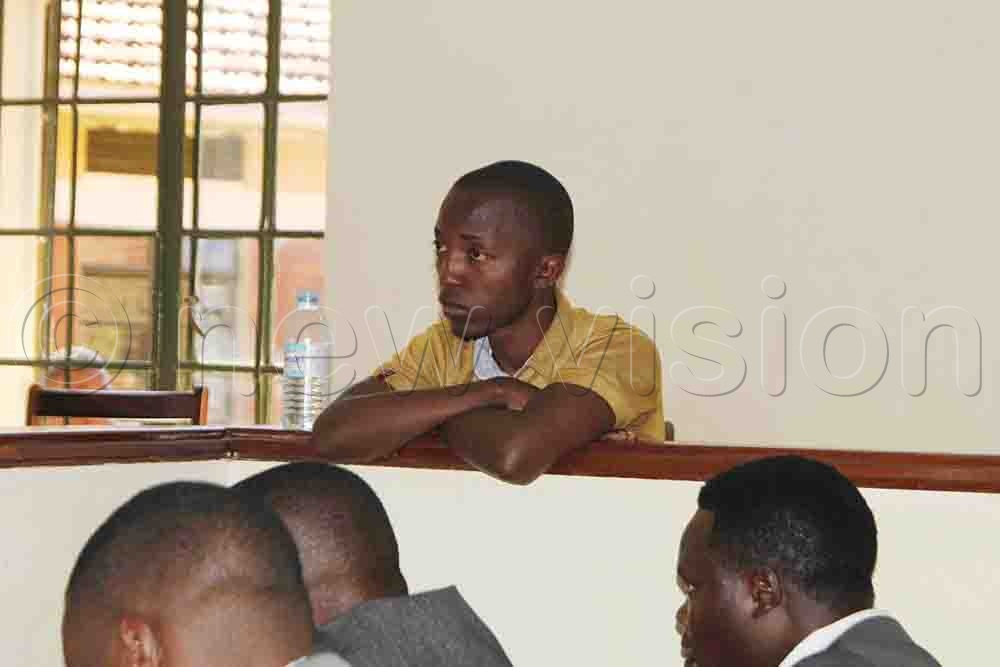
Aammari Musa Ssemwogerere in the dock.
How the documents were unmasked
LDC officials testified in detail about how authentic documents are generated:
• Each admitted student receives a unique login credential to the student portal.
• IDs are issued centrally after photography and registration.
• Exam permits are only printable by the student after fee clearance.
• QR codes, when scanned, should lead back to the institution’s secure system.
In this case:
• Mutawo’s student number was used illegally.
• The QR code redirected to details belonging to Irene Mutonyi.
• The stamps on the forged documents appeared scanned rather than embossed.
• The subjects listed on the forged permit differed from Mutawo’s official course load.
• The alleged Mukisa was not found in the institution’s records at all.
• PW4, Walusimbi Herbert, Assistant Director of LDC Lira Campus, concluded unequivocally that the institution had not issued the documents.
Defence pushes back
Both accused denied any involvement.
Ssemwogerere gave an unsworn statement, denying ever seeing the documents.
Mutonyi, testifying under oath, also denied knowledge of the forged documents.
Their lawyers argued that the ID and permit should be disregarded entirely because the chain of custody, the documented trail showing how the exhibits were handled, had been compromised.
They contended that the handling of the exhibits by invigilators, administrators and police before submission to court created weakness in the prosecution’s case.
Court’s reasoning
Chief Magistrate Adoko dedicated a substantial portion of the judgment to analysing whether the exhibits were tampered with.
He applied principles of plausibility, logical sequencing, and consistency, concluding that:
The documents were recovered in an examination setting.
They were handled by the very officials mandated to check authenticity.
They were later handed to the District CID Officer and kept securely.
There was no credible evidence of substitution or tampering.
The defence did not dispute that the documents were false—only the manner of handling.
The court found the prosecution's account logical, consistent, and supported by multiple independent witnesses.
A web of conspiracy?
The court further considered whether Mutonyi and Ssemwogerere acted alone.
The prosecution argued that the QR code trails, mismatched registration details, and the appearance of Mutonyi’s credentials on the forged documents demonstrated clear collaboration.
Though the ruling on each count was reserved for the sentencing date, the detailed judgment implies that the court found strong grounds to link both accused to a larger plot to cheat the LDC examination system.
What Next?
With conviction already entered, the two now await their sentencing on December 4, 2025.
Their fate lies in how the court will weigh:
• The gravity of 14 counts
• The integrity of the justice system
• The potential involvement of a judicial officer
• The breach of trust in a professional training environment
For LDC, the case raises important questions about digital security, impersonation risks and evolving challenges in examination administration.