
Govt, Italian agency launch project to curb illegal constructions
Gen. Edward Katumba Wamala said the initiative will support the government’s push to restore order in the construction sector and protect lives.
The works minister, Gen. Katumba Wamala (left) and the executive secretary of National Building Review Board, Flavia Gutto Bwire cutting tape during the launch of national mobile building lab truck of the Serene Project at Mestil Hotel in Kampala on April 16, 2026. Looking on right is the president of Uganda Institute of Professional Engineers Eng. Bosco Lepi. (Photos by Francis Emorut)
________________
The government, in partnership with the Italy-based Global Earthquake Model Foundation (GEM), has launched a new project aimed at curbing illegal construction and strengthening building safety standards across Uganda.
The Scientific Evidence for Risk Engineering Norms and Education (SERENE) project was unveiled at Mestil Hotel on Thursday, April 16, 2026, as authorities move to tackle the growing problem of unsafe and unregulated buildings, especially in rapidly expanding urban centres.
Speaking at the launch, works and transport minister Gen. Edward Katumba Wamala said the initiative will support the government’s push to restore order in the construction sector and protect lives.
“We are seeing a lot of developments coming up, but many are not compliant with the law,” Katumba said.
“This project will strengthen our ability to enforce standards. Illegal structures will not be tolerated, and where necessary, they will be demolished.”
He emphasised that while Uganda needs infrastructure growth, it must be guided by proper planning, approved designs and adherence to building codes.
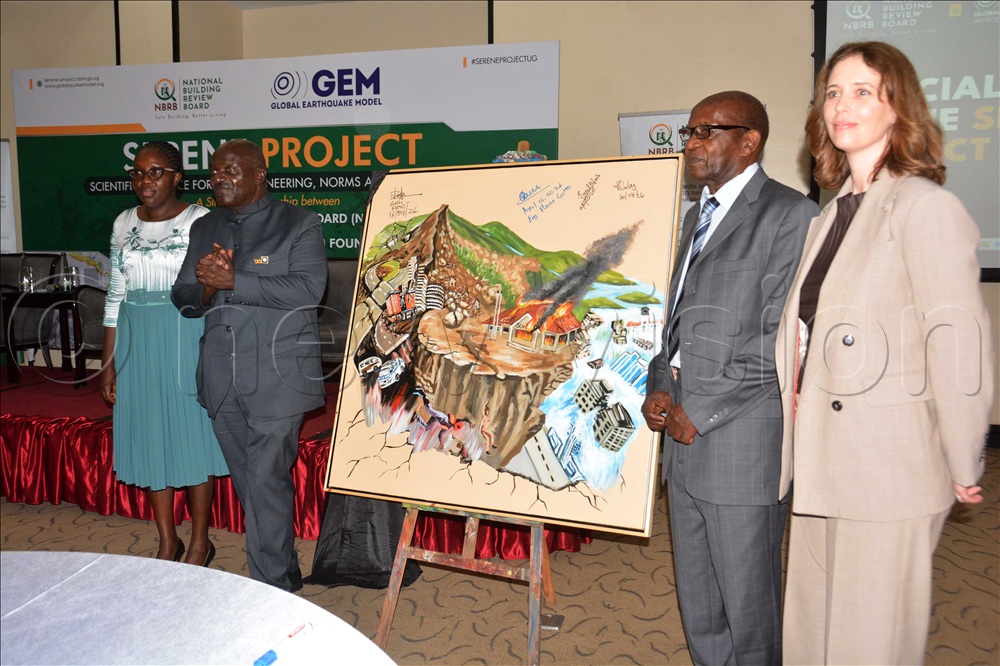
From left to right the executive secretary of National Building Review Board Flavia Gutto Bwire, works minister Gen. Katumba Wamala, outgoing board chair Emmanuel Male and the secretary general of Global Earthquake Model Helen Crowley pose for a photograph after launching the Serene Project at Mestil Hotel in Kampala on April 16, 2026.
The SERENE project, implemented in collaboration with the Global Earthquake Model Foundation, will provide scientific data and risk assessment tools to guide safer construction and improve regulatory enforcement.
Engineer Flavia Bwire, executive secretary of the National Building Review Board (NBRB), said the initiative comes at a time when the country is grappling with increasing cases of non-compliant structures.
“We continue to register buildings that are constructed without approvals or without following the required standards,” Bwire said. “SERENE will give us the scientific evidence to better understand these risks and take informed action.”
She noted that the project will assess vulnerabilities in existing buildings and support the development of stronger regulations and enforcement mechanisms.
“This is about ensuring that what we build today does not become a disaster tomorrow,” she said. “We must move towards risk-informed construction practices.”
Bwire added that Uganda faces multiple hazards, including seismic risks linked to the East African Rift System, as well as floods and landslides, making it critical to integrate resilience into building design and construction.
“Through SERENE, we are bringing advanced risk modelling tools and expertise to support Uganda in understanding and reducing risks in the built environment,” Crowley said.
She explained that GEM specialises in earthquake risk assessment and provides open-source tools that help governments and institutions evaluate exposure, vulnerability and potential impacts of hazards.
“By combining global knowledge with local expertise, we can identify where the greatest risks lie and support better decision-making,” she said. “Ultimately, this will contribute to safer buildings and more resilient communities.”
Uganda has in recent years experienced several incidents of building collapse and structural failure, often linked to poor compliance with building standards and weak enforcement.
Officials say the SERENE project will complement ongoing government efforts to strengthen inspections, enforce regulations and promote professionalism in the construction sector.
Katumba called on developers, engineers and local authorities to embrace the initiative and prioritise safety.
“This is a shared responsibility,” he said. “Government will enforce the law, but all stakeholders must play their part in ensuring that buildings are safe and compliant.”
The SERENE project is expected to run over several years, providing data, tools and policy recommendations to guide Uganda’s construction sector towards safer, more resilient development.