
Govt intensifies malaria fight with sh365b mosquito net campaign
Dr Kabanda said the campaign forms part of the Uganda Malaria Elimination Strategic Plan and aligns with the country’s long-term development blueprint.
Richard Kabanda, the Commissioner for Health Promotion, Education, and Communication at the Uganda Ministry of Health addressing journalists during a press conference at the Uganda Media Centre on April 9, 2026. (Photos by Nancy Nanyonga)
________________
The Ministry of Health has earmarked sh365 billion to conduct a nationwide mosquito net distribution campaign aimed at eliminating malaria by 2030.
The announcement was made by the Commissioner for Health Promotion and Education at the Ministry of Health, Dr Richard Kabanda, who represented Minister Jane Ruth Aceng.
While briefing the media on Thursday, April 9, 2026, at the Uganda Media Centre, Dr Kabanda said the campaign forms part of the Uganda Malaria Elimination Strategic Plan and aligns with the country’s long-term development blueprint.
“This campaign is part of the Uganda Malaria Elimination Strategic Plan and contributes to our broader goal of achieving a malaria-free Uganda, in line with Uganda Vision 2040 and our national development agenda,” he said.
Despite years of intervention, malaria continues to exert a heavy toll on Uganda’s population. The Ministry acknowledged that malaria remains one of the leading public health challenges in the country, noting that while the disease is preventable and treatable, it still claims thousands of lives annually.
Citing global data, Dr Kabanda revealed that Uganda accounts for 4.7 percent of global malaria cases, ranking third worldwide, and 2.7 percent of global malaria deaths, ranking ninth.
Officials from the Ministry of health during a press conference at Uganda Media Centre. 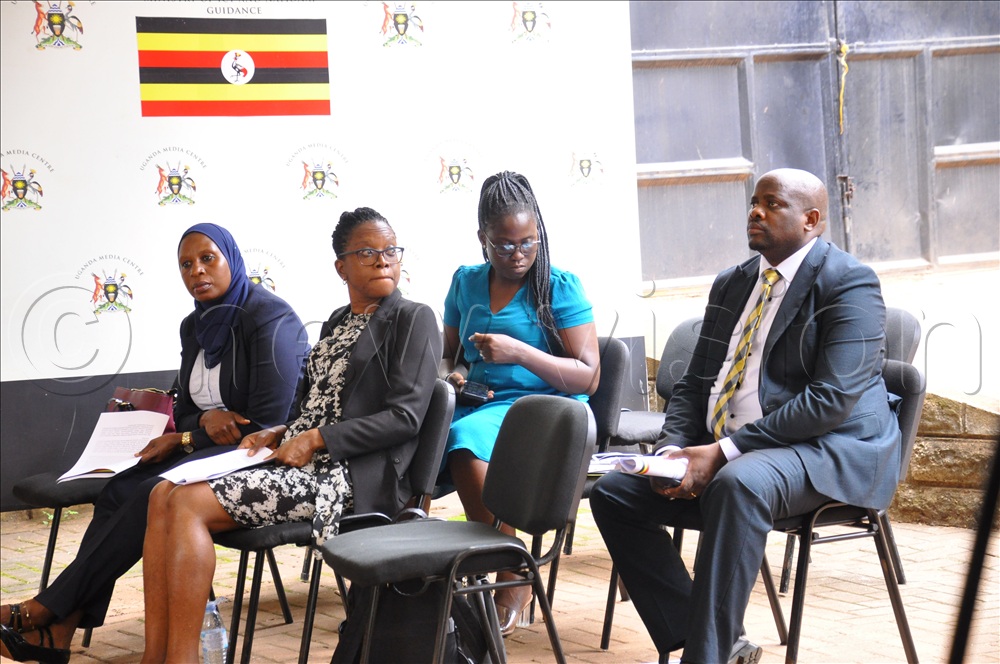
In 2025 alone, he said the country recorded 11,782,577 malaria cases and 2,342 deaths, with 55 percent among children below five years.
Malaria prevalence on the rise
Findings from the 2024 Malaria Indicator Survey show that malaria prevalence has increased to 12.5 percent, up from 9.2 percent in 2018/2019.
Deputy programme manager for the Malaria Elimination Division, Catherine Maiteke, attributed the increase to laxity of communities in adherence to malaria prevention and treatment guidelines, climate variation, and biological threats.
To reverse this trend, the ministry said the government is rolling out 25.8 million Long-Lasting Insecticide-Treated Nets (LLINs) across 130 districts under a campaign valued at approximately $100 million (about Sh365 billion).
Of this, $90 million will cover procurement and logistics, while $10 million will support operational costs. Funding is jointly provided by the Government of Uganda, the Global Fund, and the United States Government.
Dr Kabanda emphasised the proven effectiveness of mosquito nets, stating that “when used properly, mosquito nets break Malaria transmission by 50 percent, reduce morbidity and mortality by 25 percent and can reduce childhood mortality by up to 25 percent.”
He said these benefits are particularly significant for vulnerable groups, including children under five, pregnant women, and high-risk communities.
The distribution is being implemented in five phases throughout 2026 to ensure efficiency and nationwide coverage.
According to the ministry, the first wave in January delivered 3.4 million nets to 20 districts, protecting approximately 6.5 million people.
The ongoing second wave targets over 8.1 million Ugandans across 32 districts, while subsequent phases will extend coverage to other regions, including urban centres like Kampala and Wakiso, under a tailored strategy.
Wave two distribution, which starts this month, will roll out to several districts starting with Agago, Amuru, Gulu, Gulu City, Kitgum, Lamwo, Nwoya, Omoro, Pader, Mayuge, Amuria, Bukedea, Kaberamaido, Kalaki, Kapelebyong, Katakwi, Kumi, Ngora, Serere, Soroti, Soroti city, Bududa, Bukwo, Bulambuli, Busia, Kapchorwa, Kween, Luuka, Manafa, Namayingo, Namisindwa, and Sironko.
Dr Maiteke said local governments, civil society organisations, and village health teams will conduct household visits, demonstrations, and follow-ups to ensure proper usage of the nets and dispel misinformation.
The ministry encouraged households to hang the nets in the shade for 24 hours before setting them up for use, seek medical care within 24 hours of fever onset, and eliminate mosquito breeding sites such as stagnant water and bushes.