
Farmers tipped on commercial rabbit farming at Harvest Money Expo
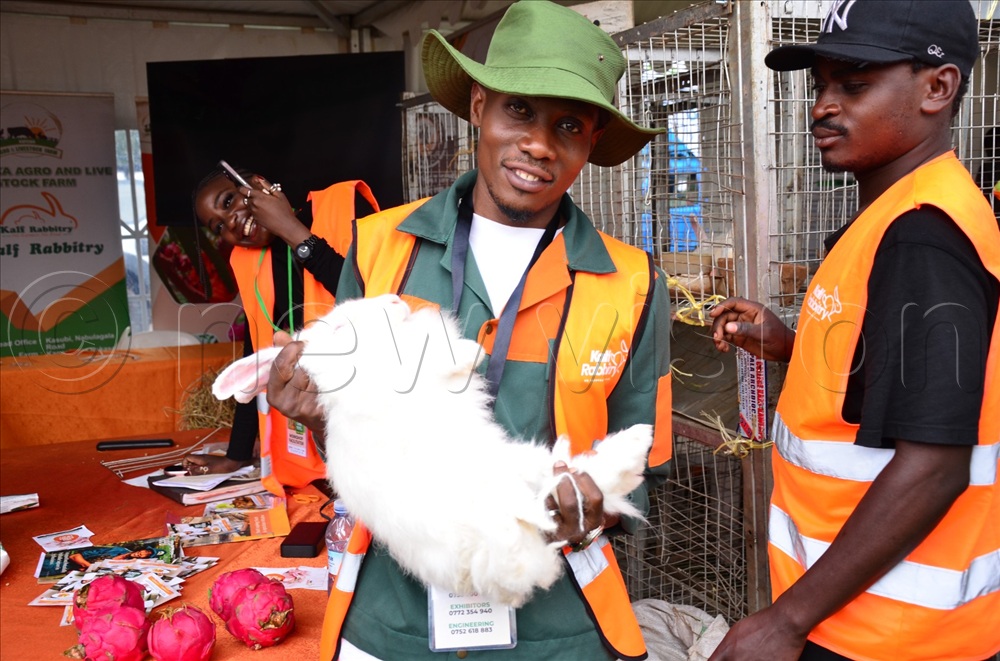
Denis Walugembe, the operations manager at Kaif Rabbitry, emphasised that farm management is the backbone of profitability in commercial rabbit farming.
Walugembe cautioned farmers against inbreeding and advised them to clearly define their production goals before selecting breeds. (Photos by Herbert Musoke)
________________
Farmers seeking to turn rabbit rearing into a profitable enterprise have been urged to prioritise proper management, feeding and disease control to maximise returns at the ongoing 10th Harvest Money Expo at Kololo Ceremonial Grounds.
The three-day agricultural exhibition, held under the theme Farming as a Business, has drawn farmers, agribusiness players and youth eager to tap into commercial agriculture opportunities.
The Expo is sponsored by Tunga Nutrition, Engineering Solutions, Uganda Development Corporation, aBi Development, Pearl Bank, Heifer International, Roke Telkom, the Ministry of Agriculture, Animal Industry and Fisheries (MAAIF), the Kingdom of the Netherlands and the Uganda Revenue Authority (URA).
Entrance is sh10,000, with an additional sh10,000 charged for specialised training sessions.
Turning rabbits into a profitable venture
Denis Walugembe, the operations manager at Kaif Rabbitry, emphasised that farm management is the backbone of profitability in commercial rabbit farming.
“Farm management plays a crucial role in profit-making, and you must keep proper records of your business,” he said.
Walugembe cautioned farmers against inbreeding and advised them to clearly define their production goals before selecting breeds.
“Know the breed you want and for what purpose, whether for commercial meat production, manure or home consumption.”
He also warned against overbreeding, noting that mating rabbits every month can be harmful.
“It leads to deaths, miscarriages, some rabbits eating their young ones, and others permanently stopping production after a short time. Give them time to rest before breeding again,” he advised.
Feeding determines earnings
Walugembe stressed that nutrition directly determines market weight and income. “A good breed with poor feeding is like wasting time,” he said.
For commercial production, he recommended rabbit pellets as the primary feed because they help animals gain weight faster and remain healthy. Other feeds, he noted, should serve as supplements. Hay is also essential and can be prepared by drying available forage to ensure a consistent supply.
“If you don’t feed them well, they will not give you the kilograms you need to increase your earnings,” he explained.
“The more rabbits you raise to maturity at good weight, the more money you earn.” Walugembe added that disease prevention starts with strict hygiene practices.
“Clean the cages every morning, provide clean water and ensure proper feeding. Hygiene and nutrition are the biggest safeguards against disease,” he said.
Youth inspired to venture into rabbit farming
The training session attracted both aspiring and experienced farmers looking to diversify. Emmanuel Odinya, a youth from Mukono district, said the knowledge gained had given him the confidence to start.
“My expectation was to gain knowledge on how to start, especially using cages. I have been inspired by other farmers here and I am going to apply what I have learned and start setting up my land right away,” he said.
Geofrey Okaka from Lira city, who has attended the Expo for five consecutive years and currently runs a piggery enterprise, said he now plans to add rabbit farming on a small scale.
“I came to learn how to improve my farm and to get contacts for quality breeds and inputs,” Okaka said.
“I now know the best management practices and the right stock for the market. The training has added a lot of value.”
He admitted that previously he had been “mixing everything together” due to lack of knowledge, but will now restructure his operations to improve yields.
With two days remaining, organisers are encouraging more farmers, especially youth and agripreneurs, to attend and gain practical knowledge that can transform farming from subsistence into a profitable business venture.