
Embracing innovation and partnerships will aid in achieving SDG targets, WASH providers told
“There are over 22,000 healthcare facilities without access to water or sanitation, and nearly 20,000 water points are non-functional. This is a crisis we must prioritise,” Kimezere, who was speaking on behalf of Unicef country representative Dr Robin Nandy, said.
Austria’s head of development co-operation in Uganda, Dr Yvonne Katjar Kerschbaumer, said while Uganda has made progress, challenges persist, especially in rural and peri-urban areas, refugee settlements, and among vulnerable groups. (Credit: Jeff Andrew Lule)
KAMPALA - Key stakeholders in Uganda’s water, sanitation and hygiene (WASH) sector have called for stronger partnerships, innovative solutions and increased financing to tackle critical gaps in service delivery and meet Sustainable Development Goals (SDGs) by 2030.
Speaking at the 15th Annual WASH civil society organisations (CSO) forum held in Kampala city, Eng. Wilberforce Kimezere, a WASH specialist at Unicef, highlighted the urgent need to address the country's alarming water and sanitation gaps.
Held under the theme: WASH Innovation for Sustainable Development, the forum was organised by Uganda Water and Sanitation Network (UWASNET), bringing together government officials, civil society leaders, development partners and private sector actors in WASH to discuss strategies, showcase innovations, and prepare advocacy tools to influence national policies.
According to 2022 statistics from the Uganda Demographic and Health Survey, 46% of the population lacks access to basic water, while 81% lack access to basic sanitation.
“There are over 22,000 healthcare facilities without access to water or sanitation, and nearly 20,000 water points are non-functional. This is a crisis we must prioritise,” Kimezere, who was speaking on behalf of Unicef country representative Dr Robin Nandy, said.
He stressed that innovation, through digital tools, financial models, technology advancement, and data monitoring, must be central to bridging such service gaps.
Unicef, he said, will prioritise innovation in its 2026–2030 programme to accelerate progress toward SDG targets, especially SDG6, focusing on ensuring availability and sustainable management of water and sanitation for all.
Kimezere also emphasised the importance of collaboration between the Government, civil society and development partners.
“Without financing and partnerships, our progress will be slow. But with the right support, we can scale solutions that make a difference,” he added.
Austria’s head of development co-operation in Uganda, Dr Yvonne Katjar Kerschbaumer, said while Uganda has made progress, challenges persist, especially in rural and peri-urban areas, refugee settlements, and among vulnerable groups.
“WASH is not just about infrastructure, it’s about human dignity, health, and opportunity,” she said.
“Innovation doesn’t always mean high-tech. Sometimes, it’s about empowering communities with simple, scalable solutions,” she said.
She cited an example from northern Uganda, where a group of women developed a rainwater harvesting system using local materials.
“That one innovation freed children to attend school and gave mothers time for income-generating work. Innovation is about people,” she said.
Kerschbaumer reaffirmed Austria’s commitment to strengthening Uganda’s WASH sector through climate-resilient infrastructure, inclusive sanitation, local capacity-building, and support for youth and women innovators.
Forum's role
Presiding over the forum, water and environment state minister Beatrice Anywar lauded the forum's role in influencing national policy over the years.
She acknowledged the urgency of scaling innovative WASH solutions to protect public health and drive sustainable development.
As Uganda faces growing demands from climate change, urbanisation, and population growth, stakeholders agreed that coordinated action, political will, and smart investment are essential to delivering safe water and sanitation for all.
Anywar urged CSOs, government agencies and development partners to refocus and realign their efforts in solving Uganda’s WASH crisis.
She warned that despite years of effort, the country still faces staggering gaps in sanitation and safe water access, gaps that continue to drain Uganda’s economy and put lives at risk.
“This sector remains one of the most challenging in Uganda,” said Anywar, urging stakeholders to move beyond rhetoric and embrace “innovation that works for the people, especially youth and women entrepreneurs.”
“Water is life. Sanitation is health. These are not luxuries; they are basic rights. And when we fail to provide them, the cost is enormous,” she added.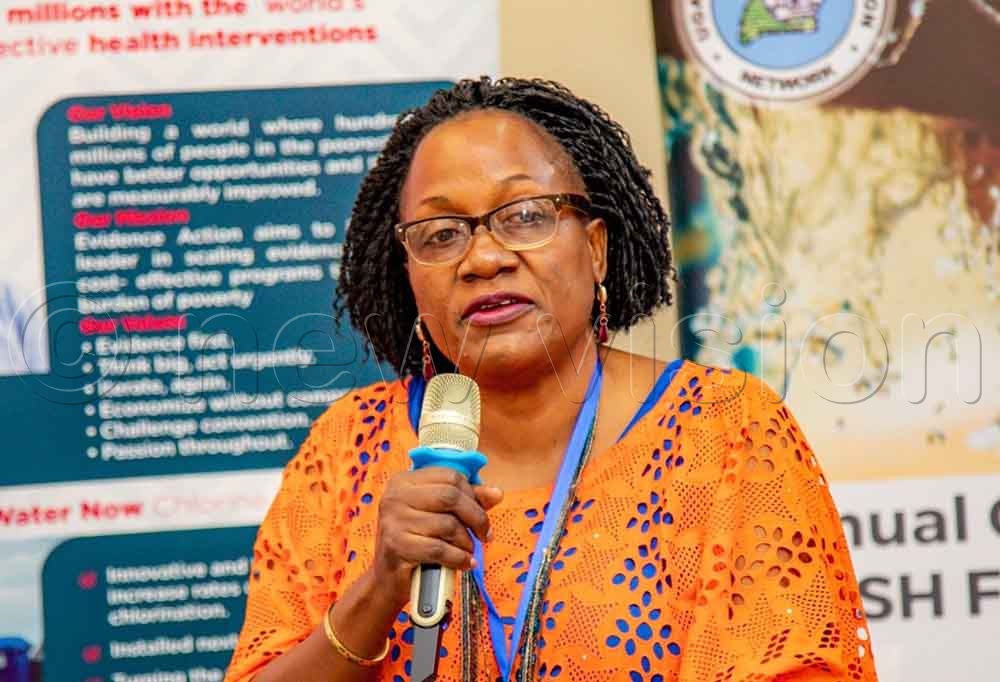
UWASNET Executive Director Yunia Musaazi addressing WASH stakeholders at the 15th WASH CSO Forum at Protea Hotel. (Credit: Jeff Andrew Lule
Citing data from the ministry, Anywar reported that safe water coverage currently stands at 72% in rural areas and 79% in urban settings, while sanitation coverage is at 79.9% in rural areas and 91% in urban areas, figures which she clarified were based on government data, contrary to statistics from development partners like UNICEF.
“We must speak with one voice. Different sources cannot give us different realities. The government’s data must be the baseline. We need harmonised, not doctored, information,” she stressed.
Despite acknowledging the progress, she further revealed that in urban areas, sewerage coverage is only at 18%.
She noted visible consequences, including flying plastic bags during rains, contamination, and disease outbreaks, all symptoms of what she called “the high cost of inaction.”
A recent joint study by the Uganda Bureau of Statistics and the Ministry of Water and Environment placed the economic cost of inadequate WASH at over shillings 389 billion annually, citing low productivity, poor health, and increased healthcare expenses.
“Poor sanitation alone eats up to 1% of our GDP every year. This is not acceptable. Investing in WASH is not just a moral obligation; it is an economic imperative,” the minister said.
Cracking down on NGO exploitation
In a rare public rebuke, Anywar also called out certain NGOs operating outside legal frameworks, particularly those collecting user fees and setting tariffs without government approval.
“There is growing evidence that some NGOs have been exploiting communities, setting illegal tariffs, using substandard materials, and building boreholes that fall apart. This is unacceptable,” she said.
She noted that under the Water Act, only the Minister is authorised to approve user fees.
She directed all NGOs in the WASH sector to submit annual work plans and reports through district local governments and coordinate their efforts through recognised platforms like UWASNET to avoid duplication and misuse of resources.
According to the minister, only 60 out of 180 registered CSOs submitted reports to UWASNET this year, and of those, just 30 confirmed submissions to local governments.
“This is alarming. We cannot allow a situation where the majority of civil society actors operate in the shadows. If we are to reach the unserved, we must change this status quo,” Anywar said.
However, she went to praise the efforts of NGOs and civil society, noting that they contribute over sh100 billion annually to the WASH sector, particularly in underserved rural and refugee-hosting districts.
"Their role in piloting innovative technologies, strengthening community systems, and advocating for inclusive policies is commendable. But let’s ensure these innovations are not just showcased; they must be scaled up and translated into action,” she said.
She specifically called for innovations that are climate-resilient, inclusive, and aligned with Uganda’s National Development Plan and Vision 2040.
“I wish my colleague, the Minister for Science and Technology, was here today. Because if we are to talk about innovation, especially AI and emerging tech, we must also talk about where the funding will come from. That is the government's responsibility,” she added.
She stressed that innovation must not remain a theoretical ideal but become a lived solution.
Anywar urged all stakeholders, government, civil society, development partners, and innovators, to recommit to transparency, coordination, and urgency.
“We must preserve Uganda’s values and identity while embracing innovation. Let us not work in isolation or compete for visibility,” she said.
“Together, we must ensure that every Ugandan, regardless of location or circumstance, enjoys access to safe water, sanitation, and hygiene,” she added.
The Executive Director of UWASNET, Yunia Musaazi, emphasised that innovation is vital to achieving universal WASH access.
She stressed that these innovations must be locally driven, people-centred, and inclusive.
Musaazi noted that significant gaps remain in the sector, with more than 10,000 villages, 5,000 schools, and about 2,000 health facilities still lacking access to clean water and adequate sanitation.
She urged all CSOs and WASH service providers to strengthen collaboration and avoid working in silos to enhance effectiveness.