
Elgon leaders call for environmental restoration amid rising degradation
The event formed part of the ongoing 560-kilometre Walk for Water and Environment from Moroto to Kampala, organised as a prelude to the annual Uganda Water and Environment Week under the theme: Water and Environment for an Inclusive and Prosperous Uganda.
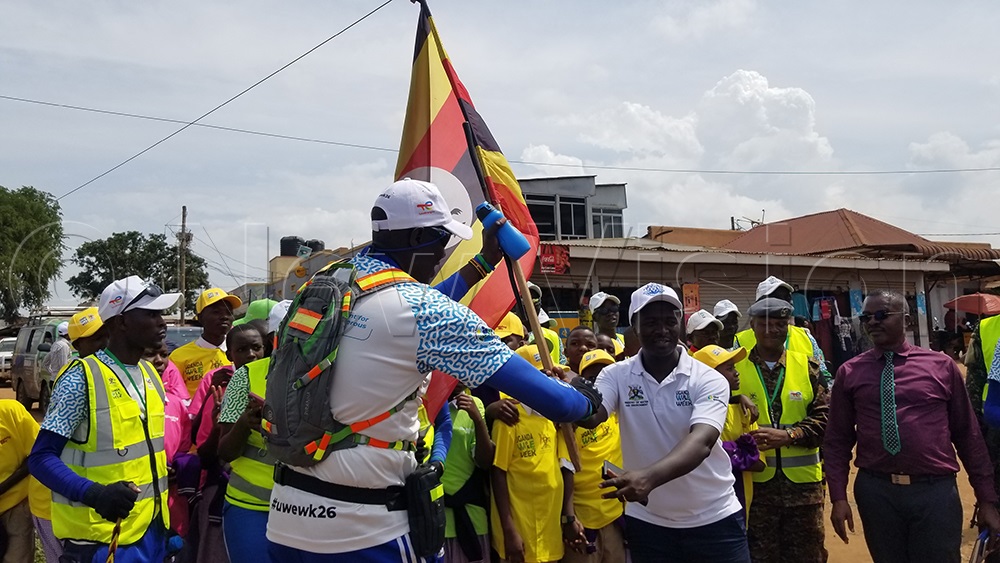
Michael Wang, the general manager of Sino Uganda Mbale Industrial Park, flags off the walkers to Tororo as they embark on their 560 km journey to Kampala. (Photo by Leonard Mukooli)
________________
MBALE — Government officials and environmental leaders have called for urgent restoration of degraded ecosystems and stronger protection of water sources in the Elgon region, warning that increasing human activities are accelerating environmental destruction.
The call was made during the March 10, 2026, pre-events to mark Water and Environment Week in the eastern region launch in Mbale city. The activities included a walk through the city, bamboo planting on the banks of River Nabuyonga, environmental sensitisation in schools and a community dialogue on sustainable environmental practices at the Sino-Uganda Mbale Industrial Park.
The event formed part of the ongoing 560-kilometre Walk for Water and Environment from Moroto to Kampala, organised as a prelude to the annual Uganda Water and Environment Week under the theme: Water and Environment for an Inclusive and Prosperous Uganda.
Participants in the walk, including members of the Walkers Association led by Geoffrey Ayeni, government officials, development partners, students, and community members, first gathered at the Islamic University in Uganda before proceeding to the Nabuyonga River flash flood point.
Walkers joined by the Sino Uganda Mbale Industrial Park and the Ministry of Water and Environment officials in planting trees at the industrial park in Doko. (Photo by Leonard Mukooli)
At the site, participants planted bamboo trees along the riverbanks to help stabilize the soil and reduce erosion, which has contributed to recurring floods in Mbale city.
Engaging communities
Ayeni said the team of 15 walkers has already covered about 270 kilometres of the 560-kilometre journey while engaging communities and local leaders on environmental conservation along the route.
“We have interacted with many stakeholders, from Karamoja up to this region, and one issue keeps coming up—the need for increased funding for water and environmental protection,” Ayeni said.
He added that pollution of water sources and environmental degradation remain widespread challenges and urged district and city leaders to intensify community awareness of conservation.
Eng. Maxiimo Twinomuhangi, the team leader of the Kyoga water catchment management zone, said restoring degraded riverbanks is critical in addressing the increasing cases of flooding in Mbale.
“We have seen over time that environmental and water resource management measures such as tree planting, wetland restoration, and riverbank protection are the most sustainable solutions to the challenges we face,” Twinomuhangi said.
He noted that bamboo is particularly effective in protecting riverbanks because its strong root system helps bind the soil and minimise erosion.
The team later visited Nabuyonga Primary School, where learners were sensitised on environmental conservation, protection of water sources, and proper waste management.
During the engagement, pupils also participated in a visual art activity, producing paintings carrying messages on climate action and environmental protection.
Eng. Maximo Twinomuhangi, in the company of Nabuyonga Primary School pupils and other Ministry of Water and Environment officials, welcomed Geofrey Ayene and other walkers into Mbale city. (Photo by Leonard Mukooli)
Role of industries
A community dialogue and press conference were later held at the Sino Uganda Mbale Industrial Park to discuss the role of industry in environmental protection and sustainable development.
George Wamunga, representing the water ministry permanent secretary, commended the industrial park for contributing to economic growth through employment and industrial expansion.
However, he emphasised the need for industries to integrate environmental protection measures into their operations.
“When the Government allocated land for this industrial park, some people blamed it
for the flooding in Mbale. However, the reality is that cumulative environmental damage caused by various activities upstream contributes significantly to these floods, including deforestation, poor agricultural practices, and urban development that disrupt natural water flow,” Wamunga said.
He urged the industrial park management to support government efforts aimed at restoring the environment in upstream communities to reduce the flooding burden in the city.
Sino-Uganda Mbale Industrial Park general manager Michael Wang said the facility has grown significantly since its launch in 2018, with support from the Government of Uganda.
“Today we host about 80 companies, more than 60 of which are operational. They produce over 150 products and provide employment to more than 3,500 people,” Wang said.
He pledged continued commitment to environmental protection measures within the industrial park, including the construction and maintenance of drainage channels to reduce flooding risks.
Wang also stated that the park encourages industries to install water treatment systems to ensure wastewater meets environmental standards.
He further revealed that the park plans to construct its water treatment plant and collaborate with environmental authorities in planting trees along nearby wetlands and riverbanks.
Restoring degraded systems
Mbale city environment officer Rhoda Nyaribi welcomed the Walk for Water and Environment initiative, saying the tree-planting exercises carried out along the route contribute to restoring degraded ecosystems.
However, she identified poor solid waste management as one of the major environmental challenges facing the city.
“We need to intensify community sensitisation to proper waste management practices, such as sorting, recycling, and responsible disposal of plastics,” Nyaribi said.
She also revealed plans to revive Mbale City clean-up campaigns that were previously introduced to improve sanitation and environmental sustainability.
Nyaribi further urged communities to adopt climate-resilient livelihood practices and warned against activities such as establishing washing bays and nursery beds along riverbanks, recommending bamboo planting as a safer alternative.
Robert Wandwasi, the Mbale district community development officer, welcomed the initiatives launched during the Water and Environment Week, saying they will help mobilise communities to restore the environment.
"These activities play a crucial role in reminding communities about their responsibility to protect and replenish the environment that has deteriorated over time," Wandwasi stated.
Meanwhile, the walkers now head to Tororo district, where they will meet with the community and industrialists at Tororo Cement factory as they continue to embark on their 560 km journey to Kampala.