
Elgon landslides victims receive Museveni condolences, aid
“The President has sent his condolences and directed that immediate relief be provided to affected households,” Aber said.
In Kaptang village, Tuikat subcounty in Kween district, where six people were killed, residents have started to relocate from the danger areas. (Credit: Leonard Mukooli)
ELGON - President Yoweri Museveni has sent his condolences to families affected by the deadly landslides that struck the Sebei region, claiming multiple lives across the districts of Bukwo, Kapchorwa and Kween.
Delivering the President’s message, relief, disaster preparedness and refugees, state minister Lillian Aber, visited the region on Sunday, November 2, 2025, to assess the destruction and extend government support to the grieving families.
A sombre mood hung over Sebei hills as Aber met with local leaders and survivors. She commiserated with the bereaved families and handed over shillings five million to support the burial of each of the 13 confirmed victims, and shillings one million to assist those injured in the disaster.
“The President has sent his condolences and directed that immediate relief be provided to affected households,” Aber said.
Relocate from high-risk areas
“We must now prioritise saving lives. Those still living in high-risk areas must relocate before it’s too late.”
Aber emphasised the Government’s ongoing efforts to search for missing persons believed to be buried under the rubble. She assured residents that rescue teams, including the Uganda Red Cross and army, are continuing recovery operations despite the challenging terrain and persistent rainfall.
“Government remains committed to supporting the community in recovering the remaining bodies and restoring basic services,” Aber added.
Relocation is the only safe option
Aber urged residents across the Elgon highlands to remain vigilant as rains intensify.
She issued a strong warning to families still occupying unstable slopes, insisting that relocation is the only long-term solution to prevent further loss of life.
The Government will fast-track the resettlement programme, but individuals must also take responsibility for their safety.”
Aber revealed that the first phase of the Government’s resettlement programme for landslide-prone communities in the Bugisu and Sebei regions is already underway. However, she acknowledged that acquiring encumbrance-free land for permanent relocation remains a major obstacle.
“We are identifying suitable land, but the challenge is finding enough space without ownership disputes,” she explained. “The process is slow, but it will continue until every at-risk family is safely resettled.”
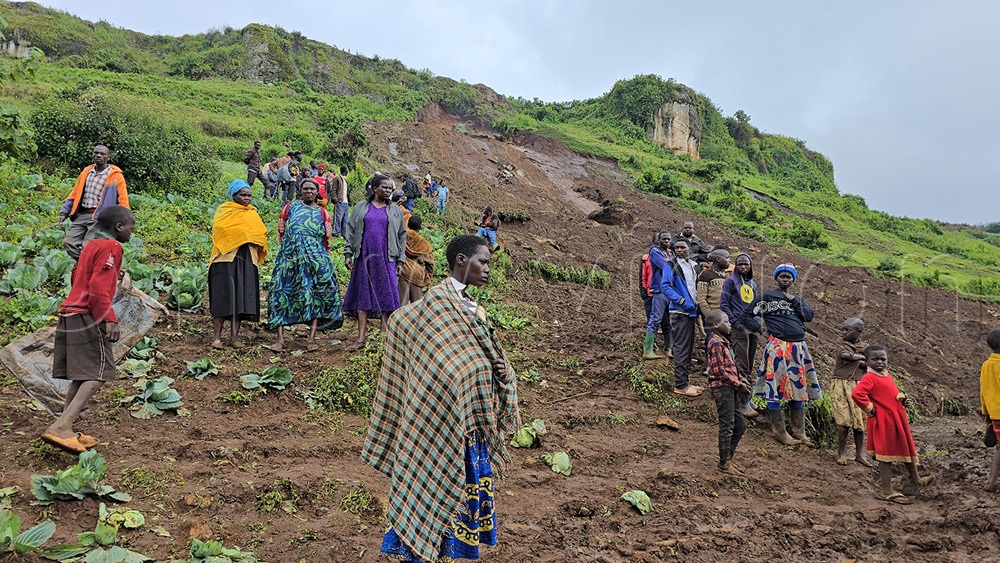
Minister Aber revealed that the first phase of the Government’s resettlement programme for landslide-prone communities in the Bugisu and Sebei regions is already underway. However, she acknowledged that acquiring encumbrance-free land for permanent relocation remains a major obstacle. (Credit: Leonard Mukooli)
Leaders call for urgent action
Local leaders and Members of Parliament from Sebei have echoed Aber’s appeal, urging co-ordinated community sensitisation and accelerated government response.
Kween District Woman MP Cherukut Emma urged local leaders to intensify awareness campaigns in their communities to ensure that people heed warnings and move away from hotspots.
“Our people must understand that these areas are no longer safe,” Cherukut said.
“We, as leaders, have a duty to sensitise them and ensure they adhere to safety advice before more lives are lost.”
Kapchorwa District Woman MP Phyllis Chemutai expressed concern that the region faces multiple threats beyond landslides.
“It’s not only the landslides killing our people, but also the heavy water runoffs that have become another disaster,” Chemutai said.
"Bridges need to be urgently repaired or constructed to prevent more fatalities.”
“The people of Sebei deserve the same attention given to other disaster-affected regions,” Chebet said.
“The Government should fast-track land acquisition so that relocation can begin immediately.”
Sustainable land use
Minister Aber also appealed to district leaders, environmental officers, and residents to adopt sustainable land-use practices and protect fragile ecosystems along Mt. Elgon’s slopes.
“Deforestation, over-cultivation, and unregulated settlement have worsened soil instability,” she said.
“We must stop encroaching on wetlands and forest reserves. The mountain is sending us a warning that if we don’t change, the losses will continue.”
Red Cross response
John Cliff Wamala, the Senior Communications Officer of the Uganda Red Cross Society, said preparations are underway to establish temporary holding grounds for displaced residents as the Government works on long-term resettlement.
“We are setting up safe spaces where affected families can stay temporarily,” Wamala said. “Our teams are on the ground providing tarpaulins, blankets, and psychosocial support to help them recover from this tragedy.”
Region under watch
As recovery efforts continue, the government says it will maintain close monitoring of the Sebei sub-region and support affected households with relief and resettlement assistance.
But for the communities living on the fragile slopes of Mt. Elgon, the debate over relocation and sustainable living remains as urgent as ever a question not just of livelihood, but of survival itself.