
Decades of hardship end as oil-rich Hoima villages get motorable road
“We can now easily reach markets, health centres, and schools. Before, poor roads forced us to sell crops cheaply, and our women giving birth in villages,” Bizimungu said.
A boda-boda rider ridding on the new road constructed by EACOP. (Credit: Peter Abaanabasazi)
HOIMA - Communities in the oil-rich areas of Hoima district are celebrating the rehabilitation of a key road after decades of struggling with impassable road networks.
Hoima district local government, in partnership with the East Africa Crude Oil Pipeline (EACOP) project, has improved transportation of agricultural produce and access to social services by rehabilitating 7.8 kilometres of previously unmotorable roads at an unspecified cost.
The road connects five villages, including Katoke, Kigaga, Kayera, Kijumba and Nyamasoga, stretching from Kiziranfumbu to Kabaale and linking to the Hoima–Kaiso–Tonya tarmac road.
Authorities say the upgraded routes have revitalised critical transport links, benefiting farmers and residents.
Speaking at the handover ceremony, Charles Bizimungu, the chairperson of Katoke village, described the construction of the road as a major relief for the community. He noted that the road had long been impassable and riddled with potholes, adding that since Katoke was established, no grader had ever reached the area.
“We can now easily reach markets, health centres, and schools. Before, poor roads forced us to sell crops cheaply, and our women giving birth in villages,” he said.
James Muhinda, a farmer, said the road would enable the community to access markets and other social amenities while reducing reliance on middlemen.
“We have been selling a kilogram of maize at sh500, but with the construction of the road, traders move from Hoima city to our villages, and we are selling a kilogram of maize at sh1000,” he said.
Leaders speak out
Hoima district chairperson Uthiman Mubarak said the road was constructed after the district wrote to the pipeline company seeking support to open and rehabilitate roads that were hindering community development.
He added that most residents are farmers and traders who previously lacked proper road access to markets.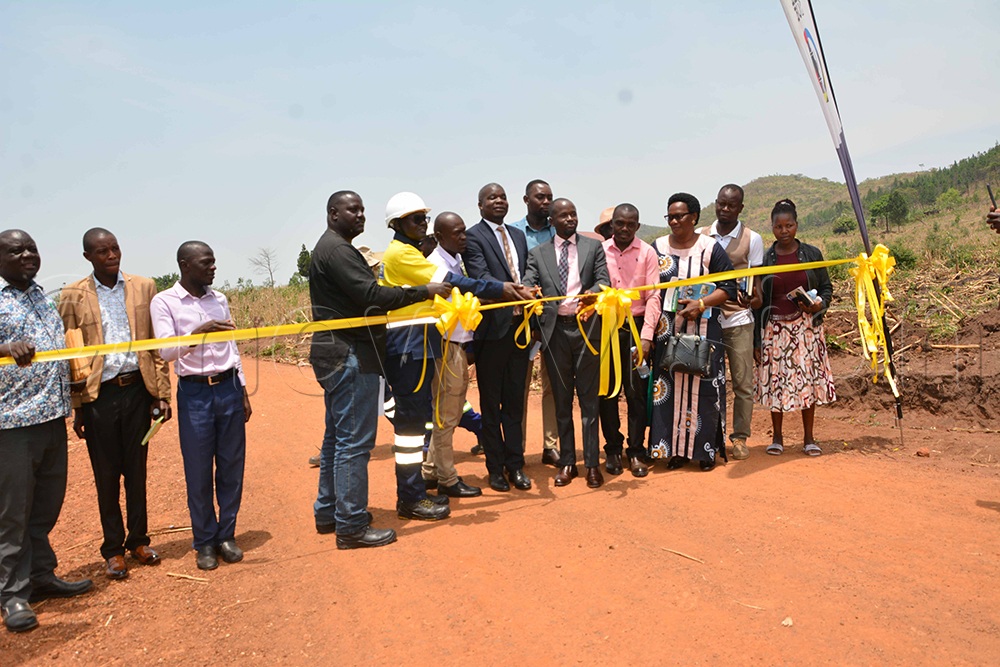
John Bosco Habumugisha, the EACOP executive director and Pius Wakabi Bugahya, the County Members of Parliament with local leaders commissioning the road. (Credit: Peter Abaanabasazi)
“We are happy and excited that EACOP has answered our requests. We requested them to open and work on this road; they have delivered it. We also asked them to support the district with funds to upgrade Mbarara Health Centre II to a health centre III in Kitoba town council; they have granted us sh1.4 billion,” he said.
He also commended residents who offered their land for the road works, noting that road expansion in the district is often delayed by landowners demanding compensation.
Pius Wakabi, the Bugahya County Member of Parliament who commissioned the road, commended the company for undertaking the project, saying road construction and rehabilitation are primarily the responsibility of government leaders.
“Road construction and rehabilitation is the responsibility of us leaders, and when someone comes and rehabilitates such roads, we do not take them for granted,” he applauded.
However, he urged the company to prioritise employment opportunities for local communities, especially unemployed youth, in ongoing oil projects. He also called on officials to support the provision of water sources, noting persistent water shortages in oil-rich areas.
John Bosco Habumugisha, the executive director of the pipeline company, said the project has supported communities through initiatives in education, environmental conservation through tree planting, health, water provision and road rehabilitation.
He said the road works form part of the company’s corporate social responsibility efforts aimed at fostering positive relations with communities in areas of operation and ensuring local appreciation of ongoing oil developments.
John Munaba, deputy district internal security officer representing Hoima resident district commissioner Roger Mbabazi, commended the company for prioritising community development, noting that road construction is vital for economic progress.
He urged residents to work hard and take advantage of oil-related opportunities rather than being influenced by individuals seeking to disrupt oil development. He encouraged the community to engage in productive activities and use the improved road to access markets.