
Church, MPs laud government on rural women empowerment
“Our next target as the government should be improving primary health care provision, especially in rural areas. When women have access to quality health services, their productivity and well-being improve significantly,” Okwi said.
Pr. Emmanuel Omoding joins a section of widows he gifted with Christmas hampers for a photo moment at Impact Ministries Church. (Credit: Javier Silas Omagor)
The Government has been commended for rolling out programmes that are increasingly enabling rural women to participate in Uganda’s growing money economy.
The praise was led by Impact Ministries Uganda Lead Pastor and Serere County Member of Parliament Emmanuel Omoding-Okabe, who said several government interventions are beginning to transform the lives of women who have historically faced financial exclusion and limited economic opportunities.
Speaking ahead of International Women’s Day celebrations, Omoding-Okabe noted that initiatives targeting grassroots households are gradually helping rural women gain financial independence and improve family welfare.
“For many years, rural women have carried the burden of sustaining households without access to affordable credit or organised economic opportunities,” he said.
“But today we are beginning to see real change. Many women are joining the monetary economy, starting small enterprises, supporting their families, and contributing to community development.”
Omoding-Okabe highlighted several government programs aimed at uplifting vulnerable households, particularly those led by women.
Among them are Emyooga and the Parish Development Model (PDM), which provide affordable capital to organised community groups to boost productivity and promote financial inclusion.
Other interventions include government-backed microfinance initiatives and women-focused empowerment schemes that encourage savings, entrepreneurship, and value addition in agriculture.
According to the legislator, these programmes are slowly breaking barriers that once kept rural women outside formal economic systems.
“When a rural woman gains access to capital and knowledge, the entire household benefits. Children go to school, nutrition improves, and communities become more stable,” he said.
However, Omoding-Okabe emphasised that more needs to be done to strengthen social services that directly support women and families.
“Our next target as the government should be improving primary health care provision, especially in rural areas. When women have access to quality health services, their productivity and well-being improve significantly,” he said.
Omoding-Okabe’s remarks were backed by several Members of Parliament who pointed to ongoing government investments aimed at expanding employment and economic opportunities for women.
Among them were Kibale County MP Constantine Okwi, Bungokho North MP Shafiga Wanyenya, and Masindi Municipality MP Rogers Byamukama.
Okwi, who on Sunday, March 8, visited Oladot Starch Factory, said he was impressed by the number of rural women employed at the facility.
“I was particularly impressed by the large number of rural women working at Oladot Starch Factory. It shows how industrialisation can directly improve household incomes and transform livelihoods in our communities,” Okwi told New Vision.
The legislator noted that the government’s push for industrialisation is creating new opportunities for semi-skilled workers, especially women who traditionally depended on subsistence farming.
Oladot Starch Factory alone employs over 100 semi-skilled rural women, providing stable incomes that are helping improve household welfare.
“I wholeheartedly support government efforts aimed at helping our mothers and sisters achieve their wildest aspirations in every sector and from wherever they are. This is commendable,” Okwi added.
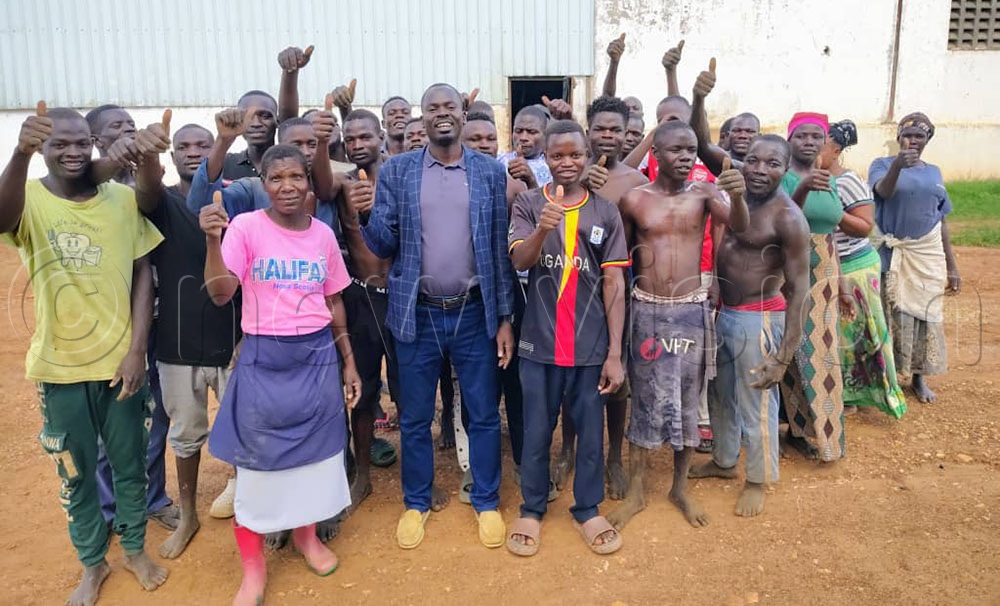
MP-Elect Kibale County Constantine Okwi acknowledged the industrialisation hubs such as Oladot which are employing and empowering rural women financially. (Credit: Javier Silas Omagor)
Industrial parks creating opportunities
Bungokho North MP Shafiga Wanyenya also welcomed the government’s industrialisation drive, citing the impact of the Sino-Uganda Mbale Industrial Park.
“This industrial park is already employing an unprecedented number of about 12,000 people, with the majority of them being our young women,” Wanyenya said.
“These jobs are empowering women economically and helping families become more financially secure,” she noted.
Affirmative action support
From Masindi Municipality, MP Rogers Byamukama pointed to several affirmative action policies introduced by the government that are improving women’s access to economic opportunities.
He cited programmes promoting women entrepreneurship, financial literacy, and access to credit as key drivers of rural transformation.
“Government has deliberately introduced affirmative action measures to ensure women are not left behind in the development process,” Byamukama said.
Soi County's MP-Elect, Isaac Malinga Maikut, said that being the pillars of society, women in the countryside were now able to participate in the money economy.
“These initiatives are helping women start businesses, participate in savings groups, and become financially independent.”
Maikut continued: "I thank President Yoweri Museveni for being inclusive in his government from the time he came into power, he has been consistent in supporting the gender agenda in this country."
Other MPs who acknowledged the government's efforts in women's emancipation included Josephine Ibaseret of Agule County, Patrick Kitiyo of Kapchorwa Municipality, Asha Nabulo Lumolo, Sironko Woman MP, Sylvia Katooko, Kibuku Woman MP, and Catherine Achola, Pallisa Woman MP.
Celebrating women’s progress
The leaders were speaking in commemoration of International Women’s Day, which Uganda joins the rest of the world in marking on March 8 each year.
The day recognises the social, economic, and political achievements of women while highlighting the need to address persistent challenges affecting them.
For many leaders and communities across the country, the growing participation of rural women in economic activities is being seen as one of the most promising indicators of progress toward inclusive development.