
Bugiri, Mayuge turn to oyster nuts farming to tackle malnutrition, teen pregnancies
Locally known as Kulekula in the Busoga Kingdom, the oyster nut is both nutritious and commercially viable. It requires minimal land and can be grown alongside other crops, allowing women to earn income without abandoning childcare or domestic responsibilities.
Florence Biriwaali, a farmer in Bugiri district with one of her oyster nut plants with its fruits. This was in Nakyegereike village, Buliida A parish, Bugiri district, recently. (Credit: Lawrence Mulondo)
BUGIRI - For years, the lush greenery of Bugiri and Mayuge districts has masked a quiet but deepening crisis.
Behind the sugarcane fields and fishing communities along Lake Victoria, thousands of teenage girls have traded schoolbooks for nursing shawls, while many children grow up stunted on diets dominated by starch.
Now, a humble but powerful crop is climbing trellises and trees across these eastern districts, promising a different future.
Oyster nut farming is being promoted as both a nutritional intervention and an economic lifeline for vulnerable women and girls, aimed at tackling malnutrition, reducing teenage pregnancies and gender based violence.
The initiative is being implemented by a consortium of development partners, including Fibre Foods, Amref Health Africa, and Busaino Fruits and Herbs, under the Social Sustainability Fund project.
The programme specifically targets women farmers, equipping them with oyster nut seeds, agronomic skills, access to markets and health services.
In Bugiri District alone, teenage pregnancy prevalence stands at 23%. Many of these young mothers are forced into low-wage, back-breaking labour to survive, perpetuating cycles of poverty.
Esther Keeya, the Acting Assistant District Health Officer for Bugiri, says the district’s proximity to Lake Victoria presents unique challenges. Fishing communities are highly mobile, with families frequently relocating in search of better catches. This instability limits access to sexual and reproductive health services and weakens family structures.
“The social lifestyle in fishing communities contributes to cases of teenage pregnancies and HIV,” she explains. “When fishermen sell fish and get money, some target young girls, who are often easy to manipulate due to poverty.”
Keeya adds that some areas, from Muwayo to Busoba, are known hotspots where truck drivers lure young girls into sexual exploitation.
Water, sanitation, and hygiene challenges further complicate the situation, making the district a priority for intervention.
Although nutrition indicators have improved with the deployment of a district nutritionist and the integration of nutrition services into health outreaches, cases of malnutrition persist, especially among children under five.
“It is expensive to treat a malnourished child,” Keeya says. “A child can spend at least two weeks in hospital, and even after discharge, follow-up care is needed. Prevention is far cheaper than treatment.”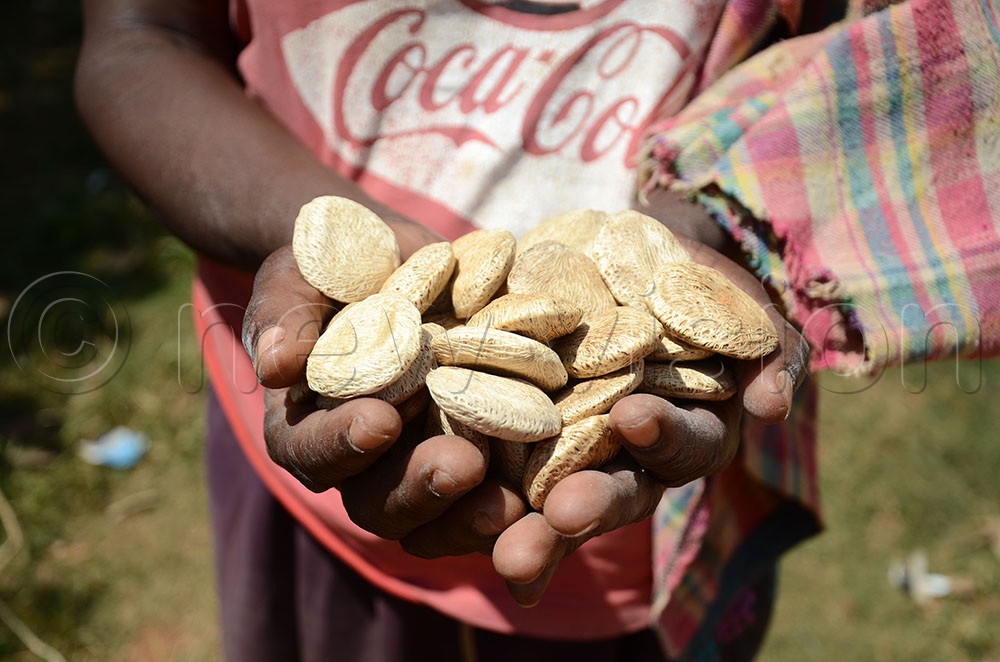
Some of the oyster nuts after being harvested. (Credit: Lawrence Mulondo)
The project is centred on the oyster nut, scientifically known as Telfairia pedata. This protein-rich perennial climber contains up to 37% protein, making it a valuable addition to starch-heavy diets common in the region.
Locally known as Kulekula in the Busoga Kingdom, the oyster nut is both nutritious and commercially viable. It requires minimal land and can be grown alongside other crops, allowing women to earn income without abandoning childcare or domestic responsibilities.
Moses Iyereget, the Social Sustainability Fund Project Officer at Amref Health Africa Uganda, says Busaino Foods supplies seeds and agronomy services, while Fibre Foods secures markets and adds value to harvested nuts.
“For Amref, our role is to improve household health,” Iyereget explains. “We focus on access to family planning, antenatal care, safe deliveries, prevention of teenage pregnancies and gender-based violence, improved nutrition, and ensuring children stay in school rather than working in gardens.”
The project uses a participatory learning and action approach, empowering farmers to identify challenges and develop community-led solutions.
For example, where family planning uptake is low, groups organise awareness sessions in partnership with nearby health facilities. Health workers attend group meetings, provide information on side effects, and deliver services directly.
“We reduce the distance between health facilities and communities,” Iyereget says. “Pregnant women receive antenatal services during meetings, and those who need further care are referred.”
Gender-based violence is also addressed through dialogue during group sessions. Iyereget notes that some women reported being beaten for using family planning without their husbands’ consent.
The project, therefore, emphasises male involvement to foster household acceptance and reduce conflict.
From five groups to hundreds of households
The health component of the project began in 2025 with five groups of 20 farmers each. Their oyster nut plants are now flowering. In 2026, Amref plans to expand to 13 additional groups, bringing the total to 260 households.
Membership requires at least one oyster nut plant. Farmers are trained in Village Savings and Loan Associations to strengthen financial literacy and are linked to formal financial institutions.
“With oyster nut income, women can pay school fees, cover medical expenses, and save,” Iyereget says. “We even coordinate with schools to monitor children’s attendance and prevent dropouts.”
Keeya believes the crop will significantly reduce malnutrition. “Many families already grow oyster nuts but lack knowledge on how to prepare them properly. Some treat them as snacks instead of incorporating them into balanced meals. Once they understand the health benefits, especially for children, they will use them better.”
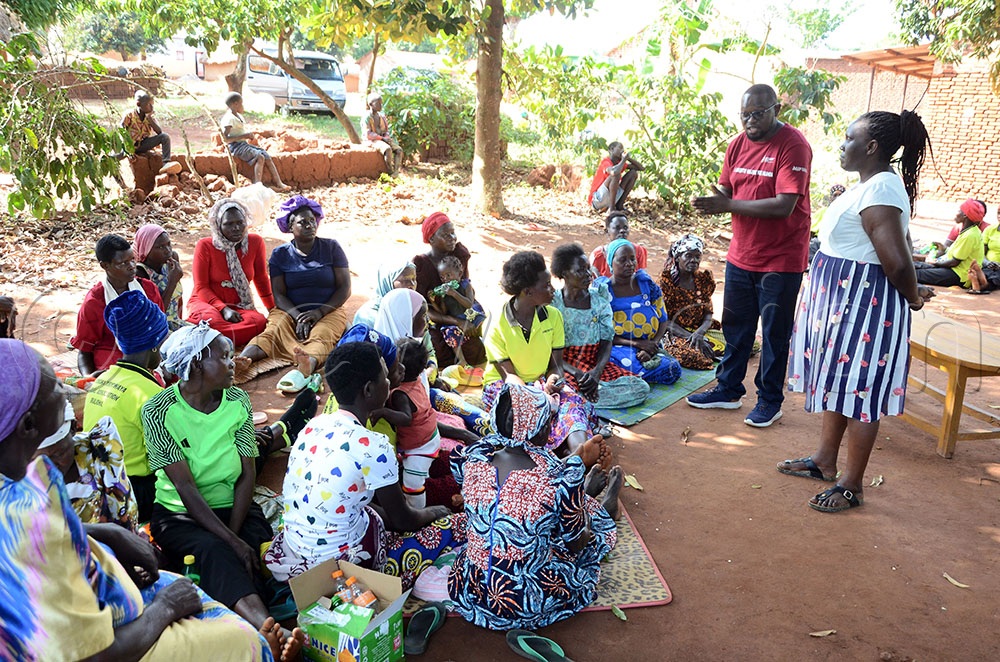
Sumaya Birungi, a midwife at Muterera Health Centre III in Bugiri district and Moses Iyereget, the Social Sustainability Fund Project Officer at Amref Health Africa Uganda, address members of Byobona Women Farmers Group during a session on access to sexual reproductive health services. This was in Nakyegereike village, Buliida A parish, Bugiri district. (Credit: Lawrence Mulondo)
Early signs of impact
“With oyster nut farming as a business, families can now buy milk, eggs, and other foods,” she says. “In homes where oyster nuts are fruiting, cases are already decreasing. Even our nutrition supplements last longer than before.”
Local leaders are noticing social change as well. Steven Bazanya, LC1 chairperson of Nakyegeleike village, recalls handling up to 30 domestic violence cases a month before the project.
“Now that women earn money from oyster nuts, they contribute to household needs,” he says. “This has reduced dependence and conflict. The groups also discuss hygiene and community development.”
Teenage pregnancies, he adds, are gradually declining as more girls stay in school.
Madina Kagoya, chairperson of the Byobona Women Farmers Group, one of the participating groups, says the group started as a welfare association but was adopted into the project in 2023. Members now sell oyster nuts, invest in vegetable farming, and support their families.
“We are now able to buy better food and provide basic needs,” Kagoya says. “Our relationships at home have improved because we contribute financially.”
How to grow the oyster nut
Consultant David Kodu explains that farmers are advised to plant two seeds together, one small and one large, representing male and female plants. Seeds are soaked in water for 24 hours before planting to speed up germination.
The plant flowers at six months, fruits at eight, and is ready for harvest after one year. Because it has a weak stem, it requires support from non-fruit trees. Farmers apply organic manure, mulch, and water during dry seasons.
When mature, the fruit splits open, releasing nuts that are collected, washed, sun-dried for three days, and stored. The hard shell allows long storage. Once cracked, the nut can be pounded and cooked like groundnut sauce, eaten with sweet potatoes, matooke, or cassava.
What participants say
For Nekesa Unise, 28, oyster nut farming has transformed her household. From her first harvest in 2024, she earned Shs600,000.
“The money helped us pay school fees for our children in Senior Two, Primary Six, Primary Four, and nursery,” she says. “We are now respected because we contribute.”
Amiina Namukoma says the nuts provide a quick, affordable sauce for her children. Income from sales supports education and savings.
Rakeri Kampi, 45, recalls when her second-born child became severely malnourished at age three. Treatment was costly, and stigma from neighbours was painful.
“My child recovered and is now 13,” she says. “I cannot allow another child to suffer because of lack of knowledge.”
As oyster nut vines continue to climb trees across Bugiri and Mayuge, they carry with them more than pods of protein. They represent dignity, knowledge, and the promise of healthier families and brighter futures for girls who might otherwise have been left behind.