
At 67, ex-UNLA soldier walks 460km to Namugongo to keep faith alive
Each kilometre carries the burdens of communities in Kitgum and neighbouring districts grappling with insecurity, cattle rustling and destructive invasions by stray animals from Kidepo Valley National Park.
Thomas Mussolini Tokwiny, a resident of Pachua village under the Kitgum Vicariate of the Gulu Archdiocese, started his fourth pilgrimage on May 9th, 2026. (Photo by Christopher Nyeko)
_________________
Long before dawn breaks over northern Uganda, Thomas Mussolini Tokwiny is already on the road.
A black backpack rests heavily on his shoulders. Tucked inside are boiled eggs, sesame paste, dried vegetables locally known as boo, and a few personal belongings. A white five-litre water container swings gently beside him with every step.
At 67 years old, most men his age would choose rest over hardship. But for Mussolini, walking nearly 460 kilometres from Kitgum to Namugongo is not a burden. It is a calling.
The soft-spoken Catholic pilgrim from Pakuba West village, Pachua parish in Mucwini West sub-county, began his fourth journey on foot to the Uganda Martyrs Shrine on May 9, 2026, determined to arrive in time for the June 3 Martyrs Day celebrations.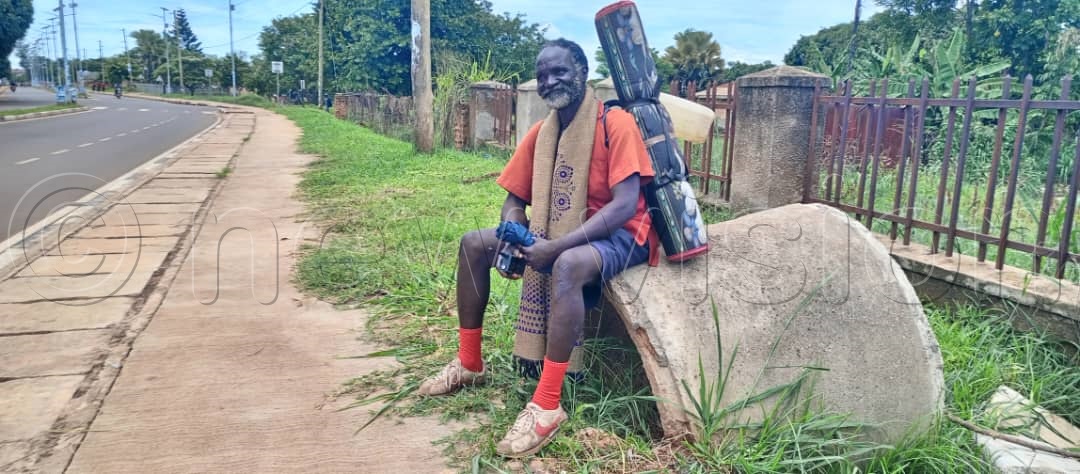
Thomas Mussolini Tokwiny, a resident of Pachua village under the Kitgum Vicariate of the Gulu Archdiocese, started his fourth pilgrimage on May 9th, 2026. (Photo by Christopher Nyeko)
“I am praying through the Uganda Martyrs for peace, protection and relief for our suffering people,” he says quietly, pausing briefly along the dusty roadside.
His journey is one of faith, endurance and sacrifice, but also one deeply rooted in the pain and hopes of northern Uganda.
Walking with the prayers of a region
Mussolini’s pilgrimage is not only personal.
Each kilometre carries the burdens of communities in Kitgum and neighbouring districts grappling with insecurity, cattle rustling and destructive invasions by stray animals from Kidepo Valley National Park.
He says he especially prays for families living in fear of armed raiders believed to cross from Karamoja and South Sudan.
Above all, he hopes to witness the day Blessed Daudi Okello and Jildo Irwa of Paimol are declared saints by the Catholic Church.
That dream led him to make one of his earliest stops at Ogom Chapel in Pader district, the home of Blessed Daudi Okello, where he spent the night in prayer and reflection.
By midday on May 11, 2026, the elderly pilgrim had reached Gulu city, where he rested for two days before resuming the long trek southwards on May 13.
Despite his age, he walks with assured strength.
Dressed in black three-quarter trousers, an orange short-sleeved shirt, white canvas shoes and striking red socks, Mussolini says he has rarely faced serious hardship during his previous pilgrimages.
Instead, he remembers kindness.
“The people I meet are welcoming and supportive,” he says with a smile. “Some give me food while others pray for me on the journey.”
A pilgrim, father and farmer
Away from the pilgrimage trails, Mussolini lives a simple life shaped by hard work and devotion to family.
He and his wife, Joyce Piloya, have raised six children, four daughters and two sons.
To provide for them, he depends largely on subsistence farming, growing cassava, maize and beans. He also keeps goats and free-range poultry around his modest two-bedroom home in Kiryandongo District.
Farming, he says, has taught him discipline and patience.
Before every pilgrimage, he carefully prepares his family's gardens to ensure food remains available in his absence. Cassava, his favourite crop, is especially important to him.
“It is a long-range crop for staving off hunger,” he explains.
Even as age catches up with him, Mussolini is preparing for another transition in life. After spending years living in the Ankole and Buganda sub-regions, he recently returned to his ancestral home in Pakuba West, Mucwini West Sub-county, where he hopes to build a permanent family home.
Soldier turned pilgrim
Mussolini’s story stretches far beyond pilgrimage.
Born on November 28, 1959, he is the son of Romeo Obita, a soldier in the King’s African Rifles. He was baptised at the age of six at Nyamitunga Catholic Parish in Mbarara, where his father had been stationed.
He later attended Wigweng Primary School in Mucwini, the same school once attended by Saint Janani Luwum.
Inspired by his father’s military life, Mussolini joined the Uganda National Liberation Army in 1976 and served until 1984, when he sought early retirement.
Today, he believes his survival through years of military service was an act of divine protection.
His pilgrimages, he says, are his way of thanking God.
The long road ahead
From Gulu city, Mussolini’s route will take him through Minakulu, Dima, Bweyale, Kigumba, Kafu, Migera, Kakoge, Wabulenzi and Matuga before finally reaching Kampala.
If all goes well, he expects to arrive between May 28 and 29, 2026, days before thousands of other pilgrims gather at Namugongo.
Meanwhile, the Gulu Archdiocese has already begun preparations for this year’s pilgrimage.
According to Rev. Fr Cyprian Ocen, Episcopal Vicar of the Gulu Vicariate, pilgrims are undergoing medical screening to assess their fitness for the demanding journey.
Special adoration sessions are scheduled for May 18 and 19, while the official send-off ceremony will take place on May 20, 2026, at St Joseph Cathedral Parish.
The pilgrims will be commissioned by Archbishop Raphael Wokorach P’mony and led by Rev. Fr Serafino Opiyo.
This year’s Uganda Martyrs Day celebrations, organised by Kasese Diocese, will be held under the theme: “Christ is Alive in Me and You.”
But along the highways stretching from northern Uganda to Kampala, few embody that message more vividly than the ageing pilgrim steadily walking south, one faithful step at a time.