
Advocates engage govt, civil society on human rights
The three-day engagement held at 7-Seasons Hotel in Entebbe municipality involved representation from the Uganda Police, Prisons services, Uganda People's Defence Forces (UPDF), Office of the Director of Public Prosecution, civil society, among others.
The engagement on Human Rights involved representation from the Uganda Police, Prisons Services, UPDF, ODPP, civil society among others. (Photo by Julius Luwemba)
__________________
As Uganda moves toward the 2026 General Election, there are reported cases of strife between the security forces and members of some political parties, an environment that portrays shifts in law, policy, institutional behaviour, and citizen–state relations.
It's upon such a concern that human rights advocates and defenders engaged different government institutions, security agencies and the civil society for a dialogue on how to uphold human rights during this campaign and election period.
The three-day engagement held at 7-Seasons Hotel in Entebbe municipality involved representation from the Uganda Police, Prisons services, Uganda People's Defence Forces (UPDF), Office of the Director of Public Prosecution, civil society, among others.
The meeting was convened by the Human Rights Centre Uganda in conjunction with Uganda Human Rights Commission, African Centre for Treatment and Rehabilitation of Torture Victims, as well as duty-bearers in the justice and security sectors, plus human rights defenders in civil society.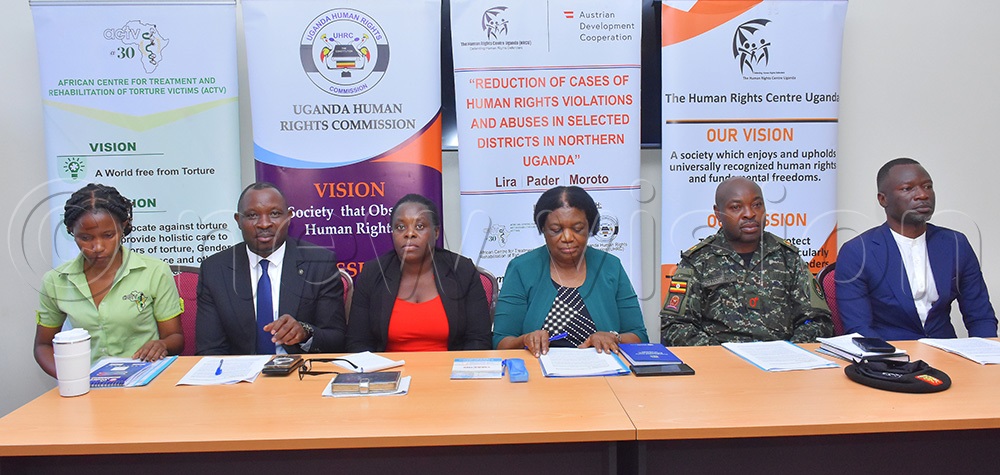
During a press conference on the status of human rights in Uganda from left; Nancy Ayebare from the African Centre for treatment and rehabilitation of torture victims, Robert Sempala the board chairperson for human rights defenders, Esther Nassiwa the human rights officer, Margaret Sekaggya the chairperson human rights centre Uganda, Gerald Bamwitirebye the head of human rights under UPDF and Philip Mangeni from the police human rights and legal services. (Photo by Julius Luwemba)
The meeting follows a report on the status of human rights in Uganda, which details the past incidents of human rights violations as well as recommendations to different players on how to uphold and defend the rights of people in Uganda.
Positive trends
The report acknowledges that while several areas continue to raise significant concerns, there are positive developments that have strengthened the protection of rights and opened new avenues for dialogue, accountability, and reform.
"There is more constructive dialogue between the NGO bureau and civil society, with structured dialogues and issue-driven conversations replacing previously adversarial approaches to civic regulation. In relation to freedom of assembly during political gatherings, there has been a noticeable shift in the conduct of security agencies, with a relative reduction in the violent dispersal of political rallies and public assemblies compared to previous election periods," former Uganda Human Rights Commission chairperson Margaret Sekaggya, currently heading Human Rights Centre-Uganda, said.
The joint report also pointed out the Supreme Court judgment of January 31, 2025, in Constitutional Appeal No. 02 of 2021, clarifying that military courts lacked jurisdiction to try civilians and ordered officials to halt all ongoing military trials of civilians and transfer them to the country’s civilian court system.
To this, Gerald Bamwitirebye, the head of human rights in the Uganda army (UPDF), said several case files have so far been transferred to civilian courts.
"The files were transferred to the Office of the Director of Public Prosecutions, and some of them necessitated the Police to carry out more investigations. That's why it has seemingly been a slow process," Bamwitirebye said.
He, however, did not divulge details regarding the number of case files so far transferred to the civilian courts.
The human rights defenders also acknowledged that the Uganda Human Rights Commission (UHRC) and Equal Opportunities Commission have, in the recent past, called out violations and held duty bearers to account.
"For instance, UHRC investigated 727 complaints in 2024. Out of the 727 complaints investigated, 307 (42%) were investigated to conclusion, while 420 (58%) were partially investigated. The UHRC’s backlog at the investigations level reduced by 66% from 803 in 2023 to 529 in 2024," Esther Nassiwa, the Human Rights officer under UHRC, stated.
Concerns
The human rights advocates remain concerned that, despite constitutional guarantees under Article 29, the authorities have routinely deployed legal instruments, security forces, and administrative measures to curtail public dissent and limit civic participation.
"During the most recently concluded Kawempe North bye-elections in March 2025, journalists were brutalised and equipment confiscated. When you block journalists from covering events that are of public interest, you not only deny them the right to seek, receive and share information; you also threaten media freedom and the right to access information for members of the public," Robert Sempala, the board chairperson for human rights defenders, expressed.
He further opined that as the 2026 general elections draw near, there are fears that the same social media platforms are likely to be shut down. "These actions by the state have created an environment of scepticism and doubt regarding the government’s commitment to upholding internet freedom. Such violations illustrate the shrinking civic and press space in Uganda, undermining press freedom, self-censorship, and the public’s access to independent information," Sempala added.
Key recommendations
The Uganda Human Rights Commission was urged to continue taking oversight and ensure expeditious handling of all cases of human rights violations and abuses in Uganda, and see that victims of human rights violations are heard and given appropriate redress.
The human rights defenders also called upon the electoral commission to follow the set guidelines and exercise impartiality in the execution of its mandate, to ensure a smooth campaign and election process.
"There is a need to create an independent oversight body similar to what is in neighbouring states like Kenya, to check police actions during protests," Sekaggya appealed.
On behalf of other implementing partners and stakeholders, she challenged the judiciary to strengthen its existing systems to ensure expeditious dispensation of justice.
"The Judiciary should work closely with security agencies such as the Police and the Office of the Director of Public Prosecutions [ODPP] to ensure that the justice chain is kept running well and also fast-track habeas corpus petitions," Sekaggya said.
Meanwhile, Nancy Ayebare from the NGO-African Centre for Treatment and Rehabilitation of Torture Victims, advised the UPDF to strengthen its civil-military division to ensure that people who have grievances with the institution are assisted.
The report on the status of human rights in Uganda also laid down a plethora of recommendations to the ODPP, prisons, media, civil society organisations and the public.