
Ugandan men urged to take part in women sexual reproductive health, rights fight
Women's Probono Initiative (WPI) deputy director Rose Wakikona, on Wednesday, July 30, 2025, while addressing the media, emphasised that SRHR is not just a woman's issue but also a man's issue.
Rose Wakikona, the Deputy Director Women's Probono Initiative (WPI) addressing the stakeholders during the dissemination at Hilton Garden in Kamwokya. (Photos by Jackline Yangi)
________________
Ugandan men have been urged to get involved in fighting for women's sexual reproductive health and rights (SRHR).
The World Health Organisation (WHO) says SRH refers to a broad range of services that cover access to contraception, fertility and infertility care, maternal and perinatal health, prevention and treatment of sexually transmitted infections (STIs), protection from sexual and gender-based violence, and education on safe and healthy relationships.
"Experiencing sexual and reproductive health means that a person has complete physical, mental and social well-being in all matters relating to their reproductive system and its functions. In everyday life, this means that people are able to have satisfying and safe sex lives, to have healthy pregnancies and births, and decide if, when and how often to have children".
WHO says access to sexual and reproductive health services is a human right and should be available to all people throughout their lives, as part of ensuring universal health coverage, something it says contributes to improved health outcomes, gender equality and wider development.
Women's Probono Initiative (WPI) deputy director Rose Wakikona, on Wednesday, July 30, 2025, while addressing the media, emphasised that SRHR is not just a woman's issue but also a man's issue. WPI is a feminist legal and advocacy organisation in Uganda.
Wakikona said this call to action comes amidst Uganda's poor performance on SRHR indicators, with one of the highest fertility rates in sub-Saharan Africa at 5.2 children per woman, and a maternal mortality ratio of 189 deaths per 100,000 live births.
Quoting the 2023 Uganda Police Annual Crime Report, she said it revealed 14,864 sex-related offences , highlighting the need for comprehensive SRHR education.
To address this gap, WPI has developed a stakeholders' toolkit on male engagement in SRHR.
Amon Ashaba Marine, a lecturer at Makerere University presenting during the meeting about the importance of men involvement in SRHR. 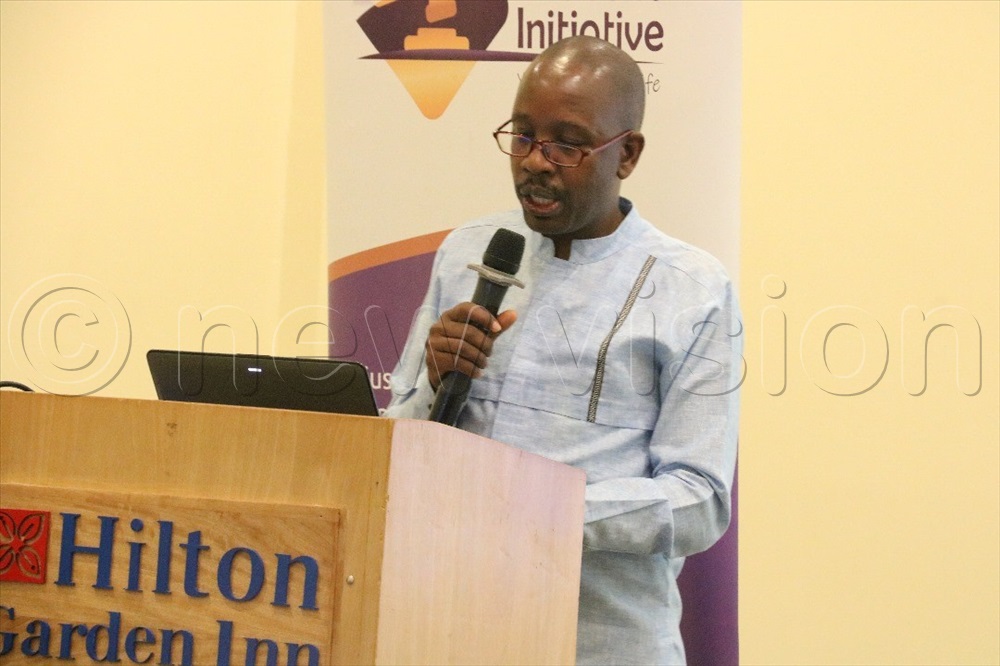
Wakikona says this toolkit provides a history of male involvement in SRHR, practical strategies, and recommendations for government, civil society, and local leaders.
She said the toolkit's dissemination aims to promote equitable policy implementation, enhance systemic accountability, and encourage multi-sectoral collaboration.
Wakikona stresses that men have a role to play in advancing gender equality because when society is more equitable, some of these pressures will ease, and they are also able to exist in a way that's fairer and more balanced.
Expected outcomes include increased awareness and understanding of the toolkit among stakeholders, strengthened stakeholder commitment to promote male engagement in SRHR and uptake of the toolkit by government entities, civil society, and community leaders for programming and advocacy.
Doctor Amon Ashaba Mwiine, a lecturer at Makerere Institute of Gender and Development Studies, said the Stakeholders' Toolkit on male engagement in SRHR is a vital resource that provides a history of how the strategy of male involvement has evolved globally and nationally in Uganda.
He added that the toolkit is an all-encompassing tool that provides information on the history, justification, origin, and milestones of male involvement in SRHR.
Doctor Mwiine said the intended users of the toolkit are government entities, civil society organisations, researchers, and academics and that the toolkit is useful for policymakers and programme designers who want to craft strategies that achieve gender equality without reproducing male domination and privilege.
"The idea of women-exclusive programming in the realm of gender equality has a history," Mwiine said, "We realised that to achieve empowerment sustainably, there's a need to also understand the experiences of men, especially if we want the transformation and change to happen in the lives of men."
The toolkit emphasises the importance of joint decision-making in accessing health services, particularly in the area of family planning.
"Men can play a significant role because, one, if you're talking about the aspect of sexual and reproductive health, and if you're looking at, for example, an aspect of accessing a family planning service, while it might be the woman going to use this type, maybe let me say IUD, but the decision really ought to be made by both of us," Mwiine said.
He concluded that the Stakeholders' toolkit on male engagement in SRHR is a vital resource for anyone working to promote gender equality and SRHR in Uganda and by engaging men, the country can foster a more balanced society where both men and women can enjoy their rights and make informed decisions about their health.