
Rising abortion-induced complication cases alarm Soroti hospital authorities
Soroti Hospital data shows that about 80 abortion-related cases were handled in the 2025–2026 period, compared to less than 50 cases reported the previous year. Medical staff say the increase points to a growing prevalence of unsafe and induced abortions in communities served by the facility.
Soroti Regional Referral Hospital has recorded a worrying rise in abortion-induced medical complication cases over the past two years, raising concern among health workers and authorities. (Photo by Juliet Akello)
___________________
Soroti Regional Referral Hospital has recorded a worrying rise in abortion-induced medical complication cases over the past two years, raising concern among health workers and authorities about the growing public health and legal implications.
An abortion is a procedure to end a pregnancy before it results in the birth of a child. It’s also sometimes referred to as a termination of pregnancy.
Soroti Hospital data shows that about 80 abortion-related cases were handled in the 2025–2026 period, compared to less than 50 cases reported the previous year. Medical staff say the increase points to a growing prevalence of unsafe and induced abortions in communities served by the facility.
According to Agnes Akongo, the Assistant Nursing Officer for Midwifery and in charge of the Gynaecology Ward, monthly records from 2025 indicate consistently high case numbers. The hospital registered 64 cases in July, 107 in August, 90 in September, 82 in October, 96 in November, and 81 cases in December.
Akongo says most patients arrive at the hospital after attempting to terminate pregnancies at home using unsafe methods.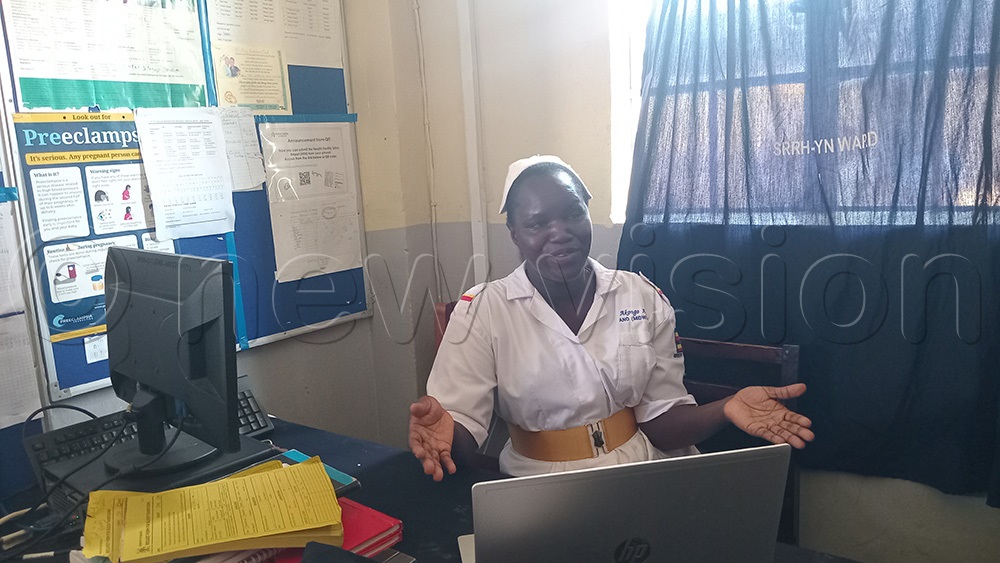
Agnes Akongo, the Assistant Nursing Officer for Midwifery and in charge of the Gynaecology Ward. (Photo by Juliet Akello)
“Many women seek medical attention when complications have already developed. In most cases, they first try to induce abortion at home before coming to the hospital,” she says.
She adds that women aged 25-49 years account for the largest proportion of cases, although adolescents and young women are also significantly affected.
Akongo cited a recent case involving a 26-year-old woman who reportedly used a combi pack at home and was rushed to the hospital with severe bleeding.
The hospital has also received cases involving girls aged 15-24, which Akongo attributes to the fear of school disruption, unstable relationships, and unplanned pregnancies.
“Some young girls fear pregnancy because they want to continue with their education, while others feel unprepared for motherhood due to the nature of their relationships,” she explained.
Community sensitisation
In response, health workers at Soroti Regional Referral Hospital have intensified community sensitisation on family planning as a key preventive measure.
“We are encouraging the public to utilise available family planning methods to reduce unintended pregnancies and the risks associated with unsafe abortion,” Akongo said.
Other causes of abortions
Meanwhile, Dr Irene Chebet, a gynaecologist at the hospital, cautioned that not all pregnancy losses are induced, noting that medical conditions also contribute to spontaneous abortions.
She cited malaria during pregnancy, infections and chromosomal or genetic abnormalities as common causes.
Chebet also warned that excessive alcohol consumption and smoking increase the risk of pregnancy loss and negatively affect foetal development.
“Women are encouraged to seek preconception care so that underlying conditions, including genetic risks, can be identified and managed early,” she said.
Chebet emphasised that under Uganda’s legal framework, abortion remains illegal except when conducted for approved medical reasons.
Article 22 of the 1995 Constitution provides for the right to life, and Article 22(2) specifically provides that no one has the right to terminate an unborn child except if it’s authorised by law.
However, no law has been created that provides specific instances in which an abortion is permitted.
However, the Penal Code Act provides for criminal penalties for several aspects of abortion and, in the absence of any other law, it remains the authority on instances in which abortion is or is not permitted.
Any person who, with the intent to procure the miscarriage of a woman whether she is or is not with child, unlawfully administers to her or causes her to take any poison or other noxious thing, or uses any force of any kind, or uses any other means, commits a felony and is liable to imprisonment for fourteen years, according to the Penal Code Act.
“Women are discouraged from procuring abortions. Pregnancy should be protected, and sexually active women should access family planning services, which are available in all health facilities with trained midwives,” she added.
Legal authorities have also warned against illegal abortions. Simon Opolot, a Grade One Magistrate attached to Amudat Magistrate’s Court, said intentional abortion is a criminal offence unless carried out for legally approved medical reasons.
“Anyone found guilty of carrying out or procuring an illegal abortion can be charged under murder-related offences,” Opolot warned.
Health experts continue to call for open dialogue, comprehensive reproductive health education, and expanded access to family planning services as key measures to reduce unsafe abortions and protect the lives of women and girls.
National data shows high levels of unintended pregnancy and unsafe abortion, with an estimated 297,000 to 314,000 induced abortions occurring annually in Uganda, highlighting the scale of the challenge facing the country’s health system.